
Arts, Ativisms and Memories: the archives of two world histories
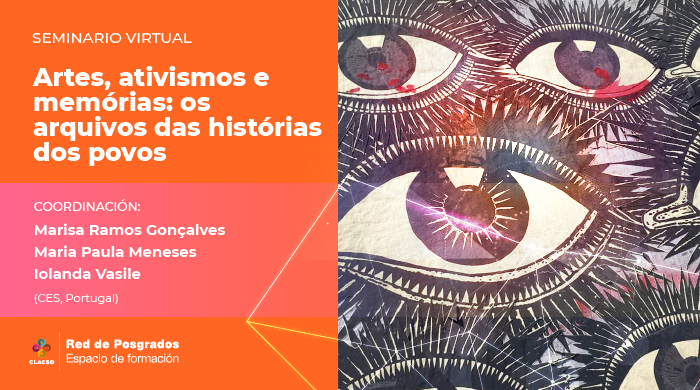
Seminar 2138
COORDINATION: Marisa Ramos Gonçalves (CES – Center for Social Studies, University of Coimbra), María Paula Meneses (CES – Center for Social Studies, University of Coimbra) and Iolanda Vasile (CES – Center for Social Studies, University of Coimbra)
TEACHING TEAM: Claudia Howald (CES, Universidade de Coimbra); Fabián Cevallos Vivar (Faculty of Fine Arts, University of Lisbon); Camilo Sousa (Director, Ébano Multimédia, Moçambique/Portugal); Cristina Sá Valentim (Centre for Functional Ecology – Science for People & the Planet , Universidade de Coimbra).; Iolanda Vasile (CES, University of Coimbra); Lara Sousa (Director, Moçambique); Maria Paula Meneses (CES, University of Coimbra); Marisa Ramos Gonçalves (CES, University of Coimbra); Raquel Ribeiro (School of Literatures, Languages and Cultures, The University of Edinburgh, UK); Vannessa Hearman (Faculty of Humanities, Curtin University, Australia)
Start: 26/08/2021 | Registration: 28/05/2021 to 23/08/2021
Workload: 12 weeks – 90 hours.
In many societies of the global South, deeply marked by the colonial relationship, the knowledge about their history is built on assumptions, methodologies and sources that perpetuate the maintenance of Eurocentric perspectives. This is a colonial heritage that is intended to be replaced by an agenda of production of plural knowledge and intercultural translations, starting from an analytical perspective on oral, collective and personal histories, starting from the arts and two creative spaces.
The seminar presents research carried out in various social and political contexts, reflecting on how to educate new generations about the histories and struggles for social justice that are found in the cultural and artistic expressions such as cinema, literature, theater, music, plastic arts, oral narratives, street arts, privileged means to communicate, produce knowledge about these stories and their cultural identities.
The central objective of this course is to help understand the gaps in the "colonial library" (Mudimbe, 1988), analyzing the history of two parts of our libraries, cartography and archives that contain knowledge, artistic and cultural expressions previously relegated to the plane of orality, subjectivity, "civilizational backwardness" and lack of scientific rigor, therefore we do not correspond to the canon of European knowledge (Meneses, 2016).
Developed from the theoretical-methodological proposal of the sociology of absences and emergencies by Boaventura de Sousa Santos (2014), this course aims to give visibility to facts and actors that have been actively produced as non-existent dominant issues. Starting from two challenges that Epistemologias do Sul poses – giving voice to those that the Eurocentric canon does not include and promoting an intercultural translation between experiences and struggles – this course chooses multidisciplinary and situated analyses, based on oral history, post-colonial studies, cultural and artistic studies, as a privileged approach to deconstruct the silencing produced by hegemonic interpretations.
To amplify reflective and methodological diversity, the course integrates a diversified group of teachers, including artists and academics. These and these will present their contributions to the debates through video classrooms; These classrooms will be accompanied by analytical texts, films and photographs that allow us to enrich the knowledge about the realities discussed during the course.
As a theoretical and methodological proposal, this seminar on the history and memories of struggles in the global South offers students tools that make it possible to (re)learn to study, learn and deepen the epistemologies of the world, providing inspiration and tools that will be useful for others. development of two research projects, in their artistic practices and city interventions.
- Xiconhoca, or inimigo: the use of caricatures in the construction of a revolutionary reference of the city/city of Moçambique
- Filming the construction of the Moçambican nation – challenges and achievements
- Protest art in Indonesia and Timor-Leste during authoritarianism and democratization
- Memory as an "intergenerational historical archive" in Timor-Leste
- Disputes over history, disputes over memory in Angola and Cuba: the role of literature
- The online photographic archive (colonial)
- Listening to insurgent voices saved in colonial sound archives. Theoretical-methodological challenges and decolonized possibilities of musical heritage.
- Performing the body-territory in the favela, an experience from Maré, Rio de Janeiro
- Afro-Colombian youth, activism and art: other narratives questioning categories on the margins
|
|
Discount for payments made before 16/08 |
In one payment from 17/8 to 23/8 |
|
CM Plenos |
$75 |
$150 |
|
CM Associates |
$95 |
$190 |
|
No link |
$95 |
$190 |
FAQ
The basic requirements for taking a seminar are:
- Availability of at least 4 hours per week to dedicate to the seminar course.
- Internet access.
- Reasonable handling of communication and computer tools.
- Language proficiency in the language in which the course will be taught. The official languages are Spanish and Portuguese.
|
|
Discount for payments made before 16/08 |
In one payment from 17/8 to 23/8 |
|
CM Plenos |
$75 |
$150 |
|
CM Associates |
$95 |
$190 |
|
No link |
$95 |
$190 |

