
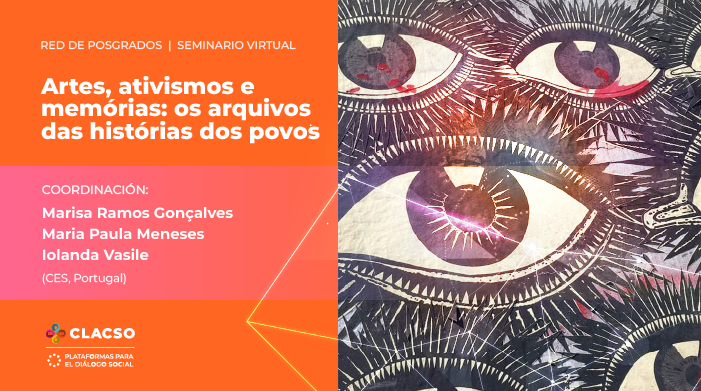
Arts, Ativisms and Memories: the archives of two world histories
Seminar 2325
COORDINATION: Marisa Ramos Gonçalves , María Paula Meneses and Iolanda Vasile (CES – Center for Social Studies, University of Coimbra)
TEACHING TEAM: Camilo Sousa (Director, Ébano Multimédia, Moçambique); Claudia Howald (CES, University of Coimbra, Portugal); Fabián Cevallos Vivar (Faculdade de Las Artes, Universidade de Lisboa, Portugal); Ifigenia Garcés Urrutia (Director, Mojiganga Artistic and Cultural School, Colombia); Inês Nascimento Rodrigues (CES, University of Coimbra, Portugal); Yara Monteiro (Writer, Angola); Iolanda Vasile (CES, Universidade de Coimbra, Portugal); Lara Sousa (Director, Moçambique); Maria Paula Meneses (CES, University of Coimbra, Portugal); Marisa Ramos Gonçalves (CES, Universidade de Coimbra, Portugal); Raquel Ribeiro (Institute of Contemporary History, FCSH/NOVA, Portugal); Vannessa Hearman (Faculty of Humanities, Curtin University, Australia).
Start: 28/08/2023 | Registration: 23/06/2023 to 27/08/2023
Workload: 12 weeks – 90 hours.
In many societies of the global South, deeply marked by the colonial relationship, the knowledge about their history is built on assumptions, methodologies and sources that perpetuate the maintenance of Eurocentric perspectives. This is a colonial heritage that is intended to be replaced by an agenda of production of plural knowledge and intercultural translations, starting from an analytical perspective on oral, collective and personal histories, starting from the arts and two creative spaces.
The seminar presents research carried out in various social and political contexts, reflecting on how to educate new generations about the histories and struggles for social justice that are found in the cultural and artistic expressions such as cinema, literature, theatre, music, plastic arts, oral narratives, street arts, privileged groups for communicate, produce knowledge about these stories and their cultural identities.
The central objective of this course is to help understand the gaps in the “colonial library” (Mudimbe, 1988), analyzing the history of two parts of our libraries, cartography and archives that contain knowledge, artistic and cultural expressions previously relegated to the plane of orality, subjectivity, "civilizational backwardness" and lack of scientific rigor, therefore we do not correspond to the canon of European knowledge (Meneses, 2016). Developed from the theoretical-methodological proposal of the sociology of absences and emergencies of Boaventura de Sousa Santos, this course aims to give visibility to facts and actors that have been actively produced as non-existent dominant issues. Starting from two challenges that Epistemologias do Sul poses – giving voice to those that the Eurocentric canon does not include and promoting an intercultural translation between experiences and struggles – this course chooses multidisciplinary and situated analyses, based on oral history, post-colonial studies, cultural and artistic studies, as a privileged approach to deconstruct the silencing produced by hegemonic interpretations. To amplify reflective and methodological diversity, the course integrates a diversified group of teachers, including artists and academics. These and these will present their contributions to the debates through synchronous and asynchronous online classrooms; These classrooms will be accompanied by analytical texts, films and photographs that allow us to enrich the knowledge about the realities discussed during the course. As a theoretical and methodological proposal, this seminar on the history and memories of struggles in the global South offers students tools that make it possible to (re)learn to study, learn and deepen the epistemologies of the world, providing inspiration and tools that will be useful for others. development of two research projects, in their artistic practices and city interventions.
- When argila discovers stories lived by women
- Filming the construction of the Moçambican nation – challenges and achievements
- Music and Lutas de Libertação: resistance, anticolonialism and memory
- Literature as a living archive: the work of Yara Monteiro
- The “intergenerational historical archive” in Timor-Leste
- Performing the body-territory in the favela, an experience from Maré, Rio de Janeiro
- Protest art in Indonesia and Timor-Leste during authoritarianism and democratization
- Disputes over history, disputes over memory in Angola and Cuba: the role of literature
- Afro-Colombian youth, activism and art: other narratives questioning categories on the margins
- Balona de Oliveira, Ana (2022), “Elas Aqui: Mulheres Artistas de Angola, de Moçambique e das Diasporas e os Circuitos da Arte Contemporânea”, in Wieser, Doris; Falconi, Jessica (org), Declinations: Questioning National Identities, Gender and SexualityCoimbra: CES/Almedina
- Barros, Miguel de e Redy Wilson Lima (2012), “Rap Kriol(u): Cabral's pan-Africanism in youth intervention music in Guiné-Bissau and in Cape Verde.” Realis – Journal of Anti-utilitarian and Post-colonial Studies 2, no. 2, 88-116.
- Cevallos Vivar, Fabián (2021). “Epistemic corpo-politics: a falante monstrosity.” AILP-CSH. pp. 1-10.
- Commission of Acolhimento, Verdade e Reconciliação (2005), Chega! Report of the Committee on Acolhimento, Verdade e Reconciliação de Timor-Leste: Executive Summary. Díli, Timor-Leste: CAVR, pp. 10-18; 52-59.
- Costa, Elaine, Barbosa Jorge Luiz (2016). “Rolezinho: Territórios e Territorialidades em Cybercultures”. Z Cultural Magazine. UFRJ: Rio de Janeiro. Pp. 1-8.
- Díaz-Boada, SA (2017). Genocide, paramilitaries and victims in Indonesia. A review of the documentary T (2012). Jangwa Pana, 16(1), 76-89.
- Gonçalves, Marisa Ramos (2016), “As Artes de Rua Em Timor-Leste: Entre o Passado eo Futuro”, em Feijó, Rui (ed.), Timor-Leste: Colonialism, Decolonization, Lusutopia. Porto: Edições Afrontamento, pp. 477–499.
- Howald, Claudia (2022, in publication). “Citizenship, why not? Political practices of Afro-Colombian youth in Quibdó.” Afro Perspectives.
- Jaramillo Marín, Jefferson, Érika Parrado Pardo, and Wooldy Edson Louidor (2019). “Violated Geographies and Experiences of Reexistence. The Case of Buenaventura, Colombia, 2005-2015”. Icons - Journal of Social Sciences (64):111–36. doi: 10.17141/iconos.64.2019.3707.
- Memórias Aparições Arrhythmias, by Yara Nakahanda Monteiro (Companhia das Letras, 2021) by Doris Wieser.
- Meneses, Maria Paula (2018), “Singing Struggles, Affirming Politics: Mozambique's Revolutionary Songs as Other Ways of Being (in) History.” in Mozambique on the Move, edited by Sheila Pereira Khan; Maria Paula Meneses and Bjørn Enge Bertelsen. Leiden: Brill, 254-278.
- Noronha, Isabel (2018), “Tacteando o Indizível”, Tese (doctorate) - Universidade Estadual de Campinas, Instituto de Filosofia e Ciências Humanas, Campinas, SP.
- Ondjaki (2001), Good morning, comrades (Lisbon: Caminho). Edition in Portuguese
- Ondjaki (2018), Good day, comrades (Buenos Aires: Ed. Puerto de Palos) Spanish edition
- Paramaditha, Intan (2019) Narratives of discovery: Joshua Oppenheimer's films on Indonesia's 1965 mass killings and the global human rights discourse, Social Identities, 25: 4, 512-522.
- Rodrigues, Inês Nascimento (2021), Simulação de 1h de emissão da Rádio Libertação (PAIGC), Radio Program. Coimbra: Rádio Universidade de Coimbra.
- Santos, Boaventura de Sousa (2019). The Demonumentalization of Written and Archival Knowledge, The end of the cognitive empire: The affirmation of the epistemologies of the South, Madrid: Trotta Editorial. (Pp. 260-268; 276-286)
- Vasile, Iolanda (2021). ““Essa Dama Bate Bué” eo Cânone Literário Angolano”. Studia UBB Philologia, LXVI, 4, 2021, p. 239 – 250.
- “As minhas african roots and as minhas são European handles”, interview with Yara Monteiro by Doris Wieser.
- “Women of the mud”
- “Reinata Sadimba, words of clay”
- Films: Lesson finish date (2018). Director: Lara Sousa. With Camilo de Sousa and Lara de Sousa.
|
|
Discount for one payment until 25/08 |
In one payment after 25/08 |
|
CM Plenos |
$75 |
$150 |
|
CM Associates |
$95 |
$190 |
|
No link |
$95 |
$190 |
FAQ
The basic requirements for taking a seminar are:
- Availability of at least 4 hours per week to dedicate to the seminar course.
- Internet access.
- Reasonable handling of communication and computer tools.
- Language proficiency in the language in which the course will be taught. The official languages are Spanish and Portuguese.
|
|
Discount for one payment until 25/08 |
In one payment after 25/08 |
|
CM Plenos |
$75 |
$150 |
|
CM Associates |
$95 |
$190 |
|
No link |
$95 |
$190 |

