
Argentina: 100 years since the La Forestal workers' struggle
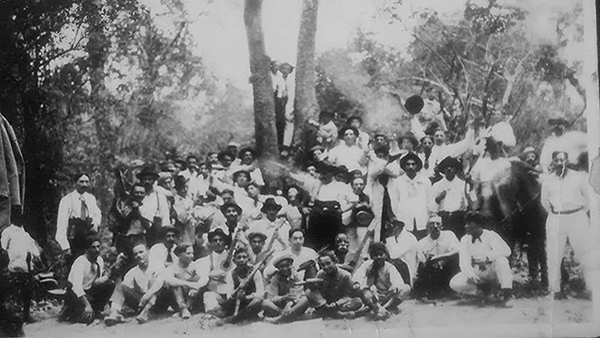

In Villa Guillermina, Santa Fe province, a series of commemorative events will begin on Friday, January 29, 2021, marking the historic struggle of the La Forestal workers in 1921. Discussion panels will run until June, analyzing the past, present, and future of a process characterized by large landholdings, rampant extractive exploitation, the presence of a monopolistic company, and a strained relationship spanning more than six decades with the numerous forestry towns of the former quebracho-producing region of Santa Fe.
The traces of that era, the testimonies of those struggles and the lessons of the present are part of the series of events planned by the Meeting for Memory, Identity and Vindication of Forest Peoples (EMIRPF) and the CLACSO Working Group “Critical Studies of Rural Development”, among other institutions, to commemorate the one hundred years of that milestone.

The January 1921 rebellion was the final episode in more than two years of open conflict in northern Santa Fe province. It began in late 1918, when workers in tannin factories, workshops, forests, railways, and boats began to organize and demand improvements. They formed the region's first union and broke the order imposed by the tannin monopoly. They united efforts in the various towns and villages and secured the support of national labor federations. They went on strike and presented a long list of demands. They sought to improve working and living conditions. The final item demanded greater respect for the workers from management.

From the outset, the company reacted with the only weapons it knew at the time: firing, arresting, and deporting those who were troublesome. Physical clashes and murders were not uncommon. In mid-1920, the company went on the offensive. First, it created and financed a provincial repressive force: the Flying Gendarmerie. This initiative aligned the interests of the provincial government and the company. Then, it closed its factories, provoking social chaos.
The workers then demanded their right to work and the reopening of the factories, the fulfillment of promised improvements, and an end to corporate violence. Finally, they launched a popular uprising. The company's reaction was brutal. The press reported that between 500 and 600 people died.

One hundred years later, for the first time, access will be opened to the grounds of the former tannin factory in Villa Guillermina, which was once the most powerful in the world, where a space for memory will be opened and the monument to Teófilo Lafuente, the first general secretary and co-founder in 1919 of the Union of Workers in Tannin and Annexes of La Forestal, will be installed.
The unveiling of the monument at the Historical, Cultural, Educational and Environmental Complex of that town, which is located in the old facilities of the federal shooting range of the factory, can be seen live on the provincial channel 5RTV and on the Youtube channel @100añosdelarevueltaenlaforestal.
Technical specifications :
-Voiceover: Lucila Pesoa, a production for the Meeting for Memory, Identity and Vindication of Forest Peoples (EMIRPF)
-Testimonials from:
-Juan Wahren, coordinator of the CLACSO Working Group on Critical Studies of Rural Development
-Members of the Meeting for the memory, vindication and identity of forest peoples: Alejandro Jasinski, Valeria Villalba, Guillermo Sánchez, Alexis Romero, Luciano Sánchez and Marcelo Cena
-Songs: Sung chronicle “La Forestal, a blow to the dignity of man”, by Enrique Llopis with stories by Emilio Lenski / Chamamé “La Forestal – From Santa Fe to the north” by Rafael Lelpi and Carlos Pino. Performed by: Dúo Guaycuru.
-Excerpt from the film: Quebracho (1974) by Ricardo Wullicher, with Héctor Alterio, Lautaro Murúa, Juan Carlos Gené, Osvaldo Bonnet and Cipe Lincovsky.
-Documentary source: Diario Tiempo Argentino
-See also: Page/12
-Podcast production: Eric Domergue
If you would like to receive more information about CLACSO's training programs:
[widget id=”custom_html-57″]
to our email lists.

