
Paraguay is burning
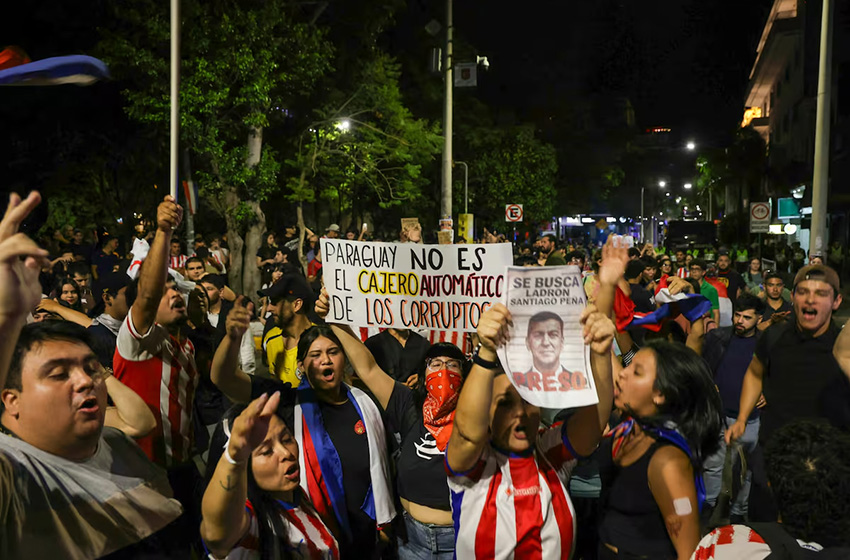
The resounding collapse of Santiago Peña 's neoliberal government in Paraguay is not the chronicle of an isolated financial accident, but rather the crystallization of the structural limits of corporate capture of the state. The intervention of Ueno Bank —an entity closely linked to the president's wealth and the emerging digital banking sector—triggered a de facto "corralito" (bank freeze) that left almost half of the Paraguayan population in limbo.
The analysis by Álvaro Lo Bianco , Master in Social Sciences and professor at the National University of Asunción
The institutional outcome, accelerated by a massive social mobilization, forced Peña's resignation, which was not accepted by Congress, and exposed the contradictions of an accumulation scheme based on extractivism, financial deregulation, and the political patronage of the Colorado Party.
The expansion of banking services promoted under the administration of Peña—who was a shareholder in the owning group until 2025, when he sold his stake—was presented as a milestone of "modernization and digital inclusion." However, the collapse of Ueno Bank revealed the privatization of the public savings bank: the institution accumulated millions in treasury deposits and manages the pensions of more than 30.000 retirees with virtually no leverage controls and marked conflicts of interest, and its collapse left nearly 3 million customers without access to their savings.
From a critical political economy perspective, the bank's bankruptcy and intervention exposes three key dynamics:
-Privatization of social risk: The massive transfer of state funds to emerging private entities to finance leverage in concentrated sectors of the economy.
-Financialization of survival: The working and informal masses were forced to depend on digital financial ecosystems for basic consumption, leaving them vulnerable to the insolvency of the banking system.
-Regulatory capture: The resignation and subsequent investigation into the top management of the Central Bank of Paraguay demonstrate how oversight institutions were dismantled or subordinated to tolerate schemes of financial opacity.
The streets of Asunción and other cities across the country have been filled with protests that go beyond the mere recovery of individual savings: they are challenging Paraguay's development model. The fiscal response, through the Deposit Guarantee Fund, is proving insufficient given the sheer number of affected depositors.
For Latin American social movements and critical thought, this historical moment raises urgent questions:
-How can we democratize savings and credit systems so that they stop operating as instruments of dispossession and speculation by the elites?
-Is it possible to dismantle the network of party-business hegemony without a profound transformation of the Paraguayan constitutional pact?
-The demand that the cost of the bailout not fall on public coffers again, nor through structural adjustments to the working class.
The fall of Santiago Peña marks an unprecedented fissure in Paraguay's neoliberal and patrimonialist order. The collapse of Ueno Bank demonstrates that deregulated financial capitalism, when it seizes control of state structures, ultimately devours its own political foundations.
The Colorado Party has governed Paraguay for most of the last seven decades through patronage and bureaucratic control. When the banking panic threatened to paralyze the daily lives of millions of families, this "business-friendly governance" collapsed. The president's impeachment/resignation, in this context, serves as a safety valve for the regime itself, an attempt to contain a social explosion of historic proportions.
Links to the far right in America
Ueno Bank was listed as a Diamond category sponsor at the gala and political summit of far-right sectors held in Mar-a-Lago, Florida, United States, where the Argentine political consultant, digital strategist and media entrepreneur Fernando Cerimedo , CEO of the marketing agency Numen and co-founder of the news portal La Derecha Diario, was awarded.
Cerimedo, currently detained in Bolivia, is recognized for his work in digital communication campaigns and social networks linked to far-right sectors in various Latin American countries and has participated in electoral strategies and digital interventions in countries such as Brazil (with the environment of Jair Bolsonaro), Argentina (with Javier Milei), Chile, Honduras and Bolivia.

