
Learning together
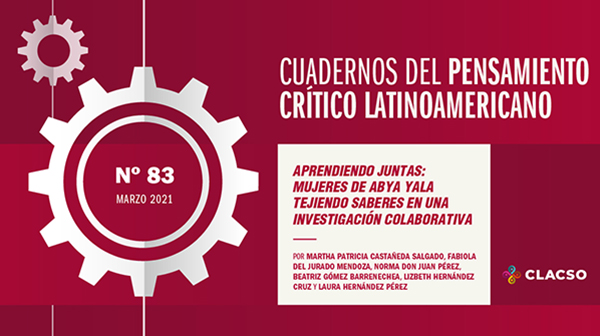
Within the collection of “Notebooks of Latin American Critical Thought”, CLACSO presents "Learning together: women of Abya Yala weaving knowledge in collaborative research”, by Martha Patricia Castañeda Salgado, Fabiola del Jurado Mendoza, Norma Don Juan Pérez, Beatriz Gómez Barrenechea, Lizbeth Hernández Cruz and Laura Hernández Pérez
Learning together: women of Abya Yala weaving knowledge in collaborative research[1]
Martha Patricia Castañeda Salgado*
Fabiola del Jurado Mendoza**
Norma Don Juan Pérez***
Beatriz Gómez Barrenechea****
Lizbeth Hernández Cruz*****
Laura Hernández Pérez******
Presentation
The National Coordinator of Indigenous Women (CONAMI), founded in Oaxaca, Mexico, in 1997, is a political project whose general objective is "To be a broad and inclusive space to make visible the demands and political proposals of indigenous women, through organized, collective, articulated and comprehensive struggle"[2]To achieve this, CONAMI works to strengthen leadership and promote the political participation of its members, thereby expanding the presence and influence of Indigenous women in the community, organizations, and government bodies in which they participate. CONAMI's actions are significant, given that historically, Indigenous women have faced considerable disadvantages in exercising their individual and collective rights, particularly political rights, beginning with the invisibility of their contributions to the struggles of the organizations, communities, and peoples to which they belong.
In this Notebook we share an experience of collaboration between indigenous women organized in CONAMI and allied academics[3], regarding the project entitled “Building relationships of equality from indigenous community practice. The political experience of the National Coordinator of Indigenous Women (Mexico)”[4], which is part of a long-standing collaboration between the authors of this document.
The initial methodological approach of this research focused on a set of face-to-face activities in which we would work with sisters from CONAMI who are part of one of the three selected organizational bodies (Collegiate Coordination, Council of Elders and Commission of Childhood and Youth), which carry out their community political work in three regions of the country[5]To gather their experiences regarding inequalities, politics, and perspectives on building equality in its broadest sense, to reflect together and develop proposals for strengthening CONAMI and influencing public policy. We begin by considering that gender inequalities are amplified when combined with inequalities of class, ethnicity, race, and age, while also recognizing a deep colonial root that is still present.
We began the research with enthusiasm and conviction, carrying out some of the planned meetings, interviews, and workshops. However, in mid-March 2020, the COVID-19 pandemic led the federal government to declare a nationwide lockdown in Mexico. This situation prompted us to reassess the conditions for continuing the research. We decided to make adjustments to the project, including reducing the number of workshops and discussions, and opting to switch to a virtual format using a digital platform. Similarly, for the remaining interviews, we relied on the solidarity of our colleagues to conduct them remotely, using whatever material and technological resources were available to each of us.
While reviewing these adjustments with Dr. Ana Silvia Monzón, the project advisor, new concerns arose regarding the effects of the pandemic and lockdown on our own lives and on the research. With her, we solidified the idea of including an autoethnographic reflection, which we tentatively began through a weekly workshop. This workshop has allowed us to put into words a series of thoughts and feelings about who we are, how we came to this project, how we have been giving meaning to the process, how we position ourselves, and how we relate to the women invited to participate. This exercise will undoubtedly influence our analysis of the life experiences and political participation of organized Indigenous women from a perspective that recognizes the power of feeling and thinking.[6] a process that dismantles and redefines ethnocentric and academic notions of information and knowledge.
One of the first effects of autoethnographic reflection has been the possibility of thinking about ourselves, by ourselves and among all of us, to highlight our particularities, our differences, but also our coincidences, which allow us to weave knowledge in an intercultural way and therefore account for a knowledge that is built from the diversity of worldviews, where there is no truth imposed on others, but a diverse dialogue where the different epistemes that we bring are recognized, valued and put into practice.
In this Notebook, we propose to share some reflections on the challenges we face when proposing this collaborative project between indigenous women and academic allies, framed now in the effects of COVID-19 on the realization of this collaborative research.[7] We seek to present our approach to promote the theoretical re-elaboration of gender inequalities, which in the case of indigenous women are inseparable from inequalities of ethnicity, class and age, as well as contribute to dismantling the power relations that exist in the production of academic knowledge, including other perspectives and political commitments.
Who are we and where do we come from, weaving together to learn?
Those of us who initiated this research are a group of women who share the experience of having been trained in institutional academic spaces. We are willing to unlearn, to engage in horizontal dialogue with other women, and we come from different places, territories, and experiences, with diverse paths traveled, and with interests focused on building possibilities for change. Each of us has an emphasis that does not always coincide with the others, but when we meet and exchange words, a mutual interest in walking together emerges.[8].
The paths we have traveled stem from our diverse identities: indigenous and non-indigenous, sexual and generational; from left-wing ideological options; from the practices of grassroots church communities, popular and critical education; from plural feminisms and women's movements; from the defense of human rights; spaces from which we have questioned the role of the dominant and privileged subject in society, as well as the unique knowledge that is erected as scientific knowledge, or the hegemonic discourses in which reason was the only paradigm of truth and in which patriarchal, sexist, racist and ethnocentric positions predominated.
In each of these spaces, we have maintained a critical stance towards the paradigms of the formal education system, which has privileged a Eurocentric vision in its institutions and still resists recognizing "other" knowledge, wisdom, and feelings. We, on the contrary, reclaim the importance of diversity, subjectivity, ancestral knowledge, the feminine, and the communal/collective.
We are committed to contributing to transforming the situation of women, so that we may live full and dignified lives, free from discrimination and violence, with justice, hope, and harmony for ourselves, for our communities, and for nature. We know that the path to achieving this transformation is long and complex, requiring the knowledge and energy of all women, and therefore, we are convinced that it requires the contribution of women themselves, not something done for or by them.
Because of the time and shared tasks, we believe it is possible to analyze social reality in a situated, non-dichotomous (black and white) way, to recover the nuances in which the richness of diversity is found.
In short, we are women committed to women's struggles, equipped with different ways of knowing, convinced that knowledge is generated from a multiplicity of processes, working to make knowledge useful resources for a dignified life, with the deep conviction that it is imperative to transform the current social conditions that exacerbate the generalized inequalities that translate into violence, suffering, precariousness and vulnerability.
How can we weave a delicate tapestry to rethink inequalities and build equality?
In collaborative work driven by conviction—the kind we're willing to do because the process is enjoyable and we're convinced the results will be useful not only for the team but also for a larger community—constant self-criticism and a tremendous capacity for listening are essential, along with the creativity and patience to resolve the process's challenges, in this case, research, within an intercultural, interdisciplinary, and intergenerational team. Building and maintaining the "inter" elements represents not only the methodological but also the theoretical and reflective axis. To consolidate these points of convergence, it's necessary, for example, to coordinate schedules, not only to ensure a convergence of working hours but also to understand, accept, and respect each person's time for responding to messages, contributing to documents, and ultimately, dedicating time to collaborative work. Unlike the market-driven logic of productivity, where time is money and shouldn't be "wasted," for us, the value and management of time allows us to rethink the idea that every moment is valuable for weaving together the different dimensions of life; that waiting and producing "in its own time" makes sense for consolidating processes not only related to work, but also to caregiving and the reconciliation of personal and collective life. Doing so isn't easy, but we are committed to transforming that logic, in this case, regarding conventional research methods.
What we have attempted from the outset is to challenge these notions of “productivity” and the fragmentation/individualization of time, in order to engage in lengthy dialogues that form the basis of a collaborative writing exercise. This experience requires developing an understanding of the unforeseen events of daily life that often interfere with individual and collective work. From there begins the process of deconstructing what is considered “appropriate” for research. As part of these dialogues, we initially dedicated several long sessions to clarifying our understanding of politics and the political, based on the concrete political practices of CONAMI. In these exercises, we recognize among ourselves that for organized Indigenous women, theorizing is always linked to the political project being promoted. Thus, the concepts that are developed and applied to political practice are dynamic; they can be modified throughout the processes and according to the action and communication needs of the women who require them in their daily community work.
Trying to be consistent with this stance, teamwork in times of COVID presents multiple challenges. To connect in the virtual space, we have built a “common room,” weaving together complexities amidst the exhausting double and triple shifts that overlap; our paid work, caregiving, health, economic uncertainties, and political work. Now we do everything from the same place and at the same time, while experiencing sleep disturbances, grief for the loss of family and friends, and fear because SARS-CoV-2 seems to be getting closer every day. This process makes it clear that the construction of knowledge cannot be separated from subjective experiences and that, as situated subjects, it is essential to recognize where we stand in order to feel and think.
Methodologically, it was necessary to formulate a creative proposal to connect with our comrades who live in different parts of the country, across various time zones, and in contexts where Wi-Fi is not a basic necessity; where the hills, the rain, and the air limit the possibilities for telecommunications, since nature is the only source of stable connectivity for the production and reproduction of life. Meeting virtually requires patience, as well as cultivating our ability to listen and pay attention. It requires transforming the object that distracted us in face-to-face meetings—the cell phone—now the primary means of communication. In this context, some of the basic contact information we need to know includes: Do you have a cell phone? Do you have a computer or tablet? What cell phone company do you use? Do you connect via Wi-Fi or mobile data? These questions coexist with those that were already being asked before the pandemic: Where does the comrade live? In the municipal capital, in a remote community? What is the state of communications in her region? What mobility does her political work require? What times and spaces are available for us to meet? What does he/she have access to and what does he/she not have access to?
Current living conditions, coupled with the digital divide and lack of technological infrastructure in Mexico, exacerbate the exclusion of most of the population, affecting Indigenous communities and women most critically. For this research, continuing the project led us to seek out and combine diverse technological options accessible to all participants, according to their specific needs. We used various platforms, such as WhatsApp, videoconferencing, Zoom, Meet, and Jitsi, to name a few, since not all participants have the necessary technological devices to standardize communication. This in itself is a challenge, as we have to quickly learn to use the platforms and adapt the methodologies to facilitate the information gathering process, while simultaneously advising our colleagues on how to use them. We have all had to familiarize ourselves with the languages of these technological communication resources. In this process, we realize the importance of incorporating cultural relevance into technological innovation to ensure truly inclusive communication.
Now, in light of this experience, other points for reflection have emerged. The initial concern about how virtual communication would flow was replaced by the realization that all the women need to talk about what affects them, and that seeing and hearing each other through screens allows us to feel differently, to connect with their stories, to share their tears and laughter. In this same context, we face the anguish of knowing that some of the sisters and colleagues who would participate in this research are at home protecting their lives, threatened by COVID-19. This situation interrupts the possibility of hearing their voices, which causes us sadness as well as challenges to continue refining the methodology.
Finally, we believe that this form of virtual communication can introduce us to a different way of thinking and feeling, and of the spiritual work we do from our worldviews. It leads us to seek alternatives to maintain it, aware that it doesn't replace everything shared when we are in the same space, but that it is essential to continue doing so.
How do we unravel power relations in knowledge production?
Racism and institutionalized structural discrimination, used since colonial times as a means of domination over women and Indigenous peoples, manifest themselves in multiple ways and in diverse spaces. It is from these perspectives that Indigenous women are considered subjects of attention due to the degree of marginalization and vulnerability revealed by the indicators established in government programs and actions. From this supremacist viewpoint, a hegemonic social representation of what it means to be Indigenous and to be an Indigenous woman is constructed, in which their knowledge, feelings, experiences, and practices are undervalued in the production of knowledge.
Feminist researchers from diverse perspectives have explicitly expressed their interest in eliminating androcentric, sexist, ethnocentric, and discriminatory biases from science in each and every one of its fields. As women, as feminists, as researchers, and as activists, we agree on the importance of generating knowledge that reveals inequalities in order to eradicate them, but not from hegemonic positions of domination and hierarchy. Rather, we must do so from the recognition of differences, diversity, and interculturality as a starting point for thinking freely, with multiple points of reference, from the richness of a plurality of perspectives, and from a dialogue of knowledge.
The critical construction and reconstruction of scientific knowledge represents an opportunity to understand and recognize ourselves as knowledge-generating subjects. It also allows us to analyze social facts, history, and culture, thus acknowledging the reality of inequalities and injustices that subjugate us, limit us, and, in many cases, kill us. In this context, the responses are multiple and diverse, and the generation of knowledge as a tool for social transformation represents a light in the darkness. However, this light is also fraught with contradictions; this space where thinking is commonplace also represents a space to which only a small percentage of women have access, making the act of thinking a privilege seemingly reserved for some.[9] with certain phenotypic and “cultural” characteristics that form an elite. It is simultaneously a space for expansion, a place that invites political and critical reflection to establish new spaces for building, exercising thought, and transforming practices. This pursuit is being driven by various actors and movements within and outside academia, who recognize that academia is comprised of a plurality of groups with divergent interests. We agree with those who are paving the way for the emancipation of thought, which requires the elimination of all forms of oppression.
From these perspectives, our shared learning leads us to reflect on: what and why do we ask? Who asks the questions? Who do we ask them? From what standpoint do we ask them? To whom and where are the answers directed? Why doesn't the university foster a committed relationship with society, particularly with the groups that need these answers? We are certain that knowledge generation must respond to a social demand. However, although academia in Mexico is highly productive and many governmental and non-governmental institutions, international agencies, churches of various denominations, and media outlets conduct research or produce information about Indigenous peoples and women, very little of this knowledge is applied to public policy development, community work, budget allocation, or the implementation of plans and projects. Even worse, few Indigenous women who have been "subjects of study" are aware of the results of these investigations or have access to this information.
As we have emphasized, this team's approach is different, as we collaborate with Indigenous women and allied academics to generate useful resources that strengthen the political participation of community organizations like CONAMI, as well as the creation of public policies that place Indigenous women at the center. We are interested in developing a political agenda grounded in the knowledge, feelings, needs, and proposals of the research participants, all situated within their daily lives and the conditions under which they carry out their political work. This is one of the expressions of the dominant power relations that we aim to dismantle by examining equality, inequality, political participation, and the implementation of public policies from the perspectives of Indigenous women themselves.
Advances in public policies that benefit women in general, and indigenous women in particular, are the product of historical demands and our demands to preserve the rights we have won.[10] and to promote those rights that are not yet recognized; from our critical questioning of the rights that disadvantage us and even violate us. We intend for the knowledge generated to reflect who we are, to allow us to continue moving forward, and for public policies to be a means for the effective exercise of our individual and collective rights.
How can we continue to weave collaborative learning?
What will this research be used for? How will it be conducted? Where, when? With whom? How many resources are available? Where will these resources come from? How will they be used? How will the results contribute to the established or future organizational processes in each of the communities where CONAMI works? These were some of the questions we, as a team, had to answer when the research proposal was presented to the sisters of the Collegiate Coordination. This exercise was enlightening for all of us, as it forced us to find the best ways to express how we were working and how we hoped our inquiry would foster a collective effort that would expand our small group of six women committed to CONAMI to include the participation of those who make up its three organizational levels.
Answering these questions by sharing our convictions about the importance of implementing alternative ways of creating knowledge has outlined the theoretical, methodological, and political challenges that have been constant throughout this process, in which reflection, systematization, and research are a political commitment to which we are dedicated. But these challenges have also been practical, everyday, and require urgent resolution.
The challenges ahead are numerous, the first of which is time. From the outset of the project, we knew it would be difficult to reconcile the time required by academia with the organizational processes. The pandemic confronted us with the reality that the entire organization of work (in its broadest sense, including domestic, care, and paid work) was disrupted. This led to a certain complexity in imagining and implementing a way to harmonize the available time for all participants, a situation we continue to face in our daily lives and in conducting the research.
The second challenge is to position "feeling-thinking" as the epistemological framework for this research, within a context of global crisis that transformed, almost overnight, the ways in which we connect and encounter one another. Feeling-thinking requires forms of sociability in which people relate holistically, that is, sharing intellectual positions with sensations, emotions, and knowledge from diverse sources. Relationships mediated through the virtual world limit some of these expressions. However, the aim is to demonstrate that, even under these conditions, feeling-thinking is a valid, valuable, powerful, and useful possibility for the creation of intercultural scientific knowledge.
The following challenge largely shapes this text and our work as a team: learning together requires our capacity and ability to step outside of socially assigned and individually assumed roles. Each of us has recognized the power relations in which we participate, questioning and modifying them through our positions in research: as Indigenous women, this meant recognizing ourselves as knowing subjects and removing ourselves from the role that much of academia has assigned us as “subjects of research”; those of us who work as academics question the established norms of scientific practice and strive to innovate. For all of us, positioning ourselves as subjects who are constantly learning from one another is an exercise in building equality and an opportunity to promote liberating knowledge as part of our political commitment and social transformation.
In this direction, we consider ourselves challenged to break with a solitary, detached, and abstract production of knowledge that promotes isolation, scientific objectivity, and competitive and hierarchical relationships. We are interested in knowledge generated through an open process that respects and values the collective and communal development of knowledge and fosters constant feedback and dialogue from heterogeneous and diverse perspectives to understand and transform social life. We believe this stance should refer not only to the content of our studies but also encompass the entire process of knowledge creation, practical application, and dissemination, from a critical and counter-hegemonic perspective.
For us, academic work can be a tool that contributes to criticism, reflection, and questioning of what has been said so far from the hegemonic power about indigenous peoples and women, as well as about visions of development and normative views of history.
Bibliography cited
Bonfil Sánchez, Paloma (2008). The spaces conquered. Political participation and leadership of indigenous women in Mexico, Mexico, UNDP
CONAMI (2016) Statutes of the National Coordinating Body of Indigenous Women (unpublished).
Fals Borda, Orlando (1986). Double History of the Coast. National University of Colombia. Bank of the Republic. The Anchor
Méndez Torres, Georgina (2013). “Mayan Women-Kichwas in the commitment to the decolonization of thoughts and hearts.” In Georgina Méndez Torres, et al. Coords. Feeling and thinking about gender: Perspectives from Indigenous peoples (pp. 27-61). Guadalajara, Jalisco, Mexico. Interdisciplinary Network of Researchers of the Indigenous Peoples of Mexico, AC, Network of Decolonial Feminisms, La Casa del Mago Publishing Workshop.
[1] This Notebook This is the first product of the project “Building relationships of equality from indigenous community practice. The political experience of the National Coordinator of Indigenous Women (Mexico)”, which was selected in 2019 to receive the grant The critical issues of gender inequalities in Latin America and the Caribbean, awarded by CLACSO.
* PhD in Anthropology. Senior Researcher at the Center for Interdisciplinary Research in Sciences and Humanities, National Autonomous University of Mexico. Email: [email protected]
** Licensed Psychologist. Professor at the Faculty of Psychology, Autonomous University of the State of Morelos. Member of the Coordinating Committee of Indigenous and Popular Cultural Groups (CGCIP). Member of the Council of Elders of the National Confederation of Indigenous Peoples (CONAMI). Email: [email protected]
*** Bachelor's degree in Urban Settlement Design. Member of Cochitleua Mexican Center for Exchanges, AC. Member of the CONAMI Council of Elders. Email: [email protected]
**** Master of Social Sciences. Professor-Researcher at the University Center for Social Sciences, University of Guadalajara. Email: [email protected]
***** Master's in Women's Studies. Member of the Yehcoa Um Collective. Member of CONAMI. Email: [email protected]
****** Licensed Social Worker. Member of the Yehcoa Um Collective. Member of the CONAMI Collegiate Coordination. Email: [email protected]
[2] CONAMI, 2016
[3] This designation refers to women from diverse social and political backgrounds who, through their perspectives, abilities, and commitment, contribute to strengthening, complementing, and supporting CONAMI's work on behalf of women. They are partners with whom a relationship of ongoing deconstruction is established to generate knowledge and methodologies. This horizontal and inclusive work process addresses tensions and differences within a continuous dialogue, challenging assigned statuses. These allies may be academics, public servants, representatives from international agencies, non-governmental organizations, or entities interested in strengthening CONAMI's work.
[4] The authors of this text have worked together for several years, gradually joining the project from 2008 onwards. On this occasion, we are interested in sharing some of the political and methodological reflections that we have developed as part of the implementation of the specific project mentioned in note 1, starting in October 2019, with the support of the grant awarded by CLACSO.
[5] CONAMI presents the following organizational structure: General Assembly, the highest decision-making authority, made up of all the organizations that are part of CONAMI; Collegiate Coordination, made up of two representatives from each of the three geographic regions of Mexico (North, Central and South) where the organization has a presence, which coordinates the work at the national level and with the Continental Link of Indigenous Women of the Americas; Council of Elders, made up of women who have been coordinators and founders of CONAMI, in charge of guiding and accompanying the actions; and five Working Commissions.
[6] While academic literature recognizes Orlando Fals Borda (1986) as the author who characterized the notion of senti-pensar (feeling-thinking), in our experience as a collaborative research team we subscribe to the idea that it is a perspective of indigenous peoples in which, as Georgina Méndez, a Chol anthropologist, (2013, pp. 36-37) emphasizes, “…indigenous women have created spaces for dialogue, for learning about other worlds, they have created methodologies based on feeling, on the awakening of creativity, on feeling of the senses, from the corazonar of methodologies such as the Mayan Women's Group KAQLA In Guatemala, the Fortalece de la Mujer Maya group in Chiapas and the Dolores Cacuango Leadership School have been doing this…”
[7] We thank CLACSO Scholarships for their understanding of this process, in relation to the adjustments to the project and the budget that resulted from the unforeseen situations brought about by the COVID-19 pandemic.
[8] The idea of “walking together” has been developed by CONAMI to refer to the way of maintaining common interests, generating and strengthening the organization, balancing the individual and the collective, and building upon the differences that characterize its members. It includes mutual support among organizations and women, as well as “doing by doing,” that is, walking together in practice.
[9] It is important to note that by saying "some women", we are also interested in denouncing that, socially, the act of thinking is linked more to men and less to women.
[10] See Paloma Bonfil, coord. (2008)
If you would like to receive more information about CLACSO's training programs:
[widget id=”custom_html-57″]
to our email lists.

