
Contributions of the Social Sciences in a context of crisis
From October 15 to 17, the Faculty of Social Sciences at the National University of San Juan, in the western province of Argentina, will host the “10th Meeting of Researchers in Social Sciences of the Central-Western Region (INRECO)” and the “7th Binational Meeting with the IV Region of the Republic of Chile.” The event is organized by the Institute of Socioeconomic Research (IISE) and will bring together academic leaders, researchers, fellows, and students from across the region, including those from [unspecified institution]. Latin American Council of Social Sciences.
Under the slogan "Contributions of the Social Sciences in a context of crisis: analytical and practical tools to challenge the current scenario“This biennial academic meeting aims to consolidate a space for exchange and critical reflection on the contemporary challenges facing the social sciences.
The conference will feature keynote addresses, thematic panels, and workshops addressing strategic areas of social knowledge. The thematic areas of the event are: development, environment and territory, state and power, education, science and culture, gender, labor and social conflict, social policies, socio-historical processes, communication and society, international studies and global affairs, and computational social sciences.
-Presentation of the CLACSO book: “After 40 years of democracy” and the documentary Forest of Memory UNSJ
Wednesday 15 – from 11:30 to 13:00 – Auditorium
-“After 40 years of democracy”
Forty years after the return of democracy to Argentina, this book offers a lucid, critical, and essential journey through its triumphs and tragedies. From that historic December 10, 1983, to the present, marked by crises, achievements, setbacks, and new struggles, this volume brings together diverse voices that analyze the progress made, the persistent shortcomings, and the urgent challenges. The research gathered here, the result of the call for papers “After 40 Years of Democracy: Achievements, Debts, and Collective Challenges,” promoted by CLACSO, reflects the richness of Argentine and Latin American critical thought, as well as the transformative power of social movements. At a time when democratic rights and institutions are once again under threat, this work is an invitation to collectively reflect on the present and to build a more just, equitable, and supportive future. An indispensable contribution for those who refuse to relinquish the ideal of a democracy with dignity.
Graciela Castro. [Coordinator and author of the prologue]
Tania Rodriguez. Gabriela Dranovsky. Daniel Filmus. Nicolás Alejo Lavagnino. José del Tronco Paganelli. Angelica Gunturiz. Juan Bautista Lucca. Yussef Becher. Alberto Enrique Pérez. Claudia Anzorena. María Belén Riveiro. María Emilia Perri. Mauro Benente. Mariana de los Ángeles Olmedo. [Chapter Authors]
-Documentary Forest of Memory of the Faculty of Social Sciences of the National University of San Juan.
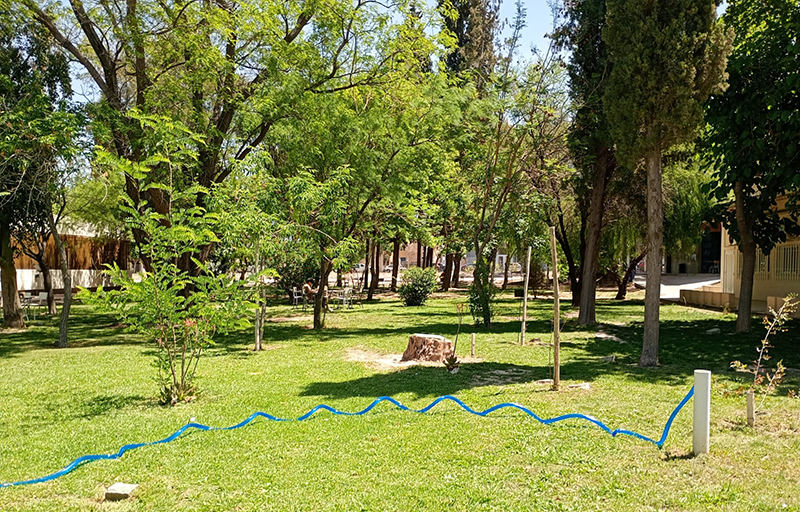
The documentary tells the story of the Forest of Memory, created in 1995 by a small group of staff members from the National University of San Juan (UNSJ) to commemorate those who disappeared and/or were murdered in the province of San Juan during the last Argentine Civic-Military Dictatorship. It is located on the grounds of the UNSJ's Faculty of Social Sciences and features a plaque bearing the name of each disappeared person at the base of a tree.
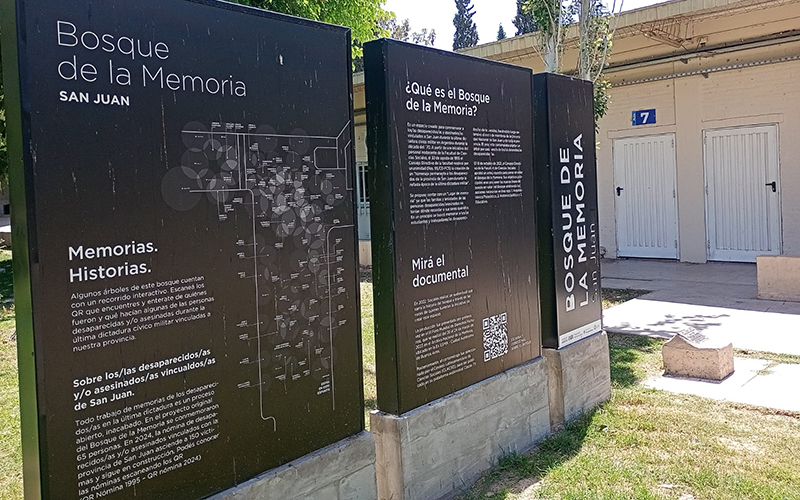
The short film features some of its protagonists: Margarita Camus, Diego Fiol, Alicia Ruso, Cristina De Santis, and Carlos Rodríguez. After a decade of indifference and neoliberal defunding, the creators of the forest's construction and institutionalization reunite in 2023 to reconstruct the events that took place at the Faculty and in the province during the 70s, as well as to recall the implications of establishing a memorial forest in the 90s and, finally, to envision an institutional policy of enhancement starting in 2021.
Directed, produced, and written by Matías Alday. Director of Photography, Editor, and Camera Operator: Enzo Vera. Camera and Still Photography: Paula Moreno. Sound: Ain Olivares. Production Assistant: María Laura. Makeup Artist: Ana Luz Nieto.
-CLACSO Member Centers Panel: “Social sciences at the crossroads of destructive discourses and scientific progress”.
Thursday 16 – 11:30 – Auditorium
Panelists:
María Gabriela CórdobaFaculty of Philosophy and Humanities (UNT). Title of the presentation: “Affects that transform masculinities: care and daily life”.
Yussef BecherMaster's Degree in Society and Institutions) UNSL/CONICET. Title of the presentation: “Socio-state inequalities and youth. Proposals from a rights and diversity approach”.
Andrea Geanina Gómez Herrera, INDES-FHCSYS/UNSE-CONICET. Title of the presentation: «Transformative interactions between University and Family Farming for the construction of territorial innovations».
Moderator: Graciela Castro, UNSL/CLACSO Steering Committee.
In Argentina, the social sciences have experienced political periods that profoundly shaped their development. Researchers and their areas of analysis had to confront political decisions that obscured their scientific and academic progress. This was the case from the 1960s until the return to democracy in 1983. Undoubtedly, the period of the civic-military dictatorship marked a profound decline in both the advancement of the social sciences and the persecution of those working in the field. The return to democracy offered glimpses of development and progress in academic training after many years of stagnation. With the exception of the first decade of the 2000s—during which policies were implemented that facilitated scientific advancement and development—the national governments that held political power during their terms increased the defunding of the area, hindering their activities. Nevertheless, during the COVID-19 pandemic, the work of social scientists made a substantial contribution, providing analyses, information, and strategies on key societal issues that informed government decisions.
Since the new national government took office in December 2023, defunding of public universities and scientific and technological organizations has intensified. Within this context, the social sciences have once again been targeted and discredited by political powers seeking to distort their subject matter. Faced with such rhetoric, which only demonstrates a complete lack of understanding of the scientific paradigms that underpin them and the rigor inherent in their research, it is essential that academic circles present some key aspects of this research to the public.
Academic activities at universities and research and training centers provide ideal spaces for sharing and disseminating projects and advances in the social sciences. In this sense, the panel aims to contribute to the dissemination and understanding of the progress made by research groups at CLACSO Member Centers in Argentina.

