
Contributions to the discussion from Córdoba, Argentina
María Teresa Bosio, Rossana Crosetto and Alicia Soldevila[1]
Córdoba is one of the provinces with significant numbers of coronavirus infections in Argentina: as of April 24, 270 cases were registered in total within the 3.435 positive cases in the country, according to sources from the Ministry of Health of the Nation (argentina.gov.ar).
This data is updated hourly, highlighting the pandemic's presence in this province, where mandatory isolation measures, according to the Minister of Health, will not have the flexibility that would be implemented in other provinces of the country.
On March 19, 2020, a mandatory quarantine was declared in Argentina due to the coronavirus pandemic, which came into effect on March 20, 2020. This decree mandated the preventive isolation of the population in their homes, their primary residence, or center of life (for children whose care is shared by their parents). This is the context in which daily life has been carried out: extraordinary, unpredictable, complex, and diverse, and in which isolation triggers, deepens, and exacerbates existing conflicts within the shared living space.
The lockdown aims to reduce infections within the context of the coronavirus pandemic, a measure that has highlighted another pandemic we have been experiencing for years in the country: gender-based violence and its most dramatic expression—femicides and transphobic murders—which continue to rise in our country. Some local data:
- In Córdoba, within the framework of preventive social isolation, consultations and reports of situations of violence increased, with the Women's Center receiving "about 300 calls daily on average" and being attended to by telephone by rotating teams of 100 professionals in law, social work and psychology; according to data from the Ministry of Women of the Government of the province of Córdoba, published in the newspaper La Voz del Interior (06/04/2020).
- Taking the average number of daily calls, we can say that as of April 24, 2020, 10.200 calls have been made regarding this serious problem. It's important to note that these figures only represent calls made by those who were able to call, leaving many other situations unreported due to isolation, vulnerability, and precarious living conditions.
- It is also necessary to highlight, alongside the worsening situations of violence, the insufficient number of professionals available to address them. These professionals are mostly women, working around the clock, seven days a week, responding to inquiries, providing advice, and receiving reports. The conditions under which these professionals undertake such a complex task are often precarious, with no support networks for their well-being. This situation is exacerbated and made more complex for those working in rural areas of the province due to a lack of resources and limited access to justice. In many cases, women have to travel from their towns to file a report with the prosecutor's office.
- According to statistics provided by the Ministry of Women of the province of Córdoba, 66% of those 300 officially recorded calls refer to situations of gender violence, sexual abuse and domestic violence.
- Twenty-three percent of these complaints refer to violations of restraining orders (which could be added to the previous percentage). These orders are issued in response to reports of violence and include restrictions on contact and communication. Violating them means, for those who filed the complaints, confronting their abusers in a context of isolation.
- The remaining 11% refers to situations of violence committed by third parties, whether neighbors, friends or acquaintances, reflecting the social conflict that intensifies in the context of isolation due to the pandemic, weakening the bonds and social networks so vital for the reproduction of existence and the care of women's lives.
- The most tragic manifestation of the current situation in Argentina is the rise in femicides. A femicide occurs every 32 hours, according to statistics compiled by the Gender Violence Observatory “Ahora Que Sí Nos Ven” between March 20 and April 12, and published by “La Nueva Mañana” on April 13, 2020.
- A key fact is that 72% of femicides occurred in the victim's home and more than half were perpetrators who were current or former partners, exposing a reality: the house, the home, the house is not a safe place for women.
- Quarantine means staying home, but these spaces are unequal for women. They are spaces where care work is concentrated, where discrimination and oppression isolate women, and therefore make them even more vulnerable. Likewise, women's material, social, and symbolic living conditions are unequal. Many of the environments in which they are experiencing quarantine are characterized by restricted or no income, precarious paid work or unemployment, and the responsibility for caring for children, people with disabilities, and the elderly, with unlimited time and insufficient resources. These are just some of the characteristics identified in the surveys being conducted by social organizations.
- The quarantine is impacting public services, many of them operating with limited staff and through teleworking (with the impacts this has on the health of workers) and others with an invisible presence, such as the justice system, which requires review in order to create and design effective responses for families, women, and transvestites at this historical moment.
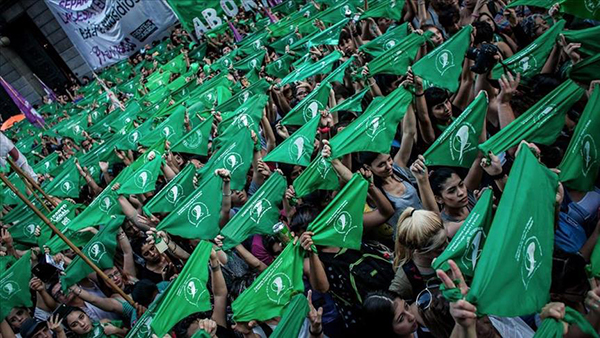
On the agenda of feminist movements in Argentina, we were one step away from achieving the approval of the Voluntary Termination of Pregnancy Bill. The impressive Green TideThe movement, which gained global visibility through its demands and political advocacy strategies, along with the national executive's explicit intention to promote debate in Congress, allowed us to foresee that in a short time we would have this law that grants us access to autonomy and the right to decide about our bodies, which Graciela Di Marco refers to as Sexual Citizenship.
The suspension of activities in the National Congress within the framework of social isolation policies postponed this debate and we have no certainty as to when it will resume; meanwhile, we observe how in some regions and provinces of our country access to Legal Interruption of Pregnancy is obstructed due to the lack of care and supplies to make it effective (misoprostol/Ameu).
It is important to clarify that Legal Interruption of Pregnancy (ILE) in our country has been permitted (Art. 86 CP) for 100 years, a fact ratified by the Supreme Court of Justice of the Nation in 2012 and by the Superior Court of Justice of our province in 2019. The provision of supplies for ILE treatments should come from the Provincial Sexual and Reproductive Health Program, either because it receives supplies from the National Ministry of Health or because it acquires them on its own, and in both cases, it should distribute them to provincial providers and municipalities.
The Campaign for the Right to Abortion in Córdoba and the Network of Professionals for the Right to Decide warn in a press release and a letter sent to the Ministry of Health and the Ministry of Women that, throughout 2020, and exacerbated by the pandemic, health institutions have lacked the medication Misoprostol. Healthcare teams supporting women who decide to terminate a pregnancy for health reasons (a priority during the pandemic) or due to rape face the dilemma of providing information without the necessary supplies to ensure the procedure is safe and not clandestine. Furthermore, there are localities where hospitals do not perform legal abortions and claim that their medical staff are "conscientious objectors," thus obstructing the right to abortion for health reasons by citing physical health reasons for granting requests for legal abortions, rather than taking a comprehensive approach.
In this context of prioritizing COVID-19 care, health institutions are readjusting their services and preparing for the disease without explicitly outlining new forms of care, referrals, and counter-referrals, especially in primary healthcare centers. This makes access to sexual and reproductive health care even more difficult in these communities, compounded by a lack of quantity, variety, and real access to the different contraceptive methods offered by the National Sexual and Reproductive Health Program. There is a scarce and intermittent supply of all methods, and significant systematic difficulties in performing tubal ligation. Women, in particular, wander from institution to institution in search of these services, increasing their risk of exposure to the pandemic, or they neglect their own health. Recently, a young woman suffered a miscarriage, and when her family requested an ambulance, the police arrived to rule out COVID-19. She is currently hospitalized in serious condition due to a lack of timely care.
The efforts of social organizations and healthcare professionals to find alternative support strategies continue. However, these communication channels are not always accessible or appropriate, especially for women living in poverty. It's also worth noting that most of those leading these efforts are themselves women experiencing the same exceptional circumstances.
The tension and action generated by the feminist movement in its fight for these rights, with its massive demonstrations and political advocacy strategies targeting legislators and officials, are currently suspended. In response, in many areas where religious conservatism has an active presence in the healthcare system and access to justice, these groups are exerting pressure to impose their practices.
To all this, it is necessary to add the inequality of women in relation to caregiving, domestic work, and a special paragraph is warranted for the elderly and the discourse of terror and death in the face of the pandemic for this population group.
Nevertheless, we believe this is a time of great challenges regarding the State's social intervention in conjunction with society, its organizations, and feminist spaces. While we are currently experiencing a period where the field of health is predominant, we believe that both health and illness are social processes, and therefore the social dimension must be included in the pandemic response to the many facets of inequality.
The statistical figures needed in epidemiological terms do not necessarily reflect the unique experiences of women and LGBTQ+ groups in their daily lives.
Care and prevention related to the Covid-19 pandemic must be considered holistically and within specific contexts, ensuring adequate spaces, resources, mechanisms, and support for addressing and preventing violence, access to contraceptive methods and legal abortion services, and comprehensive healthcare networks for women and professionals working in contexts of suffering, violence, precariousness, and poverty. In this context of a health emergency, patriarchal violence appears to be particularly vicious against women and gender and sexual minorities, with an increase in domestic, institutional, and obstetric violence.
It is the State and its institutional and material resources that must be alert to monitor and demand that public policies related to sexualities can be accessible because they are part of the comprehensive health of women.
The presence of the State, with its multiple forms of assistance for all sectors (Universal Child Allowance, emergency income support, loans for SMEs, etc.), sets a horizon for continued post-pandemic planning and development. Today, we understand that, in terms of intervention, it is necessary to revisit certain opportunities related to:
-Accessibility to public services and material and symbolic resources to realize social rights of citizenship.
-Transversality: that, through an organizational perspective, the State enters into dialogue with society and territorial organizations to assist and support citizens, especially when community isolation is proposed in response to the situational diagnosis of poverty. Issues that go beyond the health leviathan, police control mechanisms, and religious shelters.
-Intersectionality: thinking about class, sexual orientation, ethnicity and generational factors is an imperative of these times to build policies linked to equality and recognition.
[1] Faculty of Social Sciences – ETS/UNC. Faculty of Law and Social Sciences – National University of Córdoba. Argentina. Working Group on Anti-Patriarchal Struggles, Families, Gender, Diversity and Citizenship
If you would like to receive more information about CLACSO's training programs:
[widget id=”custom_html-57″]
to our email lists.

