
Anti-capitalisms and emerging sociability
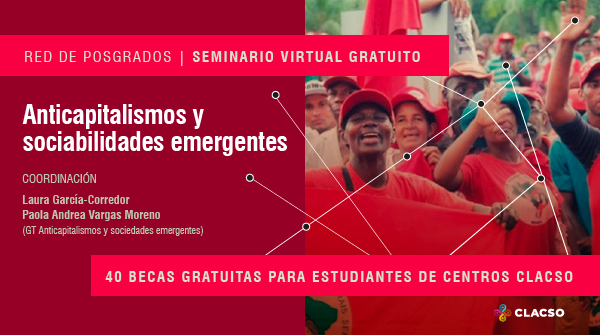
Seminar 2036
Chair: CLACSO
Coordination: Laura García Corredor and Paola Andrea Vargas Moreno (GT Anticapitalisms and emerging sociabilities, CLACSO)
Teaching team: Laura García Corredor, Paola Andrea Vargas Moreno, Pablo Ariel Becher, Alexander Maximilian Hilsenbeck Filho, Blanca Soledad Fernandez, Rodrigo Chaves de Mello Rodrigues de Carvalho (GT Anticapitalisms and Emerging Sociability, CLACSO) and Cassio Brancaleone (Universidade Federal da Fronteira Sul, Brazil)
Start: 06/15/2020 | Registration: 05/15/2020 to 06/14/2020
Workload: 12 weeks – 90 hours.
Tuition scholarships – Free seminar
CLACSO will award 40 scholarships to students from CLACSO Member Centers to attend the seminar. The scholarships cover 100% of the tuition fees.
Applications will be submitted through the CLACSO website.
For applications:
- Enter here and complete the information requested on the form.
- The available scholarships (40) will be assigned to students from CLACSO Centers taking into account gender equity and regional balance.
- Once your scholarship is confirmed, you will receive the necessary information to begin the course.
Based on the systematization of some of the debates accumulated by the Working Group on Anticapitalisms and Emerging Sociabilities (ACySE/CLACSO), we propose the virtual postgraduate seminar "Anticapitalisms and Emerging Sociabilities: Debates and Horizons of Possibilities" with the objective of interpreting and problematizing the meanings and challenges of some Latin American organizational experiences that are distinguished by proposing the construction of alternative, challenging and questioning spaces in the face of capitalism, while at the same time we intend to introduce the main theoretical debates around the critique of contemporary capitalism in Latin America and the Caribbean.
Thus, we aspire to approach the vicissitudes of an “anti-capitalist” conception, exposing what assumptions are engendered under this view and analyzing social experiences that, through their organizational attributes, bear witness to specific exchanges that allow us to speak in anti-capitalist terms.
We will explore social relations that can be considered a threat to the dynamics of accumulation, domination and exploitation in force, and that in that sense, can point towards horizons of emancipation or possess emancipatory potentialities, what we call emerging sociabilities.
- Investigating collective actions, disruptive dynamics and processes of social change: Proposals and itineraries (based on experience) of the Anticapitalisms and Emerging Sociabilities Collective ACySE
- Social movements in Latin America: Reflections for an anti-capitalist approach
- Dilemmas and challenges of social movements (MST and MTST)
- Paths towards an anti-capitalist education: 1. Educational commitments to intercultural higher education in Ecuador and Mexico.
- Special Activity I “LET'S NOT LIVE LIKE SLAVES”
- Collective action and studies on social conflict: keys to understanding movements from an anti-capitalist perspective and from emancipatory thought
- From Brazil in 2013 to the present day (A brief critical overview)
- Paths towards an anti-capitalist education 2: Education, Law and sexual-gender-affective diversities
- Special Activity II. Gender, race and intersections: Indigenous, Afro-descendant and migrant perspectives
- Academic research and social activism: Ideas and scenarios for anti-capitalist struggles at the beginning of the 21st century
- Adamovsky, Ezequiel et al. Thinking about autonomies. Alternatives for emancipation from capital and the state. Mexico: Bajo Tierra/Sísifo, 2011.
- ANTUNES, Ricardo; BRAGA, Ruy. THE DAYS THAT ABALARAM O BRASIL: as rebellions of June, July 2013. Public Policy Magazine, São Luís, Special Issue, p. 41-47, July 2014.
- AVRITZER, Leonardo. The pendulum of democracy in Brazil - An analysis of the crisis 2013–2018. Novos Estudos, CEBRAP, São Paulo, V37 n02, p. 273-289. mai.-aug. 2018.
- BRAH, Avtar (2011). Introduction. Cartographies of the Diaspora. Identities in Question. Madrid: Traficantes de sueños.
- Brancaleone, Cassio and Chaguaceda, Armando (2012), “A modo de introducción”, in Chaguaceda, A. and Brancaleone, C. (Comps.) Emerging Sociabilities and Social Mobilizations in Latin America, Universidad Veracruzana, CLACSO, Buenos Aires.
- Brancaleone, Cassio. “Sociability as a conceital construct and meaning of emerging sociability.” em: social theory, democracy and autonomy. An interpretation of the Zapatista experience of self-government. Rio De Janeiro: Azougue, 2015.
- Castillo, Mario and Gamboa, Ronny. “The link between education and gender”, in Electronic Journal “Current Research in Education”, vol.13, no. 13, (2013): 1-16.
- ACYSE Collective. “Anticapitalisms & emerging sociabilities: notions under construction”. in: Chaguaceda, Armando & Brancaleone, Cassio (eds.). Emerging Sociabilities and Social Mobilizations in Latin America. Buenos Aires: CLACSO, 2012.
- Cook, Rebecca & Simone Cusack, Gender Stereotypes. Transnational Legal Perspectives, Bogotá: Profamilia, 2010, 11-53.
- De Sousa Santos, Boaventura (2001), “The new social movements”, in OSAL
- Fernández Alvarez, MI, Manzano, V., Pautasso, M., and Triguboff, M., (2010), “Studies on social mobilization: academic traditions and theoretical approaches”, in Pereyra, B. and Vommaro, P. (Comp.) Social movements and human rights in Argentina, Buenos Aires, Ed. Ciccus, pp: 131-156.
- FERNÁNDEZ, B. (2015) “Contributions of contemporary indigenous intellectuals to the construction of the nation in Ecuador” in Blanca Fernández, Florencia Puente, Armando Chaguaceda and Paula Camara (coords.) Prefiguring the political. Counter-hegemonic disputes in Latin America. El Colectivo/Último Recurso/CLACSO: Buenos Aires.
- Garcés, F. (2009). "From interculturality as a harmonious relationship of diverse elements, to a politicized interculturality" In: Mora, D. Critical interculturality and decolonization. La Paz, Bolivia: III-CAB. pp. 21-49.
- GARCIA CORREDOR, Laura (2015). Stereotypes and social representations of Afro-descendant women. In Camara, P. Chaguaceda, A. Fernández, B. and Puente, F. Prefiguring the political. Counter-hegemonic disputes in Latin America. CLACSO. Editorial El Colectivo.
- Gómez, Marcelo (2017), “Class analysis, social movements and antagonism: emerging from theoretical paralysis”, in Theomai Journal, Critical Studies on Society and Development, no. 35
- GOULART, Deborah. The Homeless Workers' Movement in Brazil: A History of Threatened Autonomy. Thinking about Autonomies. Alternatives for Emancipation from Capital and the State. Volume 2. Alicia Hopkins and César Enrique Pineda (Compilers). Mexico: 2019.
- HILSENBECK FILHO, Alexander Maximilian. Or take back the streets and the dilemmas in the struggles: social movements in the times of governments originating from the left. Lutas Sociais, São Paulo, vol.17 n.31, p.97-110, jul./dez. 2013
- MACHADO, D. and ZIBECHI, R. (2016) “Epilogue. Crossroads of critical thought and crisis of intellectuals”. In Changing the world from above. The limits of progressivism. Santiago de Chile: Quimantú
- Machado, Eliel (2014), “Contributions to a Marxist political theory of social movements”, Revista Demarcaciones, (2), pp: 86- 101.
- MANEIRO, M. (2011) Academic research and political activism. Contributions to the discussion within the framework of the Second meeting of the Working Group on Anticapitalisms and emerging sociabilities [mimeo]
- Mato, D. (2008). Cultural diversity and interculturality in higher education. Problems, challenges and opportunities in Latin America. In: Mato, D. (coord.) Cultural diversity and interculturality in higher education. Experiences in Latin America. (pp. 21-79). Caracas: IESALC-UNESCO.
- MOHANTY TALPADE, Chandra (2008). Back to "Under the Eyes of the West": Feminist Solidarity Through Anti-Capitalist Struggles. Decolonizing Feminism: Theories and Practices from the Margins / coord. by Liliana Suárez Navaz; Rosalva Aída Hernández Castillo (aut.), ISBN 978-84-376-2469-3, pp. 407-464.
- PASSA PALAVRA. Enter the fire and panela: social movements and bureaucratization.
- Salgado Álvarez, Judith. Manual de formación en género y derechos humanos, Quito: Universidad Andina Simón Bolívar / Corporación Editora Nacional, 2013, 19-46.
FAQ
The basic requirements for taking a seminar are:
- Availability of at least 4 hours per week to dedicate to the seminar course.
- Internet access.
- Reasonable handling of communication and computer tools.
- Language proficiency in the language in which the course will be taught. The official languages are Spanish and Portuguese.

