
Historical background of public policy on violence against women
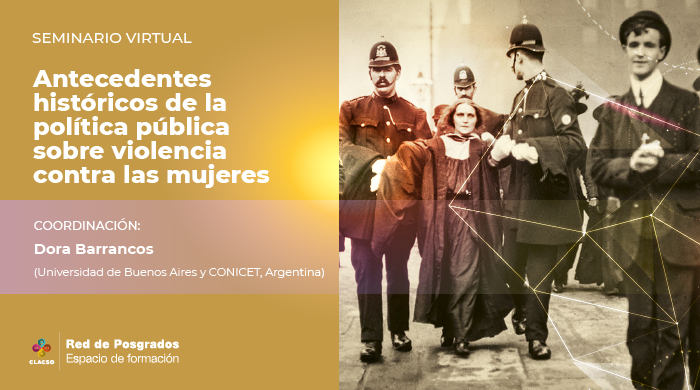
Seminar 2213
ChairCLACSO
Coordination: Dora Barrancos (University of Buenos Aires and CONICET, Argentina)
Home: 20/04/2022 | Registration: 20/12/2021 to 19/04/2022
Workload: 12 weeks – 90 hours.
This seminar examines the recent conceptualization of violence against women and the role of feminist movements in its creation and struggles to eradicate it. Throughout the 20th century, Latin American feminist movements achieved various reforms that increased women's rights, but the conceptualization of violence against women is a recent development. When examining the initial feminist agenda, it is surprising to find a challenge to the criminal law that, in all our countries, authorized the murder of a wife, daughter, or sister for reasons of honor or grief.
In some countries, such abhorrent authorizations gradually subsided with the introduction of the doctrine of "violent emotion," so often used to exonerate murderers. The groundwork of enormous conceptual and political renewal brought about by the so-called Second Wave of feminism, beginning in the mid-1960s—with a global reach—so profoundly altered the rights agenda that patriarchal violence took center stage. Although CEDAW—the Convention on the Elimination of All Forms of Discrimination against Women (1979)—made a significant contribution to overcoming discrimination and the obstruction of women's rights, and these phenomena cannot be understood outside the framework of violence, regional feminist demands to denounce the diverse manifestations of violence led to the Belém do Pará Convention in 1994. Signatory countries have been implementing legal reforms to comply with its mandate, but serious instances of backsliding and blatant non-compliance persist. In general, Latin American countries initially introduced legal norms related to so-called “domestic violence”—it should be noted that in the first phase of the feminist resurgence between the 1970s and 1990s, violence in the domestic sphere was the focus of attention. Only in recent years have “comprehensive laws” against violence against women emerged, and in many penal codes, the maximum penalties are extended to those who kill due to sexual dissidence and ethnic hatred.
GENERAL OBJECTIVES
• Understanding the contexts in which the emergence of women's rights advocacy programs can occur.
• To enable the understanding of the prevailing concept of “violence” as inherent in the patriarchal system.
• To interpret the background of the regulatory frameworks for addressing the scourge of violence in light of feminist conceptualizations and their transformative impulses on law
- Paradigms of Second Wave feminisms (1960-1999); conceptual and agenda contrasts with the first wave of feminist movements (mid-19th century to World War II)
- Patriarchy as a constitutively violent system. Origins, characteristics and recent transformations.
- The role of feminisms, the historical context and the emergence of CEDAW
- CEDAW ratification in Latin American countries and adherence to the Optional Protocol: delaying factors.
- From domestic violence to multidimensional violence. The Belém do Pará Convention: historical context, accessions and delays in the enactment of comprehensive laws against violence. Follow-up mechanism, MESECVI.
- Comprehensive laws against violence against women: legislation from selected countries
- United Nations pronouncements on human rights and women, and relating to gender-based violence. Istanbul Convention for the European Union.
- Background of litigation in the Inter-American Court of Human Rights for gender violence: the cases of the Miguel Castro Castro Prison (Peru), Maria da Penha (Brazil), “Cotton Field” (Mexico), and K. Atala Riffo and girls (Chile), “Véliz Franco” (Guatemala)
- Reflections on the debate surrounding punitive measures to eradicate violence. A segment of feminist jurists, particularly those belonging to the "abolitionist" group in criminal matters, argues against overly punitive measures.
Barrancos, Dora, A Brief History of Feminisms in Latin America, Mexico, COLMEX, 2020, INTRODUCTION
Scott, Joan, “History of Feminism”—Hojas de Warmi Yearbook, no. 14, 2009 (Published in: María Teresa Fernández Aceves, Carmen Ramos Escandón and Susie S. Porter (eds.). Social Order and Gender Identity: Mexico, 19th and 20th Centuries. CIESAS / University of Guadalajara, Mexico, 2006. Abstract and keywords CIESAS / University of Guadalajara, Mexico. The original English version of this chapter was published in Journal of Women's History, vol. 16, no. 2, 2004, pp. 10-
Offen, Karen, European Feminisms, 1700-1950, Madrid, Akal, 2015
Lerner, Gerda, The Creation of Patriarchy, Madrid, Crítica, 1986 – INTRODUCTION
Millet, Kate, Sexual Politics, Madrid, Cátedra, 1995
Talego Vázquez, Félix, Florido del Corral, David and Sabuco y Cantó, Assumpta (2012) “Reconsidering male violence, patriarchy, couple relationships and sadism”, Revista Andaluza de Antropología, n°3, pp 183-207
United Nations (1979), Convention on the Elimination of All Forms of Discrimination against Women.
Kirkwood, Julieta (1985) “Feminists and Politics”, NUEVA SOCIEDAD NO. 78 JULY-AUGUST, PP. 62-70
Vargas, Virginia (1999) “Between exclusion and citizenship”, Latin America in Motion
Bareiro, Line Between equality and de facto discrimination - ECLAC - Project Documents, Santiago de Chile, (2017)
ECLAC (2011), The leap of autonomy from the margins to the center. 2011 Annual Report of the Gender Equality Observatory of Latin America and the Caribbean (LC/W.436), Santiago, Chile
United Nations (1999), “Optional Protocol to the Convention on the Elimination of All Forms of Discrimination against Women”.
ARGENTINE REPUBLIC - DECREE 679/2020 and Annex ON CEDAW/ FRIENDLY SETTLEMENT AGREEMENT
Mejía Guerrero, Luz Patricia, The Inter-American Commission of Women and the Belém do Pará Convention. Impact on the Inter-American Human Rights System, IIDH Journal, V.56: 189-213, 2012
OAS (1994). Inter-American Convention on the Prevention, Punishment and Eradication of Violence against Women – Belém do Pará Convention -
OAS (2004) Conference of States Parties to the Follow-up Mechanism for the Implementation of the Inter-American Convention on the Prevention, Punishment and Eradication of Violence against Women – Convention of Belém do Pará – Washington 23/10/2004 – Rapporteur's Report
|
|
Discount for one payment until 16/03 |
In one payment after 16/03 |
|
CM Plenos |
$75 |
$150 |
|
CM Associates |
$95 |
$190 |
|
No link |
$95 |
$190 |
FAQ
The basic requirements for taking a seminar are:
- Availability of at least 4 hours per week to dedicate to the seminar course.
- Internet access.
- Reasonable handling of communication and computer tools.
- Language proficiency in the language in which the course will be taught. The official languages are Spanish and Portuguese.
|
|
Discount for one payment until 17/04 |
In one payment after 17/04 |
|
CM Plenos |
$75 |
$150 |
|
CM Associates |
$95 |
$190 |
|
No link |
$95 |
$190 |

