
Statistical analysis applied to social research
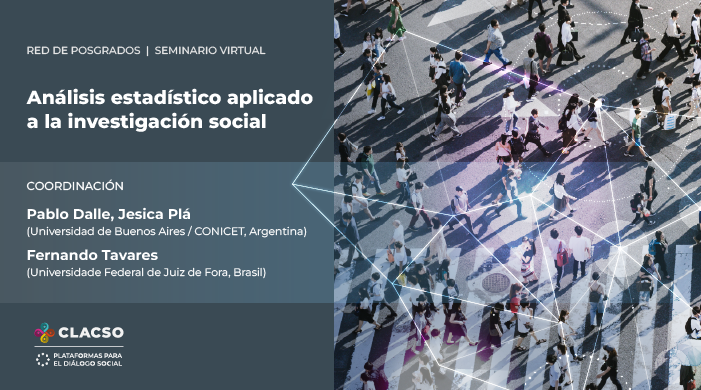
Seminar 2330
Chair: CLACSO
Coordination: Pablo Dalle, Jesica Plá (University of Buenos Aires / CONICET, Argentina) and Fernando Tavares (Federal University of Juiz de Fora, Brazil)
Home: 02 / 10 / 2023 | Registration: 08/08/2023 al 01/10/2023
Workload: 12 weeks – 90 hours
The seminar aims not only to provide theoretical knowledge about statistical tools and their potential uses, but also, and especially, to offer practical exercises so that students can develop research skills. In this regard, one of the central focuses is the active participation of students to cultivate critical thinking and a reflective approach to decision-making regarding the application of statistical tools in their research designs.
We begin with a pedagogical approach that considers students' prior knowledge as the starting point for the teaching-learning process and as the basis for selecting activities. It is not only necessary to understand the prior ideas or "preconceptions" that students have about certain processes, but also to understand the cognitive structures they use to think about these issues, the interpretive frameworks they employ when understanding the processes presented in the classroom. From this perspective, to gain confidence in using statistical models, the course proposes a final project in which students analyze a research problem within their field of study of interest, applying some of the techniques covered in the seminar to answer the research questions.
The classes cover the entire program content through lessons that include theoretical content and practical exercises.
- Types of variables according to level of measurement. Descriptive statistics. Univariate analysis (part 1): Percentages, rates and ratios.
- Univariate analysis (part 2): Measures of position and central tendency.
- Measures of dispersion. Normal curve: assumptions and usefulness.
- Contingency table analysis
- Inferential statistics. Probability theory. Estimation of means and probabilities. Analysis of variance. Hypothesis testing.
- Analysis of association between categorical variables: Test of independence (chi-square). Analysis of relative chances (odds ratio).
- Correlations, simple linear regression models
- Correlations, multiple linear regression models
- Binary logistic regression (simple and multivariate).
- Introduction to factor and principal component analysis
- Archenti, N. (2007). “The process of analyzing three categorical variables”, in A. Marradi, N. Archenti and JI Piovani Methodology of the Social SciencesBuenos Aires, Emecé. Chapter 16 (pages 279-298).
- Baranger, D. (2000). Data construction and analysisMissions: University Press/ Chair.
- López-Roldán, P. and S. Fachelli, (2015) Factor analysis. In P. López-Roldán and S. Fachelli, Methodology of Quantitative Social Research. Bellaterra (Cerdanyola 236 del Vallès): Dipòsit Digital de Documents, Universitat Autònoma de Barcelona. Selection of parts.
- Ritchey, FJ (2002). Statistics for the social sciences. The potential of statistical imaginationMexico City: McGraw-Hill.
- Sánchez Vizcaíno, G. (2000). “Logistic Regression”, in Data Analysis Techniques in Market Research. Madrid: Ediciones Pirámide.
- Sautu, R. (2003).It's all theory.. Research objectives and methodsLumiere Editions.
|
|
Discount for one payment until 28/09 |
In one payment after 28/09 |
|
CM Plenos |
$75 |
$150 |
|
CM Associates |
$95 |
$190 |
|
No link |
$95 |
$190 |
FAQ
The basic requirements for taking a seminar are:
- Availability of at least 4 hours per week to dedicate to the seminar course.
- Internet access.
- Reasonable handling of communication and computer tools.
- Language proficiency in the language in which the course will be taught. The official languages are Spanish and Portuguese.
The seminars last 12 weeks, plus the completion of a final project. A total of 90 hours of dedication will be credited.
A course consists of twelve classes, each accompanied by required reading bibliography, supplementary bibliography, discussion forums and training activities proposed by the teaching team, partial deliveries and a final project.
The course is online and asynchronous. Some instructors may propose synchronous activities. In those cases, the time and date will be agreed upon beforehand between the teaching team and the students to ensure everyone's participation.
To pass the seminar, you must participate in at least 80% of the discussion forums and activities proposed by the teachers, have completed the scheduled partial deliveries, and pass the final work.
|
|
Discount for one payment until 28/09 |
In one payment after 28/09 |
|
CM Plenos |
$75 |
$150 |
|
CM Associates |
$95 |
$190 |
|
No link |
$95 |
$190 |
The possible payment methods are credit card, bank transfer and bank deposit.

