
To broaden the horizons of educational proposals and social research

“ Of the many ways to refer to those of us present here, I choose today to use the words cultivated by José Martí: Our America—a continent possessing immense biodiversity, inhabited by vibrant cultures, and united by peoples in solidarity—is today profoundly marked by the shadow of the pandemic crisis and the uncertainties of post-pandemic reconfigurations. We are facing an inequality unprecedented in the history of humankind. As various studies have shown, the wealth of those who possess the greatest fortunes in the world has increased—in 2020 alone—by a scandalous 24%. Indeed, the era we live in is marked by such abysmal inequality that a mere handful of people accumulate more wealth than 60% of the world's population.”
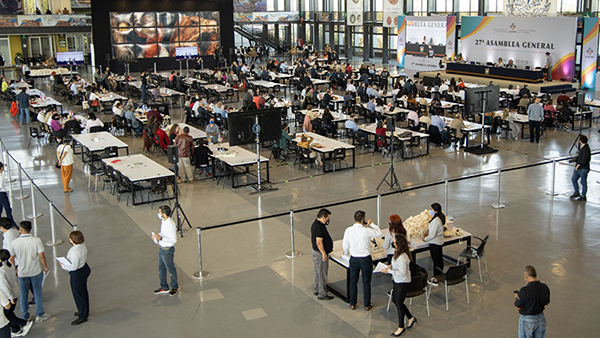
With those words, Karina Batthyány opened the management report of the XXVII Ordinary General Assembly of the Latin American Council of Social Sciences on the afternoon of Sunday, June 5, at the UNAM Exhibition and Congress Center in Mexico City.

Present are members of the Steering Committee, the Executive Secretariat and delegates from Member and Associate Centers from different countries who, with their participation and vote, are called to mark the course of the future for the next three years of the Latin American Council of Social Sciences, which, in this year 2022, celebrates 55 years of existence.

After a detailed review of her three and a half years in office, Karina Batthyány stated that “this crossroads compels us to revise and build our agendas of priority issues, organized around a program of critical reflection and strategic actions, in which all social sectors participate. This program is based on an interdisciplinary and multidisciplinary approach, drawing on the diversity of the social sciences and humanities, as well as interaction with other sciences and other forms of knowledge. This requires broadening the horizons of educational proposals and social research, as well as reinventing and consolidating spaces for academic, political, and social encounters beyond the traditional ones. All of this implies a reaffirmation of the social sciences in their critical and transformative potential.”
He then added that “the Council is a living network with a wide reach, because as a network of networks it has consolidated its work from a pluralistic, integrative, inclusive and diverse vision within the framework of the commitment to social justice, equality, democracy, human rights, essential elements to address reality, analyze its implications and visualize its trends in perspective.”
She concluded her remarks by thanking “the members of the Steering Committee, the entire Executive Secretariat team, the Member Centers, and the Working Groups for their commitment and ongoing efforts, especially during these times. All of us at CLACSO have demonstrated great adaptability to these new times, with a strong willingness to adapt and by redoubling our work and contributions.”

The directors of CLACSO areas also presented their management reports: Pablo Vommaro , Research; Nicolás Arata , Training and Knowledge Mobilization; Fernanda Pampín , Editorial Production; Gustavo Lema , Communication and Information; and Laura Gastón , Administration.

The report and balance sheet were then debated and, after important interventions by assembly members present, were approved unanimously.
The XXVII Ordinary General Assembly of CLACSO will continue on Monday, June 6, for, among other resolutions, the election of the Executive Secretary and the members of the Steering Committee for the period July 1, 2022 to June 30, 2025.

Earlier, on the morning of June 5, the Extraordinary General Assembly was held, which approved the reform of the CLACSO Statutes . The update, stated Karina Batthyány, “will allow the network's structure to become more agile, participatory, balanced, and dynamic.”

If you would like to receive more information about CLACSO's training programs:
[widget id=”custom_html-57″]
to our email lists.

