
Latin America: It's time to recover the sense of community
Milton Gabriel Hernández García1
Stay at home!
¡Asï jama Ueakuni!
In the Purépecha language.
Stay at home!
Gi nth´ui ka ng´!
In the Otomi language.
This is not the first time that the Indigenous peoples of Latin America have faced a threat of such magnitude as epidemics and pandemics. Their history of conquest and colonization is marked by such events. However, the specific conditions under which they will wage this battle are different, as they are profoundly shaped by the unequal development of capitalism on a global scale and by the various state manifestations of the neoliberal model. These manifestations have, over the past four decades, deepened impoverishment, marginalization, the dispossession of lands and territories, the loss of self-sufficiency and food sovereignty, and the proliferation of comorbidities that have further jeopardized their health.
In Latin America, the hegemonic model has relegated Indigenous peoples to the periphery of the periphery, and it is from this position that they will wage the battle against COVID-19. In this asymmetrical war, the community and communal action once again become the trench from which actions of containment, defense, and self-preservation are forged. In some cases, this is done in conjunction with the state; in others, independently of the state.
The alarm bells are ringing. Many voices have insisted that the effects of the pandemic in Latin America are compounded by ethnic, gender, and class contradictions. A few days ago, the United Nations Expert Mechanism on the Rights of Indigenous Peoples (EMRIP) pointed out that they will be the ones who “will suffer disproportionately” from the impacts of COVID-19, mainly due to the precariousness in which they already lived before the start of the health crisis. This precariousness has deep historical roots. This UN body went further, noting that vulnerability will be even more pronounced among those individuals, communities, and Indigenous peoples who, due to various circumstances, are far from their communities, whether they are migrants in impoverished urban peripheries, refugees, or internally displaced persons due to violence. Equally serious at this time is the condition of the Amazonian peoples who live in voluntary isolation or those who, having established contact with regional society and the State, have decided to isolate themselves again to protect their health.
For its part, the Fund for the Development of Indigenous Peoples of Latin America and the Caribbean (FILAC) pointed out that in the face of COVID-19, Latin America presents “an additional challenge, as a large part of the population lives in conditions of extreme vulnerability, including primarily Indigenous Peoples. These conditions translate into high rates of malnutrition, inaccessibility to health services, precarious infrastructure, and low visibility.” At the Latin American level, it identifies four vulnerabilities that directly affect Indigenous Peoples: a) those living in voluntary isolation have much more fragile immune systems in the face of external pathogens; b) those living in urban centers are often located in marginalized neighborhoods, without access to basic water or sanitation services; c) many Indigenous Peoples lost or weakened their traditional ways of life, changing their dietary patterns, which led to a change in their epidemiological profiles and the emergence of new diseases such as diabetes, high blood pressure, gastric dysfunctions, cancer, among others; (yd) In many regions of the continent, mainly in lowlands, it is facing a severe epidemic of dengue and malaria, which already affects indigenous communities.
It is true that vulnerabilities are numerous and have accumulated throughout history, but faced with a potentially devastating threat, Indigenous peoples are testing or rediscovering organizational practices to preserve life, placing the reproduction of community at the center as a space of refuge and protection. In this context, their own forms of social organization, family farming, ancestral knowledge, and territorial control are playing a fundamental role in the capacity for collective self-care. For example, in Colombia, where the Territorial Monitoring System of the National Indigenous Organization has reported that 67% of Indigenous territories lack state medical services and 90% lack potable water, many Amazonian and non-Amazonian Indigenous communities have decided to adopt a policy of voluntary isolation or territorial reservation. However, only 30% of them have enough food to withstand this period, the duration of which is uncertain.
An important example of socio-territorial organization for protecting communities is that of the 127 traditional authorities of the Regional Indigenous Council of Cauca (CRIC), who on March 17th declared themselves in a “permanent Minga for the Protection of Life, Health, and Well-being in the Indigenous Territories of the Department of Cauca, through their own systems.” This collective action involves not only intensifying the spiritual life of the communities but also strengthening territorial control processes, prohibiting the entry of visitors for any purpose, whether to tourist areas, productive sites, or sacred spaces. The CRIC's own structures declared a state of cultural, territorial, economic, and health emergency. Each traditional authority must coordinate with their community to define mechanisms that regulate the entry and exit of community members, preventing unnecessary departures from their territory. They also raised the need to “maintain and expand their own economy, based on local production and the recovery of ancestral productive and food practices.”
Four vulnerabilities directly affect indigenous peoples:
a) those in voluntary isolation have weakened immune systems against external pathogens;
b) those who live in urban centers usually inhabit marginal neighborhoods, without water or sewage services;
c) Many indigenous peoples changed their eating patterns, which led to the emergence of diseases such as diabetes, hypertension and gastric dysfunctions, among others;
d) In many regions, mainly in lowlands, it is facing a severe epidemic of dengue and malaria.
In Mexico, numerous towns and communities have organized themselves to confront the pandemic, taking as a reference the general measures dictated by the federal government, but at the same time exercising their right to self-determination and autonomy. In Sonora, on March 18, the Seri or comca'acThrough their traditional authorities, they announced on social media that the indigenous inhabitants of this town would not be allowed to leave their ejido and communal territory for the duration of the emergency. Furthermore, it was announced that from that moment on, no outsiders (cocsar or mestizo) could enter. To prevent this, detachments of the Traditional Guard were stationed at the entrances to the two Seri communities, Punta Chueca and Desemboque. The measures include the suspension of tourism and the sale of seafood. The Traditional Governor established extremely strict measures because he knows that the population comca'ac It poses a significant risk, as a high percentage suffer from diabetes and hypertension. In addition to these measures, “we are burning sage and chanting to ward off the virus. For food, we are going back to the past, gathering desert fruits and fishing in the sea for self-sufficiency.”
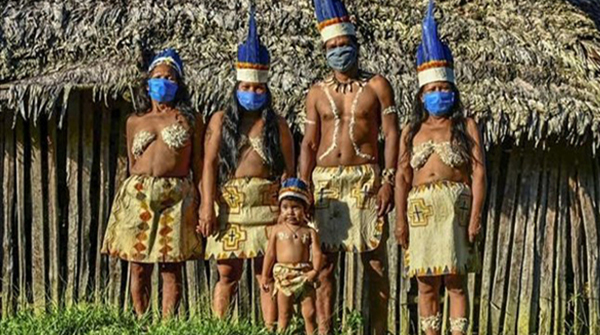
For Indigenous peoples, staying home means staying in the community. Home extends beyond four walls; it's the network of relationships woven into the fabric of daily life, extended family, and community roles. Staying home means standing guard at a checkpoint to block outsiders, going beyond the recommendations of health authorities. It seems clear to me that, at this moment, Indigenous peoples are taking these measures not against the State, but because they understand that if COVID-19 reaches them, their chances of fighting it are far worse than those of people living in cities, who, for better or worse, have greater access to the public health system and the hospital infrastructure that, for decades, was undermined by the corrupt, neoliberal order. The same order that left the country littered with more than 300 ghost hospitals, cynically inaugurated by the governor or president in office. That is why the challenge is immeasurable, and indigenous peoples face it with what they have and have always had at hand: community life.
1- Mexican journalist
If you would like to receive more information about CLACSO's training programs:
[widget id=”custom_html-57″]
to our email lists.

