
Latin America in a context of growing geopolitical disputes
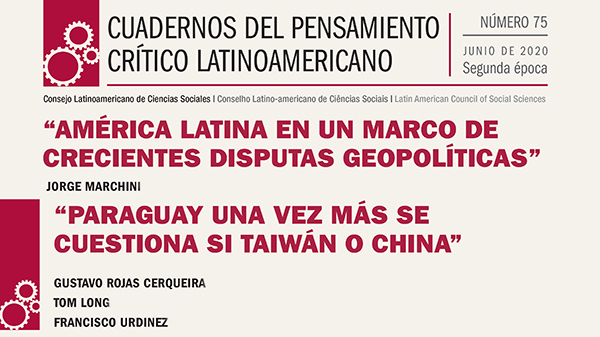
Within the "Latin American Critical Thought Notebooks" collection, CLACSO presents two research projects: "Latin America in a Context of Growing Geopolitical Disputes" by Jorge Marchini, and "Paraguay Once Again Questions Whether Taiwan or China" by Gustavo Rojas Cerqueira, Tom Long, and Francisco Urdinez.
LATIN AMERICA IN A CONTEXT OF INCREASING GEOPOLITICAL DISPUTES
Jorge Marchini
Member of the CLACSO Working Group on “Regional Integration and Latin American Unity.” Holds a degree in Economics from the University of Buenos Aires (UBA). Currently, he is a tenured professor of Economics, Common Basic Cycle, Faculty of Economic Sciences, UBA. Vice President of the Foundation for Latin American Integration (FILA).
The world faces enormous structural changes whose evolution is both highly significant and very uncertain. The deepening of geopolitical disputes is a sign of a changing era. The growth of dangerous tensions is evident, the most notable of which in recent times has been the escalating series of tariff and countermeasures on imports between the United States and China, which were unforeseeable just a short time ago.
Within this context, the contradiction is striking: while the undeniable benefits of interconnected societies through new forms of production and the significant improvement in communications and transport logistics thanks to rapid technological advancements continue to be highlighted, the development gap between core and peripheral countries is widening, and economic concentration and the prevalence of transnational corporations and investment models have intensified. This, of course, generates tensions and questions within society that, as is increasingly recognized, cannot be resolved simply by relying on the automatic adjustment and equilibrium mechanisms of the markets.
One of the most important questions is whether the historical objective of regional integration through active public policies, initiatives, and Latin Americanist institutions can still be a valid aspiration and reference point for development, cooperation, and complementarity among Latin American countries (Marchini, Kupelian, Urturi, and Wierzba, 2013). Hence the need to analyze the alternatives (conditions, advantages, and weaknesses) for jointly addressing the exacerbation of problems within a new, complex historical framework that also calls for significant international strategic repositioning.
In recent decades, Latin America has experienced significant shifts in its political and economic landscape. The "lost decade" of the 80s culminated in debt crises and hyperinflation that dashed genuine hopes for improvement following the restoration of democracy after dictatorships. The 90s, which promised to place the region at the "forefront of the world" due to the rise of neoliberal governments, ended with disastrous economic, financial, and social disruptions. The new century of the 2000s, after an initial period of painful adjustments and restructurings, ushered in a hopeful era, marked by the emergence of anti-neoliberal "popular" governments that emphasized the need to unite the region and restore the role of the state in addressing social debt, as well as by exemplary sustained economic growth, comparable only to Asian countries. But without a doubt, this cycle has changed abruptly in recent times.
Once again, the “irremediable crisis of Latin America” is being discussed in international academic circles (Campos Herrera-Umpierrez, 2019). Confusion and questions are multiplying: What has happened? Is it simply an inevitable and unfathomable fate of repeated cycles of boom and bust that seem to recur irrevocably every decade? What new debates and analyses are needed?
On the economic front, the overall challenge is the need to re-examine the relationship with the old dilemmas of peripheral development (Prebisch, 1968). It is once again essential to question whether it is possible to overcome the historical prevalence of Latin American countries' global specialization in the exploitation and export of primary products—and/or products of low industrialization—and the repetition of a cycle of negative balance of payments, coupled with their parallel subordination to international capital flows that make them highly dependent and vulnerable to external crises.
Globalization is not what it used to be
While the initial negative effects of the 2007/2008 global crisis were felt primarily in the core countries most exposed to the bursting of a speculative bubble and the magnitude of unpayable loans, subsequent developments quickly shattered the illusion that arose at the crisis's outset: that the leading commodity-producing countries might have, for the first time, "decoupled" from an international crisis (Wylde, 2012). It was not promptly assessed that growth had been driven by exceptionally positive, but unsustainable, conditions in the global market, circumstantially linked to a surge in demand from new Asian markets. This surge was largely based on artificial credit growth with sophisticated, highly speculative reinsurance, which would ultimately lead to a broader crisis.
The illusion that the structural problem, repeatedly articulated by economic thinkers from the periphery, of negative terms of trade for primary products could have been definitively reversed by the rise of new emerging economies, was shattered by subsequent developments. Especially since 2012, Latin America's vulnerability to falling commodity prices has become evident. commodities Exports (oil, food, minerals, etc.) are already facing uncertainty and pressures stemming from dependence on short-term credit flows and capital inflows, especially given the growing balance of payments deficits across the region. These difficulties have affected each country differently, depending on its specialization and the political and social reactions to the abruptly negative economic cycle (ECLAC, VA).
The stark reality is that the serious problems and imbalances persisting in the global economy have become evident, deepening regional vulnerability. Increased globalization and market liberalization have not guaranteed continued growth; on the contrary, they have become a source of growing difficulties and even greater imbalances in recent years. This vulnerability is heightened because peripheral economies are more exposed due to capital's risk aversion during a period of uncertainty. Public debt has increased sharply to compensate for imbalances and capital flows, and volatility, facilitated by extensive international financial deregulation, has not been reversed in recent years but has, in fact, intensified (Bari and Gallagher, 2015).
Uncertainty is heightened by the increasingly complex framework of globalization, as there is a lack of national or regional autonomy to strengthen economies by rebalancing the relationship between their internal and external dynamics. This vulnerability has been exacerbated by dependence on declining export markets and unstable foreign capital. The need for new mechanisms to address the major trade and financial imbalances that cannot be resolved through automatic market adjustments has been raised, albeit in a limited way, in discussions within international organizations (Marchini, 2015).
The equilibrium achieved and the post-crisis consultation and coordination mechanisms are still provisional and limited. Differences and tensions persist and continue to be addressed on a case-by-case basis with the IMF's usual adjustment measures. There is also no clarity on how to establish an independent position in the face of unprecedented geopolitical confrontations in a world also facing uncertain changes and delicate general conflicts that are beginning to affect, albeit initially indirectly, the global economy.
For peripheral countries, such as all those in Latin America – including larger countries like Brazil, Mexico, and Argentina – the debate is indeed open regarding their international role and their capacity, or lack thereof, to pursue alternative strategies and common positions to develop a differentiated perspective that involves not continuing to be merely tributaries of conditions and interests outside their purview, but rather becoming active actors and participants in determining their destiny with an agenda that aligns capabilities and efforts with their democratic priorities.
It is not to be expected that in a world with shrinking major markets, increased protectionism in some countries, and reduced capital flows to increasingly indebted peripheral markets, the countries of the region will recover the growth rates they achieved just a few years ago. Forecasts that asserted that economies would achieve a permanently upward trend during a period of greater liberalization have been wrong. It is therefore essential to recognize the need for a realistic and differentiated perspective, strengthening complementary ties that address, rather than exacerbate, imbalances and asymmetries.
Understanding protectionist keys
Diverse opinions and interpretations exist regarding the reasons for the recent slowdown in global trade. One perspective emphasizes that the decline in momentum simply reflects the end of the period of rapid integration of China and Eastern European countries into the capitalist economy, having already completed the most expansive stage of urbanization and productive re-specialization in relation to the global market (Hofman and Kuijs, 2015). Another explanation attributes the phenomenon to the shift in the composition of global trade towards products with lower demand elasticity (WTO, 2016). A third perspective focuses on the technological changes already underway in industrial manufacturing, which are enabling the decentralization of complex production processes into independent units (e.g., 3D printers, additive manufacturing) (Lipson, 2011). Finally, one factor, which is understood to be of increasing influence, was the recognition of the existence of a growing tendency of governments to support local manufacturing and substitute imports in the face of balance of payments restrictions, thus reducing the incentives for the export of products and services by companies and individuals (Keithley, 2015).
The slower pace of value chains leads to less movement in international trade, as the significance of transactions involving parts (accounted for upon import to manufacturers) and their subsequent incorporation into exported final products diminishes. However, this could be offset by the increasing internationalization of services, although a significant imbalance persists between countries supplying and receiving these services. Factors that can still facilitate the division of production on a large scale remain, such as improved communication and lower freight costs due to increased efficiency, new forms of flexible production, and lower fuel costs due to lower oil prices. On the other hand, and with unpredictable factors, there are geopolitical risks stemming from increased international tensions and conflicts.
The new conditions of global trade affect countries, sectors, and geographic regions in different ways. They create particular difficulties for countries most closely linked to value chains supplying markets in recession or undergoing significant restructuring. The decline in exports might lead one to assume that currency devaluation could be the quickest way to regain competitiveness, but its effect would be neutralized if it led to a competition with other countries through competitive devaluations. Expanding the simultaneous application of orthodox adjustment policies and measures could generate a dangerous vicious cycle of more widespread recession due to lower demand, lower production, less employment, and increased protectionist tensions, further widening the productivity gap between more and less developed countries.
From a Latin American perspective, and similarly for all peripheral countries, questions arise: Are intraregional relations evolving into a new type of South-South cooperation? Will the common trend of asymmetrical free trade agreements between large and small countries continue? Or will the intensification of multipolarity create opportunities and/or necessitate more independent positions? Is it possible to strengthen regional unity while also considering the inherent asymmetries between larger and smaller countries (for example, the demands of smaller MERCOSUR countries in relation to larger ones—Brazil and Argentina)? Is a more conducive multipolar framework emerging, one that fosters alternative policies and greater autonomy, provided there is a strategic vision that includes the harmonious defense of national interests, without conflict, with external balance, regional complementarity, and harmonious participation in global trade?
Conclusions: Unavoidable issues
Despite repeated and erroneous predictions of the beginning of a period of stronger growth, the global economic recovery over the past decade has been weak, and this has been particularly evident in Latin America. Growing imbalances may be leading to a critical scenario once again (IMF, 2019). Among the most serious signs are: the widening gap in wealth distribution between countries and within societies; the decline in global trade; the instability of international monetary and financial conditions; and the worsening balance of payments in many countries. There is also a growing recognition that the active policies implemented by developed countries to overcome the 2008 crisis were very limited; they did not revitalize economic growth, despite the enormous public resources allocated, especially to bailing out the financial system, which, conversely, led to increasing fiscal imbalances and greater public and private debt.
In this regard, it is necessary to raise the question of whether cooperation is increasing or decreasing, especially when new development goals are announced. The answer certainly cannot be straightforward, particularly given the broad spectrum in which the word “cooperation” can be interpreted. On the one hand, if it is understood as the growing awareness that shortcomings are not solely related to peripheral countries—which supposedly “don’t” know how to behave—but are instead global and systemic, then the answer must be a resounding yes: the recognition that current problems and challenges are not individual but global and systemic has grown positively.
But if we interpret the word “cooperation” as the main advances in joint efforts to address the fundamental problems of our society, especially regarding development gaps between countries and the fragility of the most vulnerable sectors, it is fair to say that the situation has worsened considerably. The regressive policies of the repeated “adjustments” that we know so well from the experience in Latin America disproportionately punish the weakest and do not resolve structural problems. In fact, they contribute to a vicious cycle of further adjustments that lead to deeper recession, thus worsening the chances of recovery.
Problems of enormous significance have been deepening, such as: disorder in relative prices, growing imbalances in the balance of payments, hidden competition for foreign investment between countries with disproportionate and destabilizing concessions, tensions with migrations, the return of the growth of unemployment and social marginalization, among others.
Failing to honestly attempt to open the field for analysis, reflection, and debate on the aforementioned issues would be to simply accept the continuation of superficial, uncritical impressions. It is notoriously common, especially during critical periods, to blame countries, peoples, cultures, or social movements without objective basis; this serves both to use them as scapegoats for the lack of solutions and to shift the burden of adjustments and damage caused by recurring crises onto those who should not bear it. We should not aspire merely to a display of "good intentions," but rather to realistic diagnoses, proposed solutions, and concrete, viable, and achievable actions based on objective conditions. Of course, existing real political and economic conditions, both national, regional, and international, should be taken into consideration.
The shift in the accumulation/development model cannot be solely "outward-oriented," especially when these markets lack dynamic demand and a "survival of the fittest" mentality prevails. It is essential to strengthen national and regional markets so that the potential benefits of increased growth and productivity from investment are not socially and economically concentrated, but rather integrated and dynamic.
It is essential to generate serious analyses and proposals that transcend preconceptions and unfounded clichés. As in any moment of crisis, understanding is necessary to act. Without it, the only option would be to resign oneself to "whatever an inexplicable fate may bring." Global geopolitical shifts call upon societies to become active participants in new scenarios, not merely spectators.
Bibliographic references
Bari, C., Gallagher, K. (2015). Governance. New Jersey: Wiley Periodicals Edition.
Economic Commission for Latin America (ECLAC).VA). Economic Survey of Latin America and the Caribbean. Santiago, Chile: Several editions.
Campos Herrera, Hernán; Umpierrez de Guerrero, Sebastián (2019). Populism in Latin America: Past, Present, and Future. Latin America Politics and Society Journal, Volume 61, University of Miami, USA, February 2019
International Monetary Fund (IMF). (2018). Outlook for Latin America and the Caribbean: An Uneven Recovery, Washington, October 2018. Available online at https://www.imf.org/en/Publications/REO/WH/Issues/2018/10/11/wreo1018
Hofman, B., Kuijs, L. (2016). Rebalancing China's GrowthWashington: Peterson Institute. Available online at https://piie.com/publications/chapters_preview/4150/03iie4150.pdf
Keithley, D. (2015). The USA and the World. Maryland: Rowman and Littlefield Publishers.
Lipson, H. (2011). 3D Printing: The technology that changes everything. New Scientist magazine.
Marchini, J. (2015). Key aspects of multilateral negotiations after the 2007/2008 crisisBuenos Aires: CEFID-AR.
Marchini, J., Kupelian, R., Urturi, A., Wierzba, G. (2013). The unity and integration of Latin America: Its history, its present, and a focus on an unprecedented opportunity. Buenos Aires: CEFID-AR.
World Trade Organization (WTO). (2016). World Trade Report 2015Washington: WTO.
Prebisch, R. (1968). Problems of Development in Peripheral Countries and the Terms of TradeBuenos Aires: Amorrortu Editions.
Wylde, C. (2012). Latin America after NeoliberalismLondon: Springer Editor.
PARAGUAY ONCE AGAIN QUESTIONS WHETHER TAIWAN OR CHINA
Gustavo Rojas Cerqueira – Tom Long – Francisco Urdinez1
Viewed from afar, the relationship between Paraguay and Taiwan—a relatively small state and a state —It's a great rarity. This long friendship began in 1957, a product of the ideological and virulently anti-communist convergence of Alfredo Stroessner and the supreme leader of Taiwan, Chiang Kai-shek. These countries could not be further apart geographically, as they are on opposite sides of the world.
Paraguay has been Taiwan's only South American friend since 1988, the year Uruguay recognized mainland China. However, a closer look reveals that the relationship between Paraguayan and Taiwanese leaders has been characterized by a deep and genuine affection, less evident in Taiwan's other relationships, which are more often characterized by the infamous "check diplomacy." Nevertheless, this affectionate and highly symbolic relationship is being challenged by changes at the international level and, gradually, by changes in Paraguay's domestic politics.
On April 17, it seemed the COVID-19 pandemic would become a real threat to the long-standing partnership. In a virtual session, the Paraguayan Senate voted on whether to urge the president to change Taiwan's diplomatic recognition to China. In the days leading up to and following the vote, Paraguayan agriculture lobbied for this change, seeing China as an unparalleled market.
A crucial argument for the Frente Guasú, the center-left party that proposed the bill and is led by former president Fernando Lugo, was that China could provide more medical supplies to help Paraguay in its fight against COVID-19. Oscar Ayala Amarilla, of the Paraguayan Human Rights Coordinator, urged the government of Mario Abdo Benítez to engage in dialogue with China to request humanitarian aid and prepare the country for the pandemic. Taiwan's allies in the Paraguayan Senate defeated the proposal, 25 to 16, but this was only the latest round in a competition that is heating up in Paraguay. A few days later, Taiwan donated $3.2 million worth of supplies to Paraguay, thus calming the criticism from those who saw China as a more valuable donor during the pandemic. Weeks earlier, it had donated one million masks and 100 medical caps to the Paraguayan Ministry of Health. A similar dynamic is playing out around the world, with Taiwan now having only 15 diplomatic partners remaining.
After the Senate vote, former Foreign Minister Eladio Loizaga criticized the Frente Guazú bill, questioning why Paraguay "seems like a beggar nation." He pointed out that countries are using Chinese economic diplomacy as a tool to obtain better concessions from Taiwan. Manuel Riera, vice president of the Paraguayan Rural Association, told ABC Color: "China is 'the market,' and we are missing the opportunity."
When a country grants diplomatic recognition to Taiwan, it signifies that it does not maintain relations with China, the world's second-largest economy and largest global importer. This choice has its roots in the civil war that engulfed China during and shortly after World War II. With the victory of Mao's revolution in China in 1949, the Nationalist faction, which had lost the war, fled to Taiwan, where it maintained its claim to be the legitimate government of China. Mao's government, for its part, insisted that the island of Taiwan was an integral part of China. Hence the dangerous competition across the Taiwan Strait and the One China policy.
Although Taiwan has traditionally enjoyed numerous friendships in Central America and the Caribbean, Paraguay is the only South American country that recognizes Taiwan and not China. It has done so since 1957, and during that time the two countries have developed a close friendship. Initially, Paraguay's recognition of Taiwan was not controversial. It followed the example of the United States, which did not recognize Taiwan until 1979. Furthermore, both Taiwan and Paraguay were led by staunchly anti-communist regimes during the Cold War, which solidified a strong ideological affinity between the Stroessner dictatorship and the Taiwanese regime. However, with the rise of China, changes have been occurring since the beginning of the century. status quo Regionally, regarding the Taiwan issue, Costa Rica switched its recognition from Taiwan to China in 2008. In recent years, Panama, the Dominican Republic, and El Salvador followed suit. A similar process has occurred globally, with the Solomon Islands, Kiribati, and São Tomé and Príncipe losing their recognition of Taiwan in the last four years. In this context, Latin America remains a key region in Taiwan's international recognition strategy: 9 of the 15 countries that continue to recognize the island are Latin American. As Taiwan loses allies, its international isolation increases, and the temptation to recognize China among its few remaining allies grows.
Recently, this has become evident in the island's contentious relationship with the World Health Organization (WHO) during the current pandemic. Taiwan demands the right to participate in international organizations and, if possible, observer status in the United Nations General Assembly. China is rigidly opposed to granting Taiwan any room to maneuver. It has only 15 countries that recognize it, and China is redoubling its efforts to leave Taiwan without any allies. The United States, aware of this situation, has begun to interfere on Taiwan's behalf. In 2019, the TAIPEI Act was adopted (Taiwan Allies International Protection and Enhancement Initiative ActThe proposed legislation aims to punish with economic sanctions those countries that cease recognizing Taiwan and align themselves with China. Making the United States' diplomatic presence contingent on a country's behavior toward Taiwan inflates the island's importance in US foreign policy to an unprecedented degree, but at a still uncertain cost and with uncertain effectiveness. Nevertheless, hours before the Senate vote, the US ambassador to Paraguay, Lee McClenny, celebrated on Twitter Taiwan's shipment of medical supplies to Paraguay, a clear political signal that any attempt within the country to recognize China is rejected. Days later, President Donald Trump himself called his Paraguayan counterpart, announcing the donation of 250 ventilators.
The relationship between Paraguay and Taiwan offers a particularly useful illustration of the dynamics of this competition. Our research, recently published in Foreign Policy AnalysisThis suggests that the South American country is paying a high “Taiwan cost” for its policy of recognition. Paraguay—a major global producer of beef and soybeans—benefited from China’s rise, although most of its trade with China was indirect due to the lack of diplomatic ties. However, Paraguay did not receive the loans, credits, and investments that China poured into the rest of South America. Our research suggests that the cost could have reached 1% of Paraguay’s gross domestic product during the “China boom.” This is becoming increasingly apparent with the economic slowdown. Paraguayan farmers and ranchers, fearing exclusion from the Chinese market, have increased pro-China pressure, even as they await the opening of the US beef market. In late 2019, the Taiwanese foreign minister had already traveled to Asunción to personally announce the full lifting of the import quota for Paraguayan beef. This emerging dynamic threatens to further fragment the once cohesive circles of the Paraguayan elite. Why does this policy enjoy support, as demonstrated by the Senate vote, despite this cost?
Taiwan has increased its aid in this competitive environment, but the island cannot counter China's enormous economy. Taiwan can only purchase a limited amount of Paraguayan beef and soybeans. Trading with China involves triangulating exports, which increases transportation costs and reduces profits. Furthermore, China has become a key player in the trade and finance of neighboring countries, Brazil and Argentina. Taiwan cannot outmaneuver China in an investment and loan war, something it attempted to do in the past. While Taiwanese diplomacy has been embroiled in corruption scandals in the past, it is clear that the island can no longer outsell or bribe the mainland. The explanation for Paraguay's continued support is more complex.
Taiwan has responded to China by paying attention to Paraguay. It cultivates friendly ties with members of the government, particularly within the Colorado Party, diplomatic personnel, cultural figures, and members of civil society. Invitations to visit Taiwan are common. Taiwan consistently praises Paraguay and its friendship. Taiwan makes Paraguay, often overshadowed by its larger neighbors, a big fish in a small pond. Paraguay expresses sympathy for Taiwan's plight because its own national identity is linked to being besieged by its larger neighbors, whether in a destructive war 150 years ago or in the ongoing negotiations over the massive Itaipu Dam. Many in Paraguay bristle at the stark choice presented by China and prefer to be one of Taiwan's few, but valued, friends rather than be lost among the many who recognize China as a "mendicant country," in the words of former Foreign Minister Loizaga.
However, the tensions in this unusual friendship illustrate why Taiwan is losing allies in Latin America and elsewhere. It also shows how Taiwan can respond, not by trying to outdo China, but by offering special recognition to those countries willing to support it. Given China's influence, this support may not amount to diplomatic recognition, but rather to backing Taiwan's observer status in international organizations, for example. Meanwhile, Taiwan's friends in Paraguay will face increasing pressure from those questioning how the country can justify its non-recognition of the world's most populous nation and emerging global economic and technological superpower.
1- Gustavo Rojas Cerqueira is a member of the CLACSO Working Group on “Regional Integration and Latin American Unity.” He is an international relations analyst specializing in Economics and International Development. He graduated from the Catholic University of Minas Gerais (PUC Minas) and holds a Master's degree in International Economic Relations from FLACSO/San Andrés/University of Barcelona. Currently, he is a researcher at the Center for Analysis and Dissemination of the Paraguayan Economy (CADEP). He is a professor of development theory at the Catholic University of Asunción (UCA). He previously taught international economic relations at the University of Belgrano and was a researcher at the Institute for Applied Economic Research (IPEA). Prior to that, he worked as a consultant for the Institute for Educational Planning in Latin America (IIPE-UNESCO), the Inter-American Development Bank (IDB), and the Latin American Trade Network (LATN/FLACSO).
Tom Long is an associate professor at the University of Warwick, UK.
Francisco Urdinez is an assistant professor at the Pontifical Catholic University, Chile.
Editorial written based on an academic article “Status at the Margins: Why Paraguay Recognizes Taiwan and Shuns China” recently published in Foreign Policy Analysis with free access from May 11th.
See Notebooks of Latin American Critical Thought
If you would like to receive more information about CLACSO's training programs:
[widget id=”custom_html-57″]
to our email lists.

