
Amazon, the threatened diversity
The Latin American Council of Social Sciences presents the first installment of the multimedia series "Amazon, the threatened diversity".
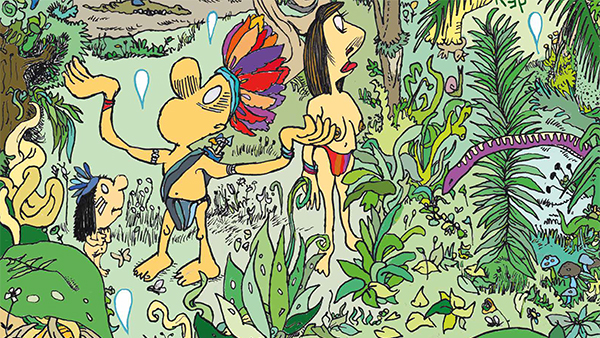
The first text published and read is by the Brazilian theologian, philosopher and writer Leonardo Boff: “Our common future depends on the Amazon”, illustrated by the Argentine cartoonist Rep.
Our shared future depends on the Amazon.
We live in a new phase for Earth, the process of planetization. Beyond its economic implications, it means that we all share the same Common Home, with the entire community of life. We have returned from exile after millions of years and are now all together in one place, on planet Earth.
The Earth belongs to no one. It is a common good of all humanity and the entire community of life (animals, trees, microorganisms, etc.). The Amazon, which spans nine countries and nearly eight million square kilometers, is part of the Earth; Brazil and other countries are not its lords. The Amazon belongs to all of the Earth, to all of humanity. Brazil, for example, manages only a portion (63%), and it does so poorly and irresponsibly.
Today we know that the Amazon is fundamental to the planet's balance, the climate system, and the absorption of carbon dioxide. Furthermore, it regulates the rainfall cycle for much of the world. This means that all of humanity has a responsibility for the Amazon; it is not just Brazil and the other Amazonian countries' responsibility. The future of life on Earth hinges on the conservation or destruction of the Amazon.
Indigenous peoples, the original inhabitants of these lands, know the rhythm of the rainforest; they know how to preserve it. They are our teachers and experts, not just the scientists who have an outsider's perspective. The beauty of the preparatory document for the Pan-Amazonian Synod lies in making native peoples the main protagonists, in order to find real and sustainable solutions for this immense biome.
Pope Francis himself warned that “the future of humanity and the Earth is linked to the future of the Amazon; for the first time, it is so clear that the challenges, conflicts, and emerging opportunities in this territory are the dramatic expression of the moment facing the survival of planet Earth and the coexistence of all humanity.” These are serious words, disregarded by large, predatory corporations, because they realize they should change their modes of production, consumption, and disposal. But they prioritize profit over safeguarding human and earthly life.
From the astronauts' perspective, it's clear: from the Moon or their spacecraft, Earth and Humanity form a single entity. Human beings are that part of Earth that began to feel, to think, to love, and to care. We are Earth with the ethical mission to care for and protect it.
The Amazon is home to 37.731.569 people, 2,8 million of whom are indigenous, belonging to 390 different groups and speaking 240 languages from a rich array of 49 linguistic branches—a phenomenon unparalleled in the history of world linguistics. The massive fires that have ravaged thousands upon thousands of square kilometers represent a direct assault on life, exacerbated by the negligence of President Bolsonaro, who seeks to implement mining and unlimited resource extraction in this vast region.
If the Amazon were completely destroyed, all of southern Brazil, extending into northern Argentina and Uruguay, would be transformed into a savanna, or perhaps even a desert. Fifty billion tons of carbon dioxide would be released into the atmosphere, making life impossible in this entire region. Hence the vital importance of this multinational biome for the future of life on our common home.
A large group of Indigenous people, with endorsements from bishops, scientists, and many others from across the continent, has drafted a document for the Pan-Amazonian Synod and for the Pope's personal endorsement, entitled "Amazon, Intangible Sanctuary of Our Common Home." Just as other biomes have been designated World Heritage Sites by UNESCO, the Amazon is even more deserving, given its vital importance for the future of life and humanity.
Leonardo Boff belongs to “Earth Charter"
Amazon, the threatened diversity
General coordination: Karina Batthyány, Nicolás Arata, Nicolás Sticotti
Editorial coordination: Marina Guerrier
Illustration: Rep (@repmiguel)
An initiative of the Knowledge Mobilization area of CLACSO
Academic advising: Gabriela Merlinksy and Bruno Malheiro
Podcast: Gustavo Lema
Design and communication: Gustavo Lema, Marcelo Giardino, Sebastián Higa
Web design: Studio 1525, Jerónimo Vergani, Diego Delgado, Douglas Moreno
If you would like to receive more information about CLACSO's training programs:
[widget id=”custom_html-57″]
to our email lists.

