
More than just a health pandemic
Agustín Salvia[1]
In addition to the health risks posed by the spread of COVID-19, the current health emergency has brought to a standstill a dual economic system, already weakened in general, but now exacerbated by the debt crisis and the stagflation of the last two years. All of this is paralyzing investment, trade, and job creation, particularly affecting small businesses and deepening the link between poverty and the informal economy. In this context, the informal sector is becoming even poorer, and the poor are becoming poorer as well. The health crisis may force us to set aside unfounded political divisions, and perhaps we will learn a new way of doing politics from it, but what doesn't seem to be receiving enough public debate is the widening of the social divide in this context.
Not only because violence, dengue fever, influenza, and other numerous infections that disproportionately affect the poor—without adequate attention from the public health system—remain the leading causes of preventable death among the poor, but also because the health emergency—like so many other government measures implemented by and for the formal economy—hits the informal economy, the marginalized worker, and that large segment of society (at least 30% of households, 35% of the economically active population) the hardest. This segment does not receive a regular salary or extra income, nor does it have a savings fund to cope with the job losses caused by the health emergency. I am referring to personal service providers of all kinds, maintenance and repair workers, street vendors, domestic workers or caregivers without steady employment, construction workers, artisans, market vendors, and stallholders of all kinds, and so on.
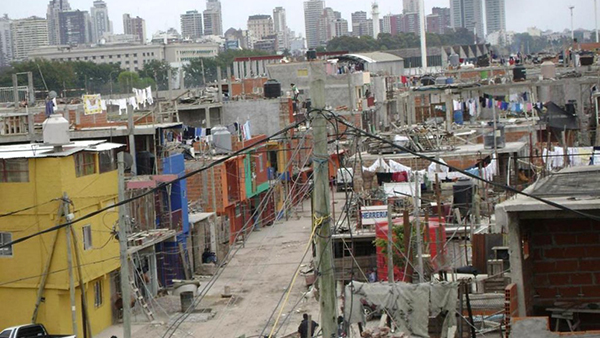
These are the groups that have been targeted by the latest economic measures of the Argentine government: extra payments of the Universal Child Allowance (AUH), a bonus for retirees and pensioners receiving the minimum pension, the Emergency Family Income (IFE), and the AlimentAR card. All of these are important palliative measures to reduce the effects of an accumulation of social crises; but nothing that will change the present or future of these sectors. Undoubtedly, the social situation would be worse without these transfers. The deprivations affecting at least a third of the population are not new. In this case, the regressive health and economic effects of the pandemic are compounded by structural deficits: overcrowding, residential degradation, lack of public health services (water, sewage, etc.), persistent malnutrition, inadequate education and health services, the fragility of the social capital at stake, the lack of valuable information, the increased risk of suffering from anxiety and stress, and rampant social violence. In short, we are not only facing a health epidemic, but also a new wave of structural poverty that is hitting the daily lives of the most vulnerable particularly hard.
In this context, far from making us a more egalitarian society thanks to a virus that, beyond its current reach, does not discriminate based on social origin, it is worth noting that the situation is exacerbating material, social, and symbolic inequalities. Therefore, alongside the need to coordinate proactive policies to address the emergency, the political challenges for the post-emergency period are growing. We need a framework of redistributive economic and social agreements—both tax and fiscal, as well as socio-productive—for the medium and long term. Argentine society urgently needs more than just stabilizing the economy, paying the debt, and overcoming the health crisis; it needs to make a qualitative leap forward in development, welfare, and equity policies.
[1] Argentine sociologist. Coordinator of the CLACSO Group on Structural Heterogeneity and Social Inequality. CONICET-UBA-Social Debt Observatory/UCA.
If you would like to receive more information about CLACSO's training programs:
[widget id=”custom_html-57″]
to our email lists.

