
Political Agroecology
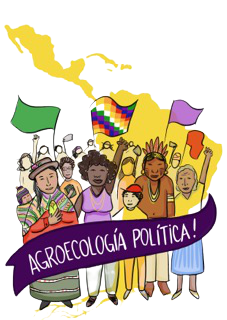
El CLACSO Working Group on Political Agroecology It emerges as a proposal for continuity and articulation to address the profound environmental and social crises stemming from the agro-industrial model and the corporate food regime in Latin America and the Caribbean. Its central objective is to critically analyze contemporary agrarian issues, including agrarian reform, from an agroecological perspective, linking critical agrarian studies with transitions toward more just, sustainable, and sovereign food systems. The Working Group seeks to generate situated, interdisciplinary, and engaged knowledge that contributes to understanding and transforming the dynamics of the corporate agri-food regime, its socio-environmental impacts, and the structural inequalities it reproduces in the region.
It also aims to strengthen dialogue between academia, social movements, and local communities, promoting research, training, and advocacy processes that position agroecology as a political, productive, and cultural alternative for the sustainability of life. Similarly, it fosters the analysis of multidimensional vulnerability and the development of proposals focused on reconfiguring food systems, defending territories, and recognizing key actors such as peasant farmers, rural youth, and Indigenous and Afro-descendant communities, within the context of struggles over land, labor, and the commons.
coordinate
Maria Inés Gazzano Santos
Department of Social Sciences, Faculty of Agronomy
-Faculty of Agronomy
-University of the Republic
Uruguay
[email protected]
Astrid Ximena Cortés Lozano
Faculty of Human and Social Sciences
University Corporation God's Minute
Colombia
[email protected]
Narciso Barrera Bassols
Faculty of Political and Social Sciences. Autonomous University of Querétaro,
Faculty of Political and Social Sciences.
Autonomous University of Querétaro,
Mexico
[email protected]

