
Agroecology: the agricultural science of the 21st century
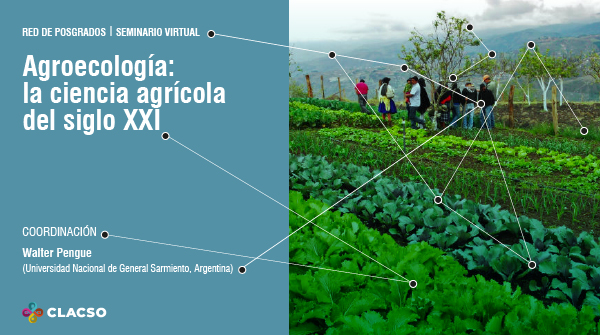
Seminar 2033
Coordination: Walter Pengue (National University of General Sarmiento, Argentina)
Start date : 08/06/2020 | Registration : 20/04/2020 to 24/05/2020
Workload: 12 weeks – 90 hours.
Industrial agriculture and the global agri-food system show clear signs of deterioration that threaten planetary stability in ecological, social, economic, and even cultural terms. This so-called modern agriculture represents one of the most impactful factors on global environmental and climate change. For more than thirty years, a new model has been emerging from science to address alternative forms of production, based on specific principles from biology, ecology, sociology, ecological economics, and political ecology. This model constitutes a discipline that tackles these agronomic, socioeconomic, and production issues holistically. This is agroecology, a scientific discipline that is currently experiencing rapid growth and is in demand by researchers and by urban, rural, and suburban societies that advocate for alternative ways of producing, consuming, and impacting the environment.
In this course, we will critically and constructively address the various approaches to industrial agriculture and its impacts, as well as new forms, methodologies, instruments, and indicators that will allow us to understand and compare viable alternatives, even in challenging environments, within the diverse framework of the local, regional, and global production system. We will also analyze, compare, identify, and resolve the differences between approaches that are partially based on other perspectives and objectives, in order to understand the system as a whole and the true meaning of this new agricultural science, which has its own principles, methodologies, objectives, subject matter, and indicators, and which must be understood in its entirety.
Agroecology operates in three dimensions, which work together and cannot be separated without stripping it of its most relevant content: food sovereignty. Therefore, agroecology as a whole is defined by its three facets: science, action, and movement. To be truly a whole, it must adhere to these principles, just like any other science. This is what we will discuss during these three intense months of work.
- Understanding the system (ecosystem, agroecosystem, neoecosystem)
- The “new era”. From the Holocene to the Anthropocene. The global impacts and indicators of modern agriculture.
- A Brief History of Agriculture and its Relationship with the Environment.
- Basic aspects of agroecological production
- Climate and agroecological production.
- The Theoretical Foundations of Agroecology.
- The Different Approaches to Agroecology
- The Agroecosystem and its Management. Agroecosystem Design.
- Practices and management in agroecological production. Scales.
- Agroecological management of pests and diseases.
- Crop Relationships – Polycultures and Others.
- Indicators and Methods for Valuing Agroecology – Issues of Social, Solidarity and Ecological Economy.
- Aguirre, P. (2017). A social history of food. 1st edition. Lugar Editorial. EDUNLA. Buenos Aires (First Chapter).
- Altieri, MA et al. (1999). Agroecology: Scientific bases for sustainable agriculture. Nordan Community Publishing House. Montevideo.
- Altieri, M.A. 1995. Agroecology: The Science of Sustainable Agriculture. CRC Press.
- Agribusiness Atlas. (2018) Heinrich Böll Foundation, Rosa Luxemburg Foundation, GEPAMA. Agribusiness Atlas 2018. Buenos Aires, November 2018.
- CALISA (2019). Cosmetic Agroecology. Changing something so that nothing changes. CALISA FAUBA. Available and consulted on March 27, 2020
- CIDSE (2018). The principles of Agroecology. Towards fair, resilient and sustainable food systems. Accessed 17/02/2020.
- Colin, A., Pimbert, M., Kiss, C. (2015). Building, defending and strengthening agroecology. A global struggle for food sovereignty.
- FHB (2014). The Meat Atlas. Facts and Figures About the Animals We Eat. FHB and LMD.
- FAO (2018). The right to food. Accessed 20/03/2020. Available at http://www.fao.org/right-to-food/es/
- FAO (2019). The 10 elements of Agroecology. Guide for the transition towards sustainable food and agricultural systems.
- Holt-Gimenez, E. (2008). Farmer to farmer: Voices of Latin America Peasant Movement for Sustainable Agriculture. SIMAS: Managua.
- Holt-Gimenez, E. and Altieri, M. (2016). “Lite” Agroecology: Co-optation and Resistance in Northern Countries. Retrieved February 20, 2020.
- GEPAMA (2019), Agroecology, what for?, for whom?, for how many?. Lecture by Dr. Manolo González de Molina. ROJAS Theater, GEPAMA, UBA.
- Giraldo, OF and McCune, N. (2019). Can the State take agroecology to scale? Public policy experiences in agroecological territorialization from Latin America. Journal Agroecology and Sustainable Food Systems.
- Gliessman, S.R. (2015). Agroecology: The Ecology of Sustainable Food Systems. 3rd Edition. Boca Raton, FL, USA, CRC Press, Taylor & Francis Group.
- Guzmán Casado, GI, González de Molina, M. and Eduardo Sevilla Guzmán (2000). Introduction to Agroecology as Sustainable Rural Development. Editorial Ediciones Mundi-Prensa.
- IFOAM (2019). Position paper on agroecology Organic and agroecology: working to transform our food system. IFOAM EU GROUP. Making Europe More Organic.
- IPBES (2018). Chapter 5: Current and future interactions between nature and society. In IPBES (2018): The IPBES regional assessment report on biodiversity and ecosystem services for the Americas. Rice, J., Seixas, C.S., Zaccagnini, M.E., Bedoya-Gaitan, M., and Valderrama, N. (eds.). Secretariat of the Intergovernmental Science-Policy Platform on Biodiversity and Ecosystem Services, Bonn, Germany, pp. 437-521
- Limbery, P. (2017). The meat we eat. The true cost of industrial livestock farming. Alianza Editorial. Madrid.
- León Sicard, T. (2016). Environmental Perspective of Agroecology. The science of agroecosystems. IEA. Editorial Universidad Nacional de Colombia. Ideas 23. Bogotá.
- MISEREOR (2018). Chappell, MJ and Annelie, B. Agroecology as a Pathway towards Sustainable Food Systems. MISEREOR, Aachen.
- Odum, EP Ecology. Modern Biology Series. CECSA Publishing House. Mexico. 1980.
- Pengue, WA. Ecological Economics and Development in Latin America. Fronteras Magazine 7. Buenos Aires. 2008.
- Pengue, WA Fundamentals of Ecological Economics. Kaicron Publishing House. Buenos Aires. 2009.
- Pengue, Walter A. Environmental Intangibles, Virtual Land and New Forms of Valuing Nature: Discussion Alternatives in the Face of the Crisis of Civilization, (pages 207-252) in Pensado Leglise Mario (compiler) Territory and Environment, Methodological Approaches, SIGLO XXI CCIEMAD, 343 pages, Mexico, 2012.
- Pengue, Walter A (2012). Social Metabolism, Resources and Sustainability: the challenge of the millennium. Frontiers 11: 29-39. ISSN 1667-3999, GEPAMA, FADU, UBA. Buenos Aires.
- Pengue, WA The emptying of Las Pampas. GEPAMA FHB. 2017
- Pengue, WA and Rodriguez, A. Agroecology, Environment and Health. GEPAMA. FHB. Book. Buenos Aires and Santiago. 2018.
- Pengue, WA. Environmental Thought from the South: Complexity, Resources, and Latin American Political Ecology. UNGS Editions. GEPAMA. Heinrich Böll Foundation Southern Cone. (2017)
- Pengue, WA (2020). The foundations and principles of agroecology: A perspective from Latin America. FRONTERAS 18. GEPAMA. Buenos Aires.
- UNEP. United Nations Environment Programme. GEO Report 5. (2010).
- UNEP. 2010. Resource Panel. Priority Products and Materials. Environmental Impact Assessment of Consumption and Production.
- Rockström J, Steffen W, Noone K, Persson A, Chapin FS, Lambin EF, Lenton TM, Scheffer M, Folke C, Schellnhuber HJ, Nykvist B, de Wit CA, Hughes T, van der Leeuw S, Rodhe H, Sörlin S, Snyder PK, Costanza R, Svedin U, Falkenmark M, Karlberg L, Corell RW, Fabry VJ, Hansen J, Walker B, Liverman D, Richardson K, Crutzen P, Foley JA (2009). A safe operating space for humanity. Nature. 2009 Sep 24;461(7263):472-5. doi:10.1038/461472a
- Smith, TM and Smith, RL Ecology. 6th edition. Pearson. Mexico. 2012.
- TEEB. UNEP.(2018). Measuring what needs to be measured in Agriculture and Food. Geneva.
- Toledo, VM Rural metabolisms: towards an economic-ecological theory of the appropriation of nature. Ibero-American Journal of Ecological Economics. 7: 1-26. 2008.
- UNEP. Resource Panel. 2014. Assessing Global Land Use: Balancing Consumption with Sustainable Supply
- Vitousek, P., P. Ehrlich, AH & PA Matson. Human appropriation of the product of photosynthesis. Bioscience 14: 368-373. 1986.
If you have a link with a CLACSO Associated Center:
- Paying in one payment: USD 95 (includes issuance and shipping costs of the digital certificate).
- Paying in one payment: USD 140 (includes issuance and shipping costs of the digital certificate).
- Paying in one payment BEFORE 07/06/2020: USD 150 (includes issuance and shipping costs of the digital certificate).
- Paying in one payment: USD 190 (includes issuance and shipping costs of the digital certificate).
FAQ
The basic requirements for taking a seminar are:
- Availability of at least 4 hours per week to dedicate to the seminar course.
- Internet access.
- Reasonable handling of communication and computer tools.
- Language proficiency in the language in which the course will be taught. The official languages are Spanish and Portuguese.
If you have a link with a CLACSO Associated Center:
- Paying in one payment: USD 95 (includes issuance and shipping costs of the digital certificate).
- Paying in one payment: USD 140 (includes issuance and shipping costs of the digital certificate).
- Paying in one payment BEFORE 07/06/2020: USD 150 (includes issuance and shipping costs of the digital certificate).
- Paying in one payment: USD 190 (includes issuance and shipping costs of the digital certificate).

