
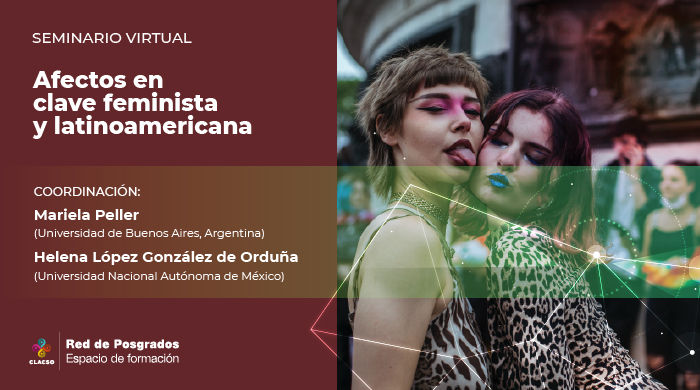
Affections from a feminist and Latin American perspective
Seminar 2256
ChairCLACSO
CoordinationMariela Peller (University of Buenos Aires, Argentina) and Helena López González de Orduña (National Autonomous University of Mexico)
Teaching team: Tamara Antonieta Vidaurrazaga Aranguiz (Academy of Christian Humanism University, Chile), Maria Alejandra Oberti (National University of La Plata and University of Buenos Aires, Argentina), Mariela Peller (University of Buenos Aires, Argentina), Helena López González de Orduña (National Autonomous University of Mexico) and Cristina Scheibe Wolff (Federal University of Santa Catarina, Brazil)
Invited teachers: María Angélica Cruz Contreras (University of Valparaíso, Chile), Rosario Fernández Ossandón (University of Chile), Lucas Saporosi, Nayla Vacarezza, Claudia Bacci and María Alicia Gutiérrez (University of Buenos Aires, Argentina)
Home: 27/07/2022 | Registration: 02/05/2022 to 26/07/2022
Workload: 12 weeks – 90 hours.
In this seminar we propose to share a series of concepts, methodologies and research topics related to affects and emotions in Latin America, from perspectives situated at the intersection of gender and sexuality studies, memory studies and feminisms.
In the region's current political context, affects and emotions are key to understanding both the advance of conservative and fundamentalist groups and the feminist uprisings and resistance of cis and trans women, as well as other subaltern subjects. Furthermore, emotional and affective energies play a role in how memories of past social struggles are reinterpreted to advance the fight for rights. They also represent a very promising horizon for promoting the necessary, yet complex, task of critically destabilizing a coloniality of knowledge still deeply rooted in the legacies of Eurocentric modern reason.
Studies of the so-called “affective turn” have renewed the theoretical agenda, expanding the methods and questions of the humanities and social sciences. While this perspective emerged in Anglo-Saxon academia, in recent years a field of research has begun to develop in and about Latin America, both with creative, innovative, and critical appropriations of metropolitan proposals, and in harmony with the tradition of sentipensar (feeling-thinking) in the region (Fals Borda). This field overlaps with gender, sexuality, feminist, and decolonial studies in the region, as they share interests related to the struggles against the oppression of cis and trans women and other precarious lives, and the possibility of producing resistance, expanding rights, fostering future emancipations, and developing alternative epistemologies.
In the current political context of the region, affects and emotions are key pieces both for understanding the advance of conservative and anti-rights groups, and the ways in which feminist revolts, the resistance of cis and trans women and other subaltern subjects and the memories of past social struggles are updated to advance in the conquest of rights, in the production of communities and in the generation of other epistemologies.
In this seminar, we aim to share and reflect on the political uses of affect and emotions in Latin America. We will present both theoretical and methodological resources, as well as case studies of recent political and cultural processes in Latin America, primarily in Chile, Argentina, Mexico, and Brazil. The program seeks to highlight the originality of affect studies in Latin America. At this point, we revisit the now classic discussion on “universalism and contexts,” raised by Nelly Richard more than 25 years ago—a discussion that remains relevant today—who questioned why those of us in the Global South, in the international division of labor in art or science, are always left to deal with the case, the context, the particular, the concrete, the real, while those at the center are left to theorize, to think about the abstract, the universal.
Our course breaks with this dichotomy—which refers to many others—for at least two reasons. On the one hand, because it values the theoretical and methodological work carried out in the region. And, on the other, because it refers not only to contemporary authors belonging to the so-called “affective turn,” but also recovers classic works from the social sciences and regional humanities, which were already focusing on those areas of social life that we now think of as emotional.
From multiple disciplines, we will share a mapping of significant current themes for the region, primarily those linked to the memories of social struggles, both those related to the recent past of dictatorships and to the feminist movement. We will work on defining a broad repertoire of emotions: hate, love, grief, failure, humor, joy, and shame, among others. This will challenge the dichotomy between positive and negative, liberating and oppressive affects. We are interested in exploring the existence of affective repertoires that enable and have enabled social transformation (as in the fight for legal abortion or the transmission of subjugated knowledge), but also how current and past conservative and patriarchal discourses use emotions to imagine, produce, and exclude identities of gender, sexuality, class, race, and generation. Affects and emotions circulate both in state violence and in the power relations of everyday life, as well as in the achievement of resistance and the imagining of different ways of life.
General objectives
- Examining the theoretical and methodological genealogies of the studies of emotions and affects in the exchange between Latin America and the Global North.
- Reflect on the productivity and challenges of conceptual vocabularies and research techniques in this field.
- To explore the analytical and political interest of crossing this field with feminisms, women's resistance, memory, and the decolonization of knowledge in Latin America.
Specific objectives
- Examine the relevance (or not) of the heuristic difference between emotions and affects.
- Thinking about the productivity (or not) of maintaining a division between positive and negative affects.
- To explore in what ways affectivity intervenes innovatively in the social sciences and humanities.
- Reflecting on the political use of emotions in Latin American scenarios of antagonism between hegemonic forces and popular resistance.
- To contrast the intellectual and political agendas of the field in Latin America and the Global North.
- Present case studies and concrete examples.
- Emotions, affections, memory and feminisms
- Feminist Affects and Epistemologies
- Affective dimension in testimonies
- Gender, emotion and politics in the resistance to dictatorships in the Southern Cone
- Affectionate files
- Feminist theory, power and affect
- Affections and memories in contemporary feminist protest
- Pride and shame. Affections and emotions in the experiences and memories of the second generation
- The conservative fundamentalist imprint: actions, arguments and hate speech against human rights
- Ahmed, Sara (2014). “Introduction: feeling one's own path”. In The cultural politics of emotions. Mexico, University Program of Gender Studies-UNAM, pp. 19-45.
- Alvarez, Sonia. “Feminisms in movement, feminisms in protest”, in Revista Punto Género, Nº11, pp. 73-102, 2019. Do Carmo, Iris Nery. “The feminist role: Autonomy and prefigurative politics in the contemporary feminist field”, in Cadernos Pagú, Nº57, 2019.
- Bacci, Claudia. “Now that we are together: feminist memories, politics and emotions”, Revista Estudos Feministas,28(2), e72446. [Epub] August 07, 2020.
- Bracken, Sara and Paternotte, David (2020) Habemus Género. La Iglesia Católica e Ideología de Género, Rio de Janeiro. Género y Política en América Latina, SPW, Akahata.
- Canevaro, Santiago (2014), “Affects, knowledge and proximity in the management of childcare. Domestic workers and employers in Buenos Aires”, in Durin, Séverine, de la O Martínez, María Eugenia and Bastos, Santiago [eds.], Workers in the Shadows. Dimensions of Latin American domestic service, Mexico: Center for Research and Higher Studies in Social Anthropology.
- Chirix, Ema (2009). “The bodies and the Kaqchikel women”. Desacatos 30, pp. 149-160. López, Helena. 2014. “Emotions, affectivity, feminism”. In Sabido, Olga and García, Adriana, (eds). Body and affectivity in contemporary society. Mexico, UAM-A, pp. 257-275.
- Cruz Contreras, María Angélica. Feminist Epistemology and the Production of Women's Testimonies about the Dictatorship in Chile: Redirecting the Focus to the Researcher's Position. Revista Prácticas del Oficio, v.1, n. 21, Jun 2018 - Dec 2018, pp. 65-75
- Cvetkovich, A. (2003) [2018]. An Archive of Feelings: Trauma, Sexuality, and Lesbian Public Cultures. Madrid: Bellaterra (Introduction and Chapter 1)
- Da Silva Catela, L. (2002). The archives of repression: Documents, memory and truth. Buenos Aires: Siglo XXI (Chapters 2 and 7)
- De la Fuente, María (2015), “Ideas of power in feminist theory”, in Revista Española de Ciencia Política, vol. 39, Spain: Spanish Association of Political Science and Administration.
- Giorgi Gabriel, Kiffer Ana (2020) The twists of hate: gestures, writings, politics. Buenos Aires: Eterna Cadencia. pp.9-83.
- Guasch, AM (2011). Art and archive, 1920-2010. Genealogies, typologies and discontinuities. Madrid: Akal. (Introduction)
- Hassoun, Jacques (1996). The Smugglers of Memory, Buenos Aires, Ediciones De la Flor. (Selection)
- Jimeno, Myriam (2003). “Crime of passion: with the heart in darkness”. In Tempo Brasileiro: 191-214.
- Oberti, Alejandra (2021). “Births” in Claudia Bacci and Alejandra Oberti (ed.) Testimonies, gender and transmission. Córdoba: EDUVIM.
- Observatory on the Universality of Rights (2017) Rights at Risk, Awid: Toronto and Mexico City.
- Passerini, Luisa (2016). “A Memory for the History of Women: Problems of Method and Interpretation”. Aletheia, volume 7, number 13.
- Peller, Mariela. (2021). The gender of disobedience: resistance to the family legacy in the daughters of repressors in Argentina, Cuadernos del CILHA, (34), 1-26.
- Rosenwein, Barbara H. History of emotions: problems and methods. Letter and Voice, 2011.
- Rossi, Julia and Campanella, Lucía (2018), The Underdogs: Three Centuries of Servants in the Art and Literature of Latin America, Buenos Aires: National University of Rosario.
- Ruiz Trejo, M. and García Dauder, S. (2018). “Epistemic-corporal” workshops as reflective tools on ethnographic practice. Universitas Humanística, 86, 55-82.
- Santisteban, Rocío (2018). “Patriarchy, machismo and racism in extractive societies: the Peruvian case”. Left Hemisphere. July.
- Solana, Mariela and Vacarezza, Nayla Luz (2020). “Feminist Feelings”, Revista Estudos Feministas, no. 28.2, pp. 1-15.
- Vidaurrazaga, T. (2021). Little companions: The children of the MIR and Montoneros in collective homes in Cuba. In Alonso, J., and Peñaloza, C. (Eds.). Exiles of the southern cone: gender, generation and classes. Santiago: Cuarto Propio.
- Wolff, Cristina Scheibe. Pieces of soul: emotions and gender in the discourses of resistance. Feminist Studies, Florianópolis, v. 23, no. 3, p. 975-989, Nov. 2015. ISSN 0104-026X. Available at: Rosa María Medina Doménech. Feel the history. Proposals for a feminist research agenda in the history of emotions. ARENAL, 19:1; January-June 2012, 161-199.
|
|
Discount for one payment until 15/07 |
In one payment after 15/07 |
|
CM Plenos |
$75 |
$150 |
|
CM Associates |
$95 |
$190 |
|
No link |
$95 |
$190 |
FAQ
The basic requirements for taking a seminar are:
- Availability of at least 4 hours per week to dedicate to the seminar course.
- Internet access.
- Reasonable handling of communication and computer tools.
- Language proficiency in the language in which the course will be taught. The official languages are Spanish and Portuguese.
|
|
Discount for one payment until 15/07 |
In one payment after 15/07 |
|
CM Plenos |
$75 |
$150 |
|
CM Associates |
$95 |
$190 |
|
No link |
$95 |
$190 |
More information: [email protected]

