
Goodbye to Roberto Fernández Retamar
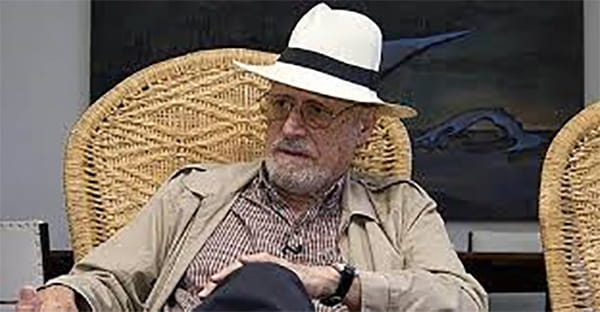
Culture is in mourning with the passing of Roberto Fernández Retamar, a Cuban poet, intellectual, and essayist who, from the Caribbean island where he was born, radiated his verses and his thought to all of Latin America and the world.
CLACSO deeply regrets the passing of this man who, through his work, intellectual brilliance, and commitment, became an indispensable cultural figure who nourished several generations. He will forever remain with us, within us. Committed to the Cuban Revolution from its inception, he held various political and cultural positions over these 60 years. Among other roles, he was a member of the Council of State responsible for Culture and, until his last day, president of Casa de las Américas.
Declaration of the House of the Americas
“He offered men what intelligence he had // […] He gave them what courage he had // […] He did his part, when the time came // […] in the end, he declared that he would start again if they let him.” Thus the poet expressed himself in the verses entitled “It would be good to deserve this epitaph,” and thus we remember him.
The death of Roberto Fernández Retamar is an irreparable loss for Cuban culture. Since his debut in 1950 with the poetry collection Elegía como un himno (Elegy as a Hymn ), his work paved the way and marked milestones in Spanish-language poetry, bequeathing to it texts that will remain forever, such as “Felices los normales” (Happy Are the Normal Ones), “¿Y Fernández?” (And Fernández?), and “Con las mismas manos” (With the Same Hands).
No less relevant are his penetrating and enlightened essays, which highlight the vastness of his thought and the magnitude of his intellectual work, whether we recall that classic of Latin American and Caribbean reflection, "Caliban", or if we think of " Towards a Theory of Spanish American Literature" , in his fervent passion for Martí's work, or in his lucid essays on the role of the intellectual and the processes of cultural decolonization in our America.
It is impossible to dissociate his name from the history of the Cuban Revolution, to separate him from a phenomenon that has been a permanent subject of concern and worry, as well as a vital stage and sounding board for his figure and his work.
It would already be a lot if that were Roberto's legacy, but to his literary work one would have to add his teaching work and his unparalleled role as editor, which led him to direct various magazines before assuming the direction of Casa de las Américas in 1965 , to consolidate it as one of the most important cultural references in our America.
But he would do even more, leading Casa de las Américas from 1986 onward, as the successor to its founder and heroine, Haydée Santamaría, and the great painter Mariano Rodríguez. The privilege of Roberto presiding over this institution in recent decades contributed to its willingness—under his leadership—to embrace risk while remaining true to itself, to the spirit that gave it birth in the immense and unfinished task of cultural integration in Latin America and the Caribbean.
On the occasion of Haydée's painful loss, Casa de las Américas released a statement—clearly written by Roberto—that concluded: “It must be said that she will be with us, within us. […] But from now on we are poorer, although we are forever accompanied by the honor of having worked under her guidance, under her encouragement, which we continue to feel, proud and deeply moved, at our side.” These words remain true for Haydée, just as they are for this dear brother of hers who has just left us. We make them our own for you, in this moment of infinite sadness, dear Roberto. Havana, July 20, 2019.

