
CLACSO agreement with US university libraries.
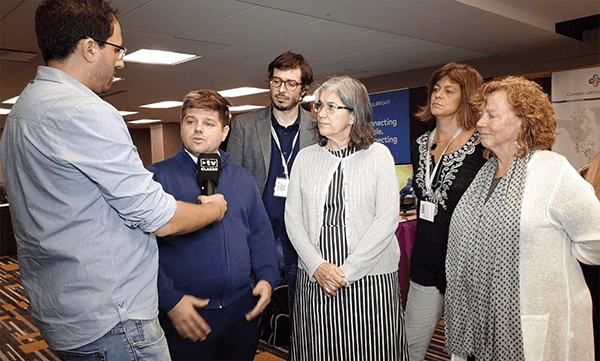
During their stay in the United States, to participate in the XXXVII Congress of the Latin American Studies Association (LASA), CLACSO signed an important agreement with American university libraries to provide them with our books.
Nicolás Arata, Director of Training, explained that “after months of work establishing links with the main libraries of North American universities, we reached an agreement through which this consortium of libraries, particularly those interested in Latin American studies, offered concrete and very significant support for the development of CLACSO's open access, always guaranteeing the principles that CLACSO promotes: open access, free downloading of materials, favoring greater dissemination of materials for the authors of this publishing fund.”
In this regard, Ángela Carreño of New York University noted that “the most important thing is the visibility of CLACSO books, the collaboration of libraries, and also the presentation of all their books,” while Lynn Shirey of Harvard University specified that “initially there are about two hundred CLACSO books and we hope that in the following years the project will continue, anticipating about one hundred more titles each year.”
“An agreement like this takes a long time because many people are involved,” explained Fernando Genovart, representing Librería Garcia Cambeiro. “There were a number of shared interests between CLACSO and the libraries in disseminating the material, and the libraries also in working cooperatively to generate more open access in a sustainable way over time.”
Nicolás Arata explained that “a first experience we had within the framework of this project, uploading 8 books to the JSTOR platform, has already resulted not only in a significant volume of downloads, but also in places of origin that CLACSO usually finds more difficult to access. We see that there is a policy of disseminating knowledge, of circulation and also of preservation over time.”
In summary, CLACSO Executive Secretary Karina Batthyány emphasized that “the main value for us is reinforcing the idea of knowledge as a public good and open access as key to that access. Joining this agreement means reaching a new audience, other frontiers, where perhaps our work was already circulating, but not so widely. And it also provides the opportunity to ensure that our work is preserved over time.”

