
- This event has passed.
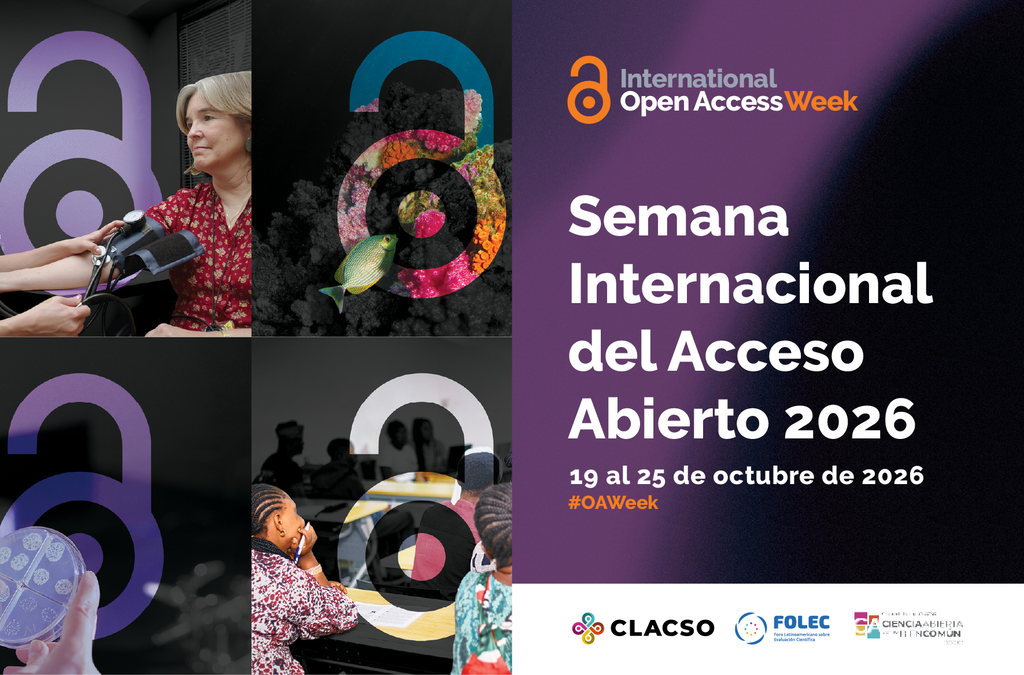
International Open Access Week 2026 – CLACSO Conference
October 19 – 12:00 pm – October 23 – 1:30 pm CMT
International Open Access Week 2026 – CLACSO Conference
"Privatization, commodification and precarization of the commons of knowledge: the costs in the Global South"
Programming:
· Monday 19/10 · [Opening] Privatization, commodification and precarization of goods
commonalities of knowledge
9 to 10:30 a.m. Mexico | 10 to 11:30 a.m. Colombia and Peru | 12 to 13:30 p.m. Argentina and Brazil
Panelists:
- Pablo Vommaro – Executive Director of CLACSO
- Arianna Becerril García – UAEM, Redalyc/AmeliCA and GT “Open Science as a common good”
- David Oliva Uribe – Senior Consultant, Communication and Information Sector of UNESCO
Moderation: Fernando Ariel López – UMET, CITRA-CONICET and GT “Open Science as a common good”
Registration form: https://us06web.zoom.us/meeting/register/8sr_Z2yzS-y44ZVQMWJIOA
· Tuesday 20/10 · Geopolitics and the internationalization of open science
9 to 10:30 a.m. Mexico | 10 to 11:30 a.m. Colombia and Peru | 12 to 13:30 p.m. Argentina and Brazil
Panelists:
- Daniela Perrotta – CLACSO – FOLEC
- Dominique Babini – CLACSO and Working Group “Open Science as a Common Good”
- Fernanda Beigel – CONICET and Working Group “Open Science as a Common Good”
- Guido Riccono – CONICET and GT “Social, Mobile and Politicized Science”
Moderation: Luis Adolfo Ortega Granados – University of Guadalajara and GT “Open Science as a Common Good”
Registration form: https://us06web.zoom.us/meeting/register/dkJnnEXGRTWY7C9JRnUgFw
· Wednesday 21/10 · The costs of epistemic and technological sovereignty
9 to 10:30 a.m. Mexico | 10 to 11:30 a.m. Colombia and Peru | 12 to 13:30 p.m. Argentina and Brazil
Panelists:
- Gabriel Vélez Cuarta – University of Antioquia and GT “Open Science as a common good”
- Esther Juliana Vargas Arbeláez – Francisco José de Caldas District University and GT “Open Science as a common good”
- Lautaro Matas – LA Referencia
- René Ramírez Gallegos – GT “Latin American Social Thought and Theory and University Internationalization”
Moderation: Martín Tena – University of Guadalajara and Working Group “Open Science as a Common Good”
Registration form: https://us06web.zoom.us/meeting/register/EIsFmlCqQbyfJsNEgz8aeQ
· Thursday 22 / 10 · AI and research data. Extractivism of the commons
digital
9 to 10:30 a.m. Mexico | 10 to 11:30 a.m. Colombia and Peru | 12 to 13:30 p.m. Argentina and Brazil
Panelists:
- Gustavo Archuby – UNLP, Argentina
- Fernando Ariel López – UMET, CITRA-CONICET and GT “Open Science as a common good”
- Isabel Jiménez Becerra – PhD in Education and Territory from the UGC and GT “Appropriation of digital technologies and intersectoralities”
- Andrés Tello – Working Group “Digital Territories and AI: Political and Subjective Challenges”
Moderation: Laura Rovelli – CONICET and Working Group “Open Science as a Common Good”
Registration form: https://us06web.zoom.us/meeting/register/6BjiYL5LRYOJGYKaey9Zaw
· Friday 23 · Science policies within the framework of open science as a common good
9 to 10:30 a.m. Mexico | 10 to 11:30 a.m. Colombia and Peru | 12 to 13:30 p.m. Argentina and Brazil
Panelists:
- Violeta Vázquez Rojas Maldonado and Pedro Ovando – SECIHTI, Mexico
- Maribel Cabrera – UNE, Union of Spanish University Publishers
- Ricardo Casate Fernández – Ministry of Science, Technology and Environment of Cuba and GT “Open Science as a common good”
- Sayri Karp – EULAC
- Guillermo Chávez – Latindex UNAM
Moderation: Fernanda Pampín – CLACSO
Registration form: https://us06web.zoom.us/meeting/register/0BgIX1rNR_Co-K06kvKL5w
Organized by:
CLACSO, FOLEC and GT "Open Science as a Common Good"
Live broadcast via Zoom – Autonomous University of the State of Mexico – UAEMex
Free activity with prior registration
Call for transmission nodes
Universities, research centers, and institutions in the region are invited to become TRANSMISSION NODES. The proposal is that the event serve as input for each institution to convene its own academic and scientific community, participate in the live broadcast of the panel discussion, continue the debate in person, and share its institutional progress on the topic.
Inquiries to [email protected]