
Academia and activism drive anti-racism program in Cuba
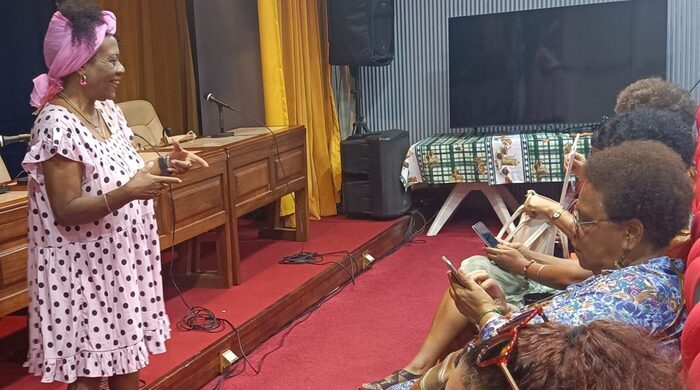
The most recent course of the Itinerant School of Afrofeminist Voices left a proposal for anti-racist action in diverse communities and spaces

Havana, April 26 - The course "Anti-racist realities: multiplying and weaving dreams" concluded with an integrative workshop that built a toolbox to multiply knowledge and dissemination about the National Program to fight against racism and discrimination in Cuba.
This recent training initiative of the Itinerant School of Afrofeminist Voices assigned tasks involving action in diverse communities and spaces. In a combination of in-person and virtual formats, the sessions took place between April 15 and 20, coordinated by professor and researcher Rosa Campoalegre [1].
“What were we trying to achieve? To break the silence surrounding the National Program to Combat Racism, the lack of awareness. The main objective is to expand its reach, and for that purpose, a group of about 10 academic institutions in the country, led by the program, have joined together,” Campoalegre explained.
The course also aimed to bring each student closer to the topic, through critical and proactive reflection on racism, from a decolonial and intersectional perspective, with knowledge situated in the advances and challenges, as a basis for its subsequent application in diverse social contexts.
The course agenda included the fight against racism, its meaning, approaches and challenges; the National Program against racism and racial discrimination, its main objectives and challenges, the methodological value of the comprehensive affirmative approach and progress, challenges, pathways and resources for the implementation of the program.
On the last day, the song “Mi casa.cu”, by the Cuban troubadour Tony Ávila, was the motivating thread to reflect and extract the tools for the performance.
Based on the deconstruction of the musical work, discussions were held about critical genealogy, the need to motivate in order to promote active participation, the relevance of appealing to ancestry in any action (as a guideline and tool), and defending identity and unity in diversity.
In the exchange and collective construction, there was agreement on the need for change, but with political, epistemic and necessary limits, without damaging the foundations.
Break the box
This course is part of the Traveling School of the International Network of Afrofeminist Voices (RIVAS), a counter-hegemonic project under construction with the University of the African Diaspora, Campoalegre stated.
“This was the first… This type of action will be developed by the School in the 18 countries of Latin America, Africa and Europe that make up RIVAS and the theme will be selected based on the diagnosis of the racial problem there and, in particular, the political influence of Afro women in the fight against racism,” she added.
According to the researcher, in Cuba the diagnosis showed that the most important thing is to support and expand the National Program to fight racism and then continue with issues, especially Afro-feminist ones.
He explained that they designed the course “from a level of familiarization, so that people would know the National Program to fight against racism, be motivated to multiply it and take at least one important action extending the issue to the neighborhood.
“The activities are the 'Workshops My House Needs' (a phrase taken from Ávila's song) with a Cuban twist (a national anti-racist program). The workshops will be taught by graduates of the first course,” Campoalegre announced.
It is hoped that a second course will be offered to accredit teachers and tutors who will be deployed in different settings across the country, including the University of Cienfuegos, in partnership with the Nelson Mandela Chair of the Center for Psychological and Sociological Research (CIPS).
“We believe we are on a path to continue. What distinguishes it, in what sense is it pioneering? In the articulation between academia and Afro-descendant activism, it is a course that erases the boundaries between both processes, the academic and the activist; it is a very powerful action of activism with an academic and scientific foundation,” the specialist assessed.
The beginning of the journey
“Training plays a fundamental role in the fight against racism and discrimination; therefore, studying the scope and content of the national program is essential,” declared Professor Felicitas López, from the Nelson Mandela Chair and the Afro-descendants and counter-hegemonic proposals working group of the Latin American Council of Social Sciences (CLACSO).
In his opinion, “school is one of the means to achieve this and a step forward in our project to eradicate discrimination and racism. That is what we are working on,” he affirmed.
Through WhatsApp, researcher Geidi Fundora shared: “Congratulations on this fruitful and motivating experience that this course has been” and that “it will multiply, as we dreamed from the beginning.”
The initiative was promoted by the Nelson Mandela Studies Chair of CIPS, accredited by the Latin American Faculty of Social Sciences, with the participation of the University of Pedagogical Sciences and others. (2023)
The full text can be viewed at the following link
[1] Professor and Senior Researcher at the Center for Psychological and Sociological Research. Recipient of the Cuban Academy of Sciences Award. Coordinator of the CLACSO Working Group on Afro-descendants and Counter-Hegemonic Proposals. Email: [email protected]

