
“Addressing the challenges of the 21st century is not feasible without a significant redistribution of income.”
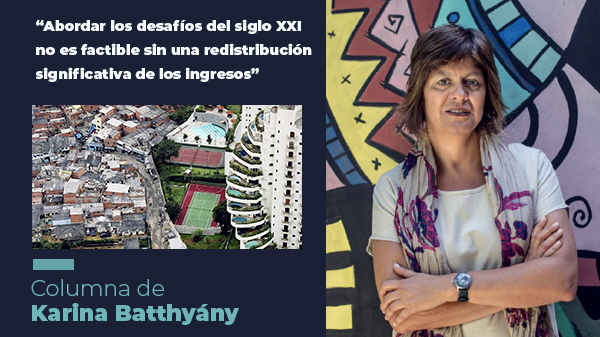
(Transcription of Karina Batthyány's Column)
(In InfoCLACSO – December 15, 2021)
I propose dedicating this column to the theme of our upcoming Conference in #Mexico2022 on the Webs of Inequalities. And while we've already discussed inequality several times in this column, the Global Inequality Report 2022 was released last week—an interesting research project that brings together more than 100 researchers from the World Inequality Lab, coordinated by the French economist Thomas Piketty. I suggest we explore some of the elements and data presented there, always, of course, from the perspective of Latin America and the Caribbean.
This report allows us to put current figures to a topic—as you well know—that concerns us and that we have addressed several times in this forum, and which is, of course, part of the public debate: inequality. Contemporary inequality, in this case, income and wealth inequality. Inequalities that, as we know, are very large and are growing. According to this report, the richest 10% of the world's population currently receives more than half, or 52%, of global income. Meanwhile, the poorest half receives less than 10%, 8.5% to be precise. So, there we have our first shocking statistic.
We can also observe that global wealth inequalities are more pronounced than income inequalities, because the poorest half of the world's population owns only 2% of total wealth, in contrast to the richest 10% of the world's population who own three-quarters of all global wealth.
I think these numbers—I insist—are truly scandalous. What's happening here in Latin America? For example, we have data showing that the top 10% captures 55% of the national income, compared to—in the same proportion—36% in Europe. I repeat: here, the top 10% keeps more than half of the national income, while in Europe, that same 10% keeps 36%.
Another way we know to measure global inequality is by comparing the average income of the top 10% to the average income of the bottom 50% (and this report does just that). It shows that in Brazil, for example, undoubtedly one of the most unequal countries in the world, the bottom 50% earn 29 times less than the top 10%.
If we go to another country to compare how this happens between Latin America and other regions and compare it with France, that same relationship is that the bottom 50% earn 7 times less than the top 10%, so that we can put it in context with our region.
Furthermore, this report also reveals two processes that have been occurring simultaneously over the past 20 years. On the one hand, there has been a decrease in global inequality between countries, resulting—among other things—from the growth experienced by most of what are called “emerging economies.” On the other hand, there has been a very significant increase in income inequality and wealth inequality within each of these two countries. Some countries have even experienced dramatic increases in inequality, as has been the case in the United States, Russia, and India.
This report, coordinated by Piketty, rightly asserts that global inequalities appear to be as great today as they were at the peak of Western imperialism in the early 20th century. Furthermore, it focuses on the extreme inequality present at the top of the wealth distribution. This inequality stems from a significant disparity in growth rates between the upper and lower segments of the wealth distribution. Thomas Piketty himself—in one of his now-classic books, "Capital in the Twenty-First Century"—described this process in great detail. In that book, he demonstrates that since 1995, the wealth of the world's richest people has grown between 6 and 9% annually, while average wealth has increased by only 3%.
What does that mean in simpler terms? It means that in recent decades, global billionaires—that is, the 0.01% at the top of the distribution—have captured a disproportionate share of wealth growth, going from representing 7% of world wealth in 95 to 11% today.
But in addition, as if all this were not enough, the report shows us how all this was exacerbated during the COVID-19 pandemic, with 2020 being the year with the most pronounced and recorded increase in the share of billionaires in the world's wealth.
Finally, another conclusion of this report is that over the last 40 years, countries have become significantly richer, but governments have become significantly poorer. This is because the share of net wealth (in rich countries) held by public actors is close to zero, or in many cases negative. In other words, all the wealth is in private hands. This is closely related to public debt and the ratio of that public debt to public assets. And this, of course, has been further exacerbated during the COVID-19 pandemic. It's worth remembering that governments have spent (depending on the country) on average the equivalent of 10% to 20% of their gross domestic product to address the COVID-19 crisis.
Two dimensions remain to be addressed in this report, which relate to gender inequality in income and the environmental correlates of these income and wealth inequalities.
-I was very impressed… You were talking about these incredibly brutal logics, and I was thinking how difficult it was in some countries to implement wealth taxes or solidarity contributions, as they were called in different places. The pressure from conservative sectors, who own this wealth, to prevent these measures from being implemented seems minimal considering the gravity of this brutal logic of inequality…
-Absolutely. And as we have said before, it is more than clear to us that addressing the challenges of this 21st century is not feasible without a significant redistribution in these areas, in terms of these scandalous and aberrant inequalities of income and wealth that this Piketty report only confirms.
And speaking of that, I'd like to ask your permission to make a comment because it relates to the issue of inequality, as well as income and wealth, and it's precisely about what will happen next weekend in Chile: that crucial election for Chile, one of our beloved Latin American countries, which is choosing a very significant political, economic, and social path. We are watching this process very closely, paying close attention to the results at the close of the campaign, but also to the first preliminary results, hoping that the path begun with the constitutional process will continue, along with everything we have been analyzing here at InfoCLACSO regarding the Chilean process, both in this forum and at CLACSO in general. We are watching closely, and of course, we send our best wishes to the Chilean people who have to make a crucial decision next Sunday.
If you would like to receive more information about CLACSO's training programs:
[widget id=”custom_html-57″]
to our email lists.

