
Now that indigenous women will lead indigenous politics
By Felipe Milanez1
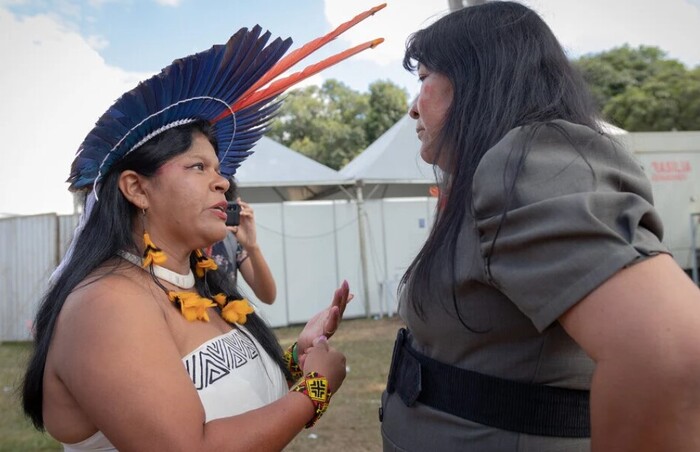
We are living in a historic, unique and special moment: the “start of a new time”, as the Minister of Indigenous Peoples, Sônia Guajajara, was assassinated at the Funai headquarters in Brazil on the first day of the new government. At his table was Joênia Wapishana, federal representative Célia
Sônia Guajajara is a collective people, who always walks together with two parents, and her name, in addition to her great capacity for political articulation, represents a true change: indigenous people must occupy the positions and positions that they say respect their realities, the interests of their people, and so Names must start from the bases and two territories. This is a new country that emerges!
The first indigenous minister will be accompanied by the first president of Funai, the extraordinary lawyer and the first indigenous woman to conquer the vague federal representative, for Roraima, Joênia Wapishana. At the end of a period of trials it is being led by those who form the main essence of resistance in our territories: indigenous women. During the violent years of Bolsonaro, indigenous women organized and created a large national movement, the Articulação Nacional das Women Indígenas Guerreiras da Ancestralidade (ANMIGA), organizing two large marches in Brasília. In the elections there is a great Chamado on Terra, a movement to resume politics. And now we have reached important positions in the new government with proposals and it is exciting to see this new world emerge!
The same Funai that Sˆønia Guajajara persecuted, that persecuted non-indigenous servants dedicated to serving the country in its institutional capacity, the same entity that functioned for the spurious negotiations of the invasions of two territories, now goes to another direction, the one that is provided for in its regulation: a defends the promotion of two rights of indigenous people. How nice it is that Joênia Wapishana, together with Sônia Guajajara, to lead this process!
I worked in Funai in 2006, the first time Lula governed, and there was no indigenous people in the directorates of the Fundação. Despite being an ancient demand of the indigenous movement that Funai was presided over by an indigenous person, institutional racism prevented this conquest for decades.
In 1984, the great Kayapó leader Megaron Txucarramãe was the first indigenous person to assume the direction of the Xingu Indigenous Park. Megaron worked in Funai until he was fired, in Dilma's government, for protesting against Belo Monte. Megaron's gestão was historical and signaled that it was obvious, but the mantle of colonialism prevented: only the indigenous people who must occupy the leadership positions over their collective interests.
This moment is critical, and must be deepened so that all positions and decision-making positions are occupied exclusively by indigenous people, because we respect the realities and demands of our people! A new indigenism where non-indigenous people can effectively position themselves as allies of the struggle, but with respect to the protagonism. A movement called “rearguard indigenism”, alluding to the term “rearguard intellectual” by sociologist Boaventura de Sousa Santos. There is no more indigenism that silences indigenous voices, but rather it is in the rearguard of a collective struggle.
The indigenous people went through a tragic period whose violence, which affected the entire Brazilian society, was disproportionate, marked by genocide. Two years of a government of fascist ideology, was when the indigenous movement, now led by brilliant lawyer Eloy Terena, filed the Bolsonaro genocide case for the Haia Court. When indigenous advocacy faced the courts with administrative measures that finally attack the existence of two indigenous peoples. Eloy was appointed by Sônia Guajajara as executive secretary of the newly created Ministry of Indigenous Peoples.
One of the most emblematic actions that denounced institutional racism in this period was led by lawyer Fernanda Kaingáng: JBS had dismissed indigenous workers from one of its meat processing plants in Chapecó, the Kaingáng Institute, together with the Public Ministry of Labor to bring justice. The Kaingáng will expire in the first instance and foram reintegrated and paid with remuneration at the start of the vaccinations on indigenous lands. In the petition filed by Fernanda, through the Kaingáng Institute, to the Public Ministry of Labor, she argues the terrible effects of institutional racism, which blatantly affects, like apartheid, the indigenous people who live in the south of Brazil:
“Large indigenous groups inhabiting insufficient lands over decades will result in economic vulnerability, cultural erosion imposed by the prohibition of speaking their mother tongues and imposition of external values and many times contrary to their cultures, alicerçados by practices of institutional racism that sustain, até os current days, “slow and constant processes of ethnocide.”
Fernanda Kaingáng is now being indicated by the indigenous movement to take over as director of the Indian Museum, in Rio. This is another historic change, to which I support with enthusiasm! It would be a necessary and urgent deepening of the transformation of indigenism – the Indian Museum spent three decades controlled by the same director and the same political group, passing through governments of different spectrums from FHC, Lula, Dilma to Temer, revealing that racial domination does not allow Brazil to cross left-wing and right-wing governments. It's time to change this history and build a different future.
According to Fernanda, we see the basis of the indigenous movement, the indigenous organizations as women's representatives in the South of Brazil. Fernanda worked between 2003 and 2010 as a Brazilian indigenous specialist in the negotiations of the Nagoia Protocol, and since 2010, she began working primarily in the field of the Intergovernmental Committee on Intellectual Property, Traditional Knowledge and Genetic Resources, or IGC of the World Intellectual Property Organization and its purpose. for the museum, including expanding indigenous participation and qualifying that participation in international forums. She is an advocate, activist of human rights, environment and culture for 25 years, brilliant intellectual of the Kaingáng people.
Fernanda elaborated a new project for the museum that passes to her chamar Two Indigenous Peoples, with the results of an elaborate and sophisticated program. In the new museum, a shared governance is planned, encouragement of cooperation and partnerships, a series of measures to work inter-institutionally on cultures and cultural expressions of indigenous peoples, scientific dissemination policies, training of servers.
It will make a museum much bigger than what Darcy Ribeiro dreamed of. Darcy Ribeiro tells in his Confissões as a feito a criação do “first museum turned, specifically, against or preconceito”. He was created to “dismantle and eradicate the idea that Indians are violent and bloodthirsty, jungle and brutal, evil and cunning, that there are some two stereotypes that the Brazilian population as a whole respects them.” In addition to an exhibition history, the Indian Museum held the first postgraduate course in anthropology – a course that was later transferred to the National Museum. Therefore, from its beginning it was an institution designed to research and articulate knowledge aimed at combating racism against indigenous people. In addition, its collection also contains documents that can be fundamental for the defense of two indigenous rights – it was the one that was found in 2013, by researcher Marcelo Zelic, do Armazém da Memória, disappeared after decades, or famous Relatório Figueiredo.
Darcy Ribeiro will be happy, wherever it is, to know about the possibilities of a new missão in the museum, now in the future, I hope, being led by indigenous women highly qualified to fight against racism in Brazil. Escreve Fernanda Kaingáng in the proposal for the Museum of Indigenous Peoples of its new missão: “Formulate and execute public policies for the promotion and protection of the diversity of traditional cultural expressions that integrate the cultural, material and immaterial heritage of indigenous peoples, through actions and programs developed jointly with the peoples indigenous people, their organizations and communities.”
As an area researcher, I see this historic opportunity to create an active center for the production of public policies for culture with indigenous people. Torço so that Fernanda, another indigenous person indicated by the indigenous movement, is effectively nominated for the position!
In all the coordinations of the Funai there is indigenous movement in the villages and in the bases of the communities for indigenous names to host the posts. I hope that the historical names of Sônia Guajajara and Joênia Wapichana are part of a commitment that will be assumed every day by the government.
Long live the struggle of the indigenous women, who lead the most of all struggles, as Sônia says, the struggle for Mãe Terra!
Original article published in capital letter
1. Professor of the Federal University of Bahia – UFBA. Member of the CLACSO Working Group “Political ecologies from the South/Abya-Yala”.

