
Two years after the uprising: Has disability found dignity?
By: Jaime Ramírez and Constanza López
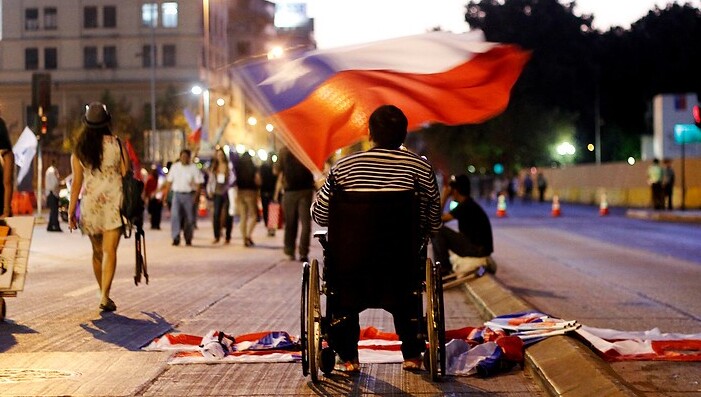
The popular uprising ignited a challenge to neoliberal cultural hegemony regarding what it means to be and to live with a disability in everyday life. This is a challenge to the ways in which the material and symbolic disability of bodies is produced and reproduced, and the precarity this implies for those institutionally categorized as such. Faced with this, they must redefine the impact of this imposition, collectively taking ownership of their destiny to sustain life beyond the enclaves of individualization where these experiences are often confined.
We write this column from a militant alliance, as a researcher with a disability and a researcher committed to the social movement. We approach disability as an embodied and political experience, one of vulnerability and pride, but also of inequality and social injustice.
Two years ago, in October 2019, the popular revolt erupted. Once upon a timeáYes, hundreds of students putítransport is in checkúPublic in the capital. We subíand the value of the meter, we askedíWe had to get up before 6 a.m. to continue paying the regular fare, while our representatives earned million-dollar salaries and were completely disconnected from the daily lives of ordinary citizens. The transition and the joy of it exploded on both the traditional left and right.íwhich he never achieved. Statues crumbled, meritocratic dreams...áCosta Ricans and our fundamental charter, fracturing the sense of communityúa neoliberal system imposed behind closed doors by a group of cisgender, white men of the élite econeconomic factors linked to the dictatorshipíVico-military. After the rape of the "never mace"From thousands of eye injuries and new debts of justice and reparation, we continue to mobilizeáventuring towards a horizon of dignity, without consideringúa precarious and historically invisible group, whose systemic rights have been violatedáethically their fundamental rights: we are talking about people with disabilities.
In 2016, the Second National Disability Survey was published: nearly 3 million people (16,7% of the population) live with a disability, a situation closely linked to the production relations of neoliberal capitalism; 50% live below the poverty line; less than 50% are economically active (most in precarious conditions); and, with an average of 8 years of schooling, they tend not to complete their secondary education. In particular, women with disabilities make up 20,3% of the total female population nationwide, double the percentage of men; they often have to take on the care of family members; and, along with gender and sexual minorities with disabilities, and to a greater extent than their male counterparts, their sexual and reproductive rights are violated: for example, through forced sterilizations that, in turn, facilitate sexual abuse without reproductive consequences and with impunity. Women also make up 73,9% of caregivers, often without receiving any payment in return.
As we can see, disability produces poverty, and poverty, in turn, causes disability, based on intersectional matrices that simultaneously place people in differentiated social positions of inequality, resistance, oppression, and privilege. In the words of Colin Barnes, sociologist of disability and emeritus professor at the University of Leeds, the politics of disability “addresses challenges to oppression in all its forms. Like sexism, racism, heterosexism, and all other forms of oppression, it is a human creation. It is therefore impossible to confront one type of oppression without confronting all others and, of course, the cultural values that have created and perpetuated them.”
In Chile, within the current context of forging a new social pact, we are concerned that disability is once again being viewed as a pathology, rather than a social and political construct. Evidence of this lies in the diverse range of national and international laws and regulations to which Chile has subscribed, yet the oppression of people with disabilities remains unchanged. For example, they are disproportionately affected by the logic of private solutions to public problems, particularly regarding access to education, healthcare, and a dignified old age. This is linked to our vision of the country: neoliberalism strongly shapes our social relations, and it is therefore crucial to rethink the future of Chile with disability in mind, considering it an opportunity within this constitutional process. The popular revolt ignited the dispute over hegemonyíA neoliberal cultural perspective on what it means to be and to live with a disability in everyday life. That is, a challenge to the ways in which the material and symbolic disability of bodies is produced and reproduced, and the precarity this implies for those institutionally categorized as such. In response, they must redefine the effects of this imposition.n, appropriatecollectively taking control of their destiny to sustain lifeáyes thereá of the enclaves of individualization where these experiences are being confined.
The State should be built by each and every person who shares the territories that make up our “nation.” Are people with disabilities part of our communities? Are they relegated to political irrelevance due to the difficulties they face in participating in street protests, uprisings, and the inaccessibility of revolutionary spaces? Are they included within the modern concept of citizenship, whose boundaries have historically excluded those who are mentally ill, disabled, crippled, elderly, Black, and the multitude of bodies that dissent from the male, white, able-bodied, heterosexual, patriarchal, and capital-owning subject? Challenging these boundaries undermines the neoliberal common sense, entrenched in our institutions and subjectivities.
We are therefore pleased that our colleagues with disabilities were heard at the Constitutional Convention. However, we demand that this forum address this issue with the urgency and importance that its recognition deserves within the socio-political sphere, rather than as a pathological issue. The revolt has opened a space of dignity against the daily trampling and condemnation of all fragility and vulnerability to oppressive paternalism or the violence of indifference, dispossession, and death. In this context, we consider that disability emerges as a possibility for revolution and emancipation, from the recognition of a radical movement that autonomously and contingently fights for and affirms relational and critical modes of being.etics of life.
[We are grateful for the contributions to this column of reflections from José Reyes, Ninoshka Godoy, Paulina Sepúlveda, Lorena Núñez, Pamela Gutiérrez, Juan Andrés Pino, Juan Carlos Cea and participants of the virtual discussion “Popular revolt and constituent process in Chile: anti-ableist debates from the social movement”, organized by the Chilean team of the Working Group on Critical Disability Studies of the Latin American Council of Social Sciences, in April 2021]
Jaime Ramírez and Constanza López
Jaime Ramírez is a researcher specializing in disability issues, an activist, and holds a master's degree in Political Science. Constanza López is a researcher, activist, feminist, and doctoral candidate in Interdisciplinary Studies on Thought, Culture, and Society. They are members of the CLACSO Working Group on Critical Disability Studies.
This article was originally published on November 19, 2021 The Disconcert.cl

