
Four years after the passing of Theotonio dos Santos
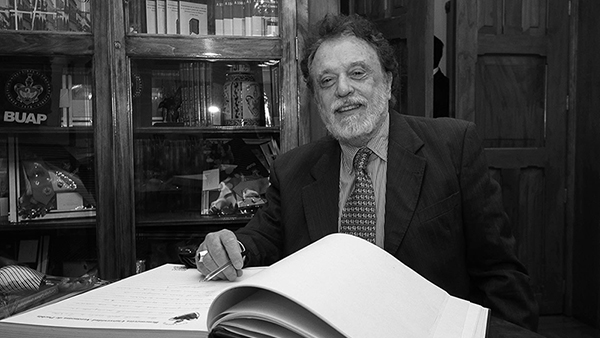

I don't believe in witches, but they do exist.
Monica Bruckmann
I was born from nothing masturbation
In 27 nights and desperate days
Sou um deus
And nothing stops me on my triumphant path
I was conceived by the masturbation of Nothingness
In 27 desperate nights and days
I am a god
And nothing stops me on my triumphant walk.[1]
In 1958, at just over 20 years old, Theotonio dos Santos Junior (as he signed his texts at that time) declared in an interview with the newspaper Diario de Minas:
- Journalist: Do you believe any youth has been diverted into literature?
- Theotonio Junior: Evidently, it exists, it vexes the “beat generation” in the US or the “outside” in England, or the existentialists all over the world. It is the most honest attitude of a young writer in our time. This is not mine, because I am not a writer.
- J: Did you think you died like that, at 21 years old?
- TS: No, because I know that you will die at the age of 67, after completing my work.”
- – Journalist: Do you believe in a transgressive youth in literature?
- – Theotonio Junior: Of course it exists, look at the Beat Generation in the US or the Outsiders in England, or the existentialists worldwide. It's the most honest attitude of a young writer of our time. Mine isn't like that, because I'm not a literary man.
- – J: Have you ever thought about dying like this, at 21 years old?
- – TS: No, because I know I'm going to die at 67, after I've finished my work."
At that time, Theotonio and other young miners were part of a generation of young intellectuals, artists, and writers known as the "Complement Generation," named after the art and literary criticism magazine they published in Belo Horizonte, which shaped a significant part of Brazilian cultural life rooted in the mining region. This generation included the writer Silviano Santiago, the creators of Brazilian modern dance Klaus and Angel Viana, the art critic Frederico Morais, the painter Vilma Martins, and several others. At that time, Ruy Castro, Theotonio's cousin, was taking his first literary steps, encouraged by his older cousin.[2].
Part of the fame that the young Theotonio had achieved, which led some critics to consider him one of the great promises of Brazilian poetry, was the publication of his first book of poems “the construction”, which caused a great impact due to its boldness and style.
When Theotonio approached 62 years of age, he recalled that interview which, obviously, caused him great concern and even a certain anguish: What if those youthful words declared with such conviction were a strange premonition?
Despite being agnostic and, like all miners (born in Minas Gerais), a reserved and modest man, he shared his anguish with some friends. This led him to seek the advice of two Mexican witches who could help him change the course of a possible fate, or, as García Márquez would say, a chronicle of a death foretold. And, to make matters worse, a death foretold by the victim himself. This could become not only a tragedy but a humiliating oversight!
On one of his many academic trips to Mexico, he made an appointment with the witches who, incidentally, held master's degrees in the craft, which gave the patient a special kind of confidence. In the end, they were witches with postgraduate degrees and proven theoretical and practical experience in traditional knowledge of great importance not only in Mexico but in several Latin American countries. Modesty aside, Peruvian witches also enjoy a certain regional prestige!
Theotonio arrived at the consultation room full of confidence. He was greeted by two women with welcoming expressions and firm demeanor. They inquired about the reason for his visit and his request. He recounted his story in great detail, and the women, without saying much, left the small room where they had received him to evaluate the case. After a few minutes, they returned with a proposal: they had managed to contact his ancestors and discovered that, some generations ago, one of the family members had chosen an early death, and that this had marked subsequent generations. However, they would accept a proposal to renegotiate this tradition. Theotonio listened calmly, as was his custom, to the details of the conversation with his ancestors and, finally, said that he accepted the proposal on two conditions: that he could live to be one hundred years old, maintaining all his intellectual and physical faculties, and that he would have the opportunity to die like the Brazilian journalist Barbosa Lima Sobrinho, who died at one hundred while writing his last article.
They withdrew again to take the proposal to the ancestors and returned optimistically to announce that they had accepted and that, from that moment on, Theotonio and future generations could benefit from the pact. Having said this, they proceeded to perform the cleansing ritual, using farm hen eggs to remove the negative energies from the patient's aura. After the session, one of the witches advised him against taking any of the green taxis in Mexico City, because if he did, he would be robbed.
Theotonio left happy and satisfied with the new pact. Lost in thought, I wouldn't be surprised if he was even outlining the structure of his next book; after all, he had just gained almost forty more years of intellectual output. He took the first taxi he found to return to Mexico City. Unfortunately, it was one of the green taxis banned by the witches, and unfortunately, he was robbed and then practically kicked out of the small Volkswagen Beetle, since he had no money in his pockets. The anticipated robbery only reinforced his belief in the effectiveness of the Mexican witches and the seriousness of the pact he had just sealed.
I met Thetonio in January 1999, a few weeks after that incident, in Havana, during the first Meeting on Globalization and Development, which the Cuban Association of Economists organized for more than ten consecutive years, with the support and constant presence of Fidel Castro in the debates. It usually brought together more than a hundred intellectuals from all over the world to discuss different dimensions of the global economy in the grand auditorium of the Hotel Palco in Havana, before an audience of almost a thousand people.
From then on, Theotonio never had a routine medical checkup. He consulted a homeopathic doctor who, with some magic pills, regulated his blood pressure, fatigue, or any other health problem that fell outside the normal range. He was hospitalized a few times for serious health issues: pneumonia, a spike in blood pressure, and perhaps a very bad case of the flu without many lasting consequences. But he always returned to his family doctor, who, with the magic pills, saved him from having to ingest any cocktail of remedies, so unpleasant for daily life. As a classical homeopath, he only prescribed some incredibly powerful little white pills that, depending on the dosage, resolved almost any health problem.
In May 2017, during routine tests requested by his university as part of a senior research fellowship, Theotonio discovered he had terminal pancreatic cancer. With palliative chemotherapy, his life expectancy was six months. Theo survived for nine months, 50% longer than the most optimistic medical prognosis. During his final weeks, we used the lucid moments afforded by the morphine he took to manage his pain to finish selecting texts for his anthology, which the Latin American Council of Social Sciences (CLACSO) was preparing for publication.[3].
The day we finished the selection and the anthology's index was complete, we celebrated with a bottle of Chilean red wine and a Peruvian dinner prepared especially for the occasion. He, who was barely eating and could hardly keep any liquid down, drank, ate, and danced with a joy that filled our kitchen with a strange hope, with a feeling of a job well done (between chemotherapy treatments, emergency hospitalizations, and long hours in hospital corridors, we always carried the computer or some printed texts to continue the work). It was exactly during Carnival, like today, that that celebratory dinner took place.
A week later, on February 27, 2018, Theotonio "was enchanted," as João Guimarães Rosa would say. At 81 years old, he worked almost until his last day. The witches couldn't guarantee him a hundred years of life, but they could ensure he lived in good health and with all his intellectual and physical faculties until the end.
Witches don't exist, but certainly, they do exist...
Monica Bruckmann
Rio de Janeiro, February 27, 2022
[1] Theotonio Junior. To Construction. Complement Editions: Belo Horizonte. 1957
[2] In April 2016, Ruy Castro spoke with journalist Eduardo Tristão Girão and declared, in an article published under the title "Ruy Castro tours Maletta bookstores and reveals himself as a passionate bibliophile": The writer reveals that he is looking for the poetry book A construção, by Theotônio dos Santos, which, he estimates, is probably worth no more than R$ 5. "He was part of a cultural movement here in BH in the 50s called Geração Complemento. He's my cousin, he lives in Rio, and he doesn't have this book either. I lost mine, which he gave me when I was nine years old, with the following inscription: 'For the intellectual future, for your future bookshelf, awaiting your future book,'" he says.
[3] The anthology is available in the CLACSO virtual repository, under the title: Building Sovereignty - An Interpretation of and for Latin America. https://www.clacso.org/construir-soberania-una-interpretacion-economica-de-y-para-america-latina/
If you would like to receive more information about CLACSO's training programs:
[widget id=”custom_html-57″]
to our email lists.

