
72 years after the Palestinian Nakba
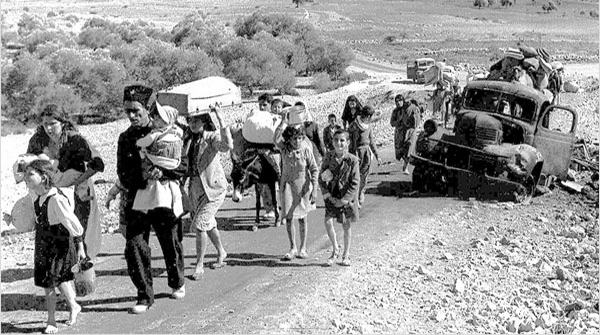
Arab refugees stream from what was then Palestine, on the road to Lebanon in northern Israel to flee fighting in the Galilee region in the Arab-Israeli war, November 4, 1948. CREDIT: Associated Press.
Nakba, which in Arabic means "catastrophe" and is commemorated every May 15, refers to the forced expulsion and exodus of the native Palestinian population between June 1946 and May 1948 as a result of the Arab-Israeli War that led to the creation of the state of Israel.
In the presentation of the book “Nakba – Palestine, 1948, and the Claims of Memory”, compiled by Ahmad H. Saadi and Lila Abu-Lughod, with an Argentine prologue by Karina Bidaseca and published by CLACSO, Editorial Canaán and the Embassy of the State of Palestine in the Argentine Republic in 2017, it explains that "thethe 1948 war that led to the creation of the State The devastation of Israel also resulted in the of Palestinian society. At least 80 percent of the Palestinians who lived in the largest part of Palestine on which Israel was established over 77% of Palestinian territory They became refugees. Their fate It depended on the decisions of the politicians of the countries to Those who fled or became bureaucrats in international agencies. The minority of Palestinians in any The number ranges from 60.000 to 156.000, according to sources.–, who they were left behind, they became nominal citizens of newly established Jewish state, subject to a separate system of la military administration of a government that also confiscated the bulk of his lands."
To commemorate the 72nd anniversary of the Palestinian Nakba, the Embassy of the State of Palestine in the Argentine Republic is broadcasting a series of lectures recorded especially for these days of reflection, which will be transmitted until the first week of June.

Opening remarks: Karina Batthyány (Executive Secretary, CLACSO) / Husni Awdel Wahed (Ambassador of the State of Palestine to Argentina)
Moderated by: Pablo Vommaro (CLACSO) / Mariano Alí (Embassy of the State of Palestine in Argentina)
Presenters: Martín A. Martinelli (Special Group on Palestine and Latin America/National University of Luján) / Jorge Ramos Tolosa (Special Group on Palestine and Latin America/University of Valencia) / Ángeles Castaño Madroñal (Working Group on Epistemologies of the South/University of Seville) / María Paula Meneses (Working Group on Epistemologies of the South/Center for Social Studies, University of Coimbra) / Karina Bidaseca (Working Group on Epistemologies of the South/CLACSO South-South Program)
Organized by: CLACSO / CLACSO Special Group on Palestine and Latin America / CLACSO Working Group on Epistemologies of the South
Hosted by: Embassy of the State of Palestine in Argentina
This activity requires prior registration via the following form
Schedule of online conferences on the occupation of Palestine:

Argentine professor Martín Martinelli from the National University of Luján and the Working Group “Palestine and Latin America” spoke about “Nakba, the cornerstone of Palestinian collective memory”.
In turn, Karina Bidaseca, from the University of San Martín and member of the Working Group “Palestine and Latin America”, spoke about “The skin and the colonial scar in the art of Palestinian women”.
All the lectures can be viewed here:
The book “Nakba – Palestine, 1948, and the Claims of Memory” explains that, "PFor the Palestinians, the 1948 war certainly led to a 'catastrophe'A disintegrated society, a dispersed people, and a complex and historically changing yet secure communal life were violently ended. The Nakba has thus become, for both Palestinian memory and history, the dividing line between two qualitatively opposed periods. After 1948, the lives of Palestinians at the individual, communal, and national levels were dramatically and irreversibly changed. However, this destruction of Palestinian society was overshadowed by the powerful presence of what was internationally represented and understood as a birth or rebirth. The death-rebirth dialectic, a philosophical concept with enormous support in Western religious and secular thought, was applied to the Jewish people. The 1948 war that led to the creation of the State of Israel was waged to symbolize their rebirth a decade after their persecution in Europe and their subjection to Nazi genocide. The creation of Israel was represented and sometimes it was conceived as an act of restitution that resolved this dialectic, extracting the good from the bad. The Palestinians were excluded from the unfolding of this story. Their catastrophe was either disregarded or reduced to a matter of unfortunate refugees, similar to the many millions around the world who wandered through Europe after the end of the Second World War.... "

If you would like to receive more information about CLACSO's training programs:
[widget id=”custom_html-57″]
to our email lists.

