
50 years after "The Theory of Revolution in the Young Marx"
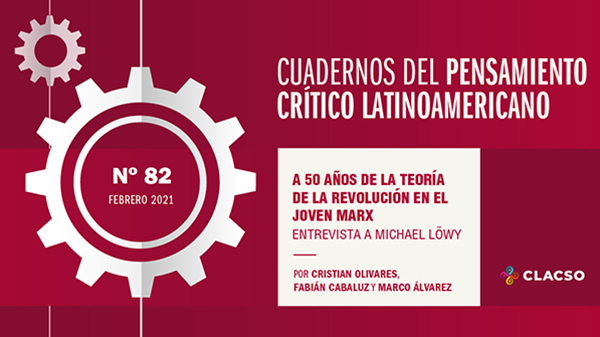
Within the collection of “Notebooks of Latin American Critical Thought”, CLACSO presents the research: “50 years after The Theory of Revolution in the Young Marx – Interview with Michael Löwy"by Cristian Olivares, Fabián Cabaluz and Marco Álvarez
50 years after The theory of revolution in the young Marx
Interview with Michael Löwy
Cristian Olivares*
Fabian Cabaluz**
Marco Álvarez**
Five decades have passed since the publication of The theory of revolution in the young Marx"(1970) by the Franco-Brazilian sociologist and Marxist philosopher Michael Löwy. Considered one of the most influential works in the field of heretical Marxism, this first book by Löwy has become a key text in the political formation of several generations of critical thinkers and/or revolutionary militants.
This text, which resulted from his doctoral thesis defended in Paris in 1964, was written in a context marked by the triumph of the Cuban Revolution and, particularly, in a Parisian atmosphere characterized by the intensification of the class struggle, which received a significant boost from the miners' strike in 1963 and the entire movement that culminated in the events of May '68. These were years of revolutions and popular uprisings, where The theory of revolution in the young Marx It came to nourish revolutionary humanism under the principle of the self-emancipation of the masses, in radical rupture against the prevailing Marxist vision at that historical moment which oscillated between the decadence of Stalinism and the phenomenon of Althusserianism.
Michel Löwy's book, grounded in the method of "genetic structuralism" proposed by his mentor, Lucien Goldmann, delights us with its analysis of the early work of the young German philosopher. It rigorously revisits the historical struggles that unfolded in Europe during the 1840s, the organizational and combative experiences of the working class, and the development of the European socialist and communist movement—socio-historical elements that it connects to an analysis of the work and activism of Karl Marx.[1]Furthermore, it analyzes the historical and dynamic evolution of Marx's work, emphasizing its internal modulations, leaps, reorientations, internal transformations, and debates with European philosophers and socialists; in other words, it seeks to demonstrate the winding path through which the philosopher from Trier constructed his categories, philosophical conceptions, and political perspectives. Finally, this research transcends narrow disciplinary boundaries, creatively articulating sociological, historiographical, philosophical, and political theory contributions.
On this occasion, we wish to highlight two major arguments put forward by Michael Löwy that we consider highly relevant and current for those of us who, from anti-capitalist positions, stubbornly uphold Marx's legacy. First, Löwy's work allows us to delve into the life and work of the young Marx, particularly concerned with how he developed his theory of revolution and the notion of "workers' self-emancipation" in the context of the revolutionary struggles that unfolded in Europe between 1840 and 1848. According to his analysis, "workers' self-emancipation" consists of three dialectically linked moments: first, the verification of the nature potentially revolutionary of the proletariat; second, the proletariat's tendency toward communist consciousness through its revolutionary praxis (which is where the change in consciousness coincides with the change in circumstances); and third, that the role of the communists in this process would consist of developing this tendency toward its full coherence. Thus, Löwy points out that it is in this threefold movement that the "critical-practical structure" or the praxis of Marx's thought is manifested.
Secondly, we would like to highlight that, throughout the book, Michel Löwy guides us through the work of Karl Marx, from his early writings in the "Rhenish Gazette" to "The Communist Manifesto." Along this path, he clearly illustrates different phases or transitions in Marx's thought: his tensions and breaks with the Left Hegelians, his approaches to the study of economic issues and the field of political economy, his questioning and distancing himself from the philosophies of Hegel and Feuerbach, his evolving understanding of the popular sectors and the proletariat, his relationship with the French, German, and Belgian socialist/communist movements, the points at which he embraced communism, and his engagement with different perspectives on materialism, among other things.
Below, we share the interview we conducted with our colleague Michael Löwy, as part of the celebration of the 50th anniversary of the publication of The theory of revolution in the young MarxThe interview delves into the author's initial motivations for writing the thesis, his methodology, and some of the work's central tenets. It also connects various elements of the text to other publications by the same author, focusing on the ideas of Commander Ernesto "Che" Guevara and Walter Benjamin's conception of history. Finally, the interview addresses some reflections on the necessary connections between the work of Karl Marx and other revolutionary currents, as well as the importance of reflecting on current self-education processes and projects.
Interview:
Dear Michael Löwy, we are commemorating and honoring the 50th anniversary of the publication of your book. The theory of revolution in the young Marx which was published by Maspero in Paris in 1970 and which, in turn, is the product of your doctoral thesis project. To begin, we wanted to ask you: When and how did the idea of working on the intellectual and political evolution of the young Marx arise? Was it during your sociology studies at the University of Sãor Paulo; in the Reading Group on The Capital where Fernando Enrique Cardoso, Paul Singer, among others participated; or was it in the seminars given by Lucien Goldman on the philosophical thought of the young Marx? Please tell us about this formative period in your career.
It was in Brazil that I became interested in politics, socialism, and Marxism, before university; my discovery of and interest in Marx dates back to my teenage years, during my political activism. At university, Marx wasn't discussed, much less the "young" Marx; and in the seminar of The Capital in which I participated, they talked about The Capital And not the young Marx. That is to say, it was on my own that I became interested in the young Marx and his philosophy, as it was an ethical-political and philosophical dimension that attracted me more than the critique of political economy. Based on that, I began to read about the young Marx and wrote a short article about it in the Brasiliense Magazine (1961); and from the beginning of the 60s I decided to do my doctoral thesis on the young Marx with Lucien Goldmann, as my idea was to go to Paris to work with him.
That was the starting point, so it had nothing to do with university. It had more to do with an interest in the philosophical, ethical, and political dimensions of Marxism; and with Rosa Luxemburg, because she was my fundamental political reference point during those years, and from there I felt the urge to do a reading Rosa Luxemburgist –if one can say so– of the young Marx.
When it is published The theory of revolution in the young MarxAt the same time, Lucien Goldmann, your mentor, to whom you dedicate the book and whose influence you acknowledge, “genetic structuralism,” also passes away. Fifty years after this influence and Goldmann's passing, could you speak to us about the enduring relevance of his theoretical and methodological thinking?
Lucien Goldmann was a fundamental inspiration for me, and when I first arrived in Paris, he was teaching lectures on the young Marx, which greatly interested me. In fact, the method of my dissertation was inspired by Goldmann, particularly by what he called "genetic structuralism," that is, studying thought not in isolation, but within the context of the historical totality: analyzing thought in relation to the historical processes unfolding at that moment, the class struggles, the different positions in the social, political, and cultural spheres, and so on; in other words, conducting a Marxist (historical, materialist) analysis of the young Marx's own thought. That was essentially the approach, based on Lucien Goldmann's method of studying thought, culture, and so forth.
Well, that doesn't mean Goldmann agreed with all my arguments. He had his criticisms. Above all, he didn't see the connection I was making between the evolution of the young Marx's thinking and the social, proletarian, or communist movements of his time. He didn't agree with that argument, and that's where we disagreed. But the method of my research was indeed the Goldmannianthe “genetic structuralist”.
To speak of Goldmann is also to speak of Lukács (the “young Lukács,” whose evolution you have dedicated yourself to researching), but above all, it is to speak of Lukácsian dialectics, and this principle you mention, that of totality. Could you tell us about Lukács and the young Marx, in addition to alluding to the recent controversy/critique you have made of Žižek Regarding his Stalinist assessment of the old Lukács?
The Lukács that interested me, and that also interested Goldmann, was the one of History and class consciousnessIt wasn't Stalinist at all, since it was a book from 1923, before Stalin seized power in the USSR. It's a book that I would say is partly Leninist and partly Luxemburgist, and it also reinterprets historical materialism with the dialectical concept of totality, which greatly appealed to me. But I insist that, although from a methodological and epistemological point of view Goldmann and Lukács were my main references, my reading of the young Marx stemmed from and was inspired by Rosa Luxemburg, by the—let's say—fundamental idea of Marxism in its later analysis, which was so important to her, that the revolution must take the form of the revolutionary self-emancipation of the proletariat.
What my thesis brought to the table—but which was not truly understood by either my thesis committee or most of the critics who reviewed it—and which was the true theoretical and political heart of the thesis, was the relationship between the idea of the revolutionary self-emancipation of the oppressed and the philosophy of praxis. That is to say, when Marx writes the Theses on FeuerbachIt is the beginning of a new conception of the world – as Engels said – breaking with both Hegelian and/or left-wing neo-Hegelian idealism and with traditional materialism that comes from the French encyclopedists with their German disciples, including Feuerbach, among others.
Anyway, in the Theses on FeuerbachMarx inaugurates a new worldview—which we can call a “philosophy of praxis,” in Gramscian terms—that is a new materialism and, at the same time, the foundation of a new conception of revolution. The conceptions of revolution in Marx's time were, on the one hand, materialist, which held that material conditions determine the behavior of individuals and peoples, so that to change society, material conditions had to be changed. And who can do that? Not the people, because the people are victims of material conditions that prevent them from having consciousness; therefore, the emancipation of the people must come “from above.” This is the origin of the French Encyclopedists with their idea of the “enlightened despot,” the enlightened king or emperor; and later, in the 19th century, the revolutionaries, with the idea of a revolutionary vanguard elite that would emancipate the people. That's one perspective. On the other hand, there were the Hegelians, the idealists who argued that to change society, one must change ideas, consciousness, and thought through philosophical critique; and Marx, initially, adhered to this position. He was a left-wing neo-Hegelian: in one of his major articles from 1844, he stated that the revolution begins in the minds of philosophers and then takes hold of the masses. Therefore, Marx was part of this neo-Hegelian, idealist vision, which held that revolution begins in thought.
It is in the Theses on Feuerbach where Marx breaks with these two ideas, both that of the materialists and that of the neo-Hegelians, proposing in one of his theses that it is in revolutionary praxis where the change of circumstances coincides with the change of consciousness: in their collective—mass—and revolutionary action, the oppressed, the workers, the proletariat, change the material circumstances, the social structures, politics, etc., and, at the same time, their consciousness; they acquire their revolutionary consciousness. A little later than the Theses on FeuerbachMarx and Engels write The German ideology, which is where those ideas will be developed.
The central thesis of my work was about that relationship between the new worldview – the new philosophy of Marx, the philosophy of praxis based on the Theses on Feuerbach y The German ideology—with the idea that the revolution must take the form of the revolutionary self-emancipation of the oppressed: the relationship between the philosophy of praxis and the idea of the self-emancipatory praxis of the oppressed; that was the theoretical and political heart of the thesis. Unfortunately, I believe it was not grasped by either my jury—mainly professors of history, very important and respectable—or Goldmann himself, who were focused on the question of whether or not Marx's thought had any relation to the proletariat of his time, which was what my thesis argued (that Marx's ideas were an expression of a class position, based on the struggles, experiences, and ideas that were developing within the proletariat of his time). That thesis, rather classical Marxist, where ideas are related to social classes (although Marx, obviously, has nothing to do with the proletariat due to his personal position, but it was his political choice to approach the proletariat and identify with it, appropriating its ideas, its experience of struggle, etc., to develop his revolutionary thought from the perspective of the oppressed), is a socio-historical thesis – if you will – that was heavily criticized by the jury and Goldmann, who said no, that the proletariat of that time did not exist, etc., I'm not going to go into details; but the discussion focused on that, and I think they didn't realize that the core of the thesis was that relationship of the philosophy of praxis with the idea of revolutionary self-emancipation.
Parallel to the publication of The theory of revolution in the young Marx you posted The thought of Che Guevarawhich is also celebrating its 50th anniversary. Could you outline some ideas about the philosophy of praxis and revolutionary humanism in Marx and Guevara?
The two books appeared at the same time, but they were written in different periods. The thesis was written from '61 to '64; I presented it in '64, and for reasons I still can't explain, it was published in 1970. As for the book about Che Guevara, I wrote it in '69; that is, in a different historical period, in a different context; and in that work I was indeed interested in demonstrating that Che Guevara was not only the heroic guerrilla fighter, an exemplary combatant, and so on, but also a great Marxist thinker.
I don't think there's a direct relationship between the two books. They're from different historical situations. Obviously, they're different figures; but there is a lot of overlap, for example: praxis is a fundamental theme, both for Che Guevara and the young Marx; and the question of Marxist humanism, a very important theme for me that I developed both in my doctoral thesis and later in polemical articles against Althusser, arguing that Marxism is indeed a revolutionary humanism, and I found that revolutionary humanist reading of Marxism in Che Guevara and it seemed fundamental to his thinking. There—if you will—is a connection, but I insist that they are different books; while Che's work has a theoretical ambition, it's not an academic thesis: it's a book of political intervention that doesn't adhere to academic rules, it doesn't have the same character.
What can you tell us about the young Marx's conception of history? And, please, in your capacity as the quintessential revolutionary Benjaminian exegete, if you can link this to Walter Benjamin, whose death 80 years ago, besieged by fascism in the small Catalan cove of Portbou, was commemorated around this time.
When I was studying the young Marx, I had no idea about Walter Benjamin's work. I hadn't discovered him. My discovery of Benjamin came much later; it was in the late 70s, almost 20 years later. So I don't think there's a connection; it's difficult to compare them.
In my doctoral thesis, the main political idea is that of the revolutionary self-emancipation of the proletariat, breaking with all the visions that proposed emancipation "from above," whether in Stalinism with the role of the tyrant as the supposed emancipator, or in the idea of a vanguard that would emancipate the workers. My thesis included the idea that emancipation comes "from below." That was a vision—I'm not saying of history, but certainly a vision of politics—in the young Marx.
What we find in Benjamin that does have some connection to that is the fact that he places at the center of his vision what is proper to historical materialism and Marxism: the class struggle, and not the development of the mode of production, not the contradiction between forces in the relations of production, not the analysis of the forms of the State… in short. The heart, the center, the essence of historical materialism, for me, is the class struggle, the struggle of the oppressed classes, the proletariat more broadly, the oppressed classes. There I see a point of continuity—if you will—with the young Marx, in that importance of the class struggle and of revolution, of course (which is the other fundamental idea of Benjamin's political conception: revolution). The class struggle and the revolution. There I do see—if you will—some kind of relationship between the young Marx and Benjamin.
In the 1997 preface of The theory of revolution in the young MarxYou speak of the importance for the Marxist tradition of developing a open behaviorA learning disposition interwoven with other emancipatory threads. Thinking strategically, what are the fundamental currents with which Marxism should engage in dialogue today?
Throughout the history of Marxism, we see that it has always developed through dialogue; sometimes through critical confrontation, but also by learning from other schools of thought, from social and historical struggles, and so on. In other words, Marxism is not a closed set of dogmas or sacred texts; it is a dynamic and evolving ideology. Marx himself changed his conceptions based on the historical experiences of the proletariat. After the Paris Commune, he reformulated his political conception, his vision of the state, and so forth. I believe we must do the same.
I believe that I have raised two dialogues in my writings that seem important to me, but they are not the only ones, since there are other currents with which it is worthwhile to discuss: with Freudian psychoanalysis, critical sociology, and so on.
What I find very important is the dialogue with the thought of the libertarian revolutionary tradition (not only anarchist in the strict sense, but libertarian), with its experience, especially in Spain in '36, and also with its historical reflections, the writings of Bakunin, Malatesta, and several others; there are still very interesting things to be found there today. I think this dialogue between Marxists and libertarians is important. I also think a convergence in action is very important, which has occurred at many points in history: in the Paris Commune, in Spain in '36, and even today in various movements, such as in Mexico, in Chiapas, in the Kurdish movement in Rojava, and so on. This seems to me a very important dialogue, in which—as in any dialogue—we have to listen to what others say, but where we also have something to contribute from our own tradition.
And the other dialogue that I consider fundamental is with ecology. I am increasingly convinced that the ecological question is the fundamental political question of our time in the 21st century, and I believe that Marxists must rethink their formulations, their approaches, in light of the ecological crisis. I consider that fundamental, and that is why I speak of “ecomarxism” or “ecosocialism,” because I believe that convergence between ecology and Marxism is essential.
I think these are two aspects that, stemming from this opening of Marxism, can be implemented today, but I want to emphasize the ecological question in particular because it's the newest. Dialogue with anarchism has had several phases in the history of Marxism; but the new issue that arises today, a question of the 21st century, is the ecological question. There's already a whole body of literature on an ecological reinterpretation of Marx's own writings—John Bellamy Foster, for example—and there's a whole "eco-Marxist" or "eco-socialist" current that has developed in recent years, illustrating this renewal of Marxism in our time.
Finally, from Our America, what do you think are the central categories developed by the young Marx for the struggles of our times? And what recommendations or methodological observations could you offer to those of us concerned with creating educational spaces (or spaces for political self-education) around the work of Marx and the Marxist tradition in general?
This idea of self-education seems very important to me, and I think it's something that was already being considered, perhaps in a slightly different way, by the young Marx and Rosa Luxemburg. They started from the idea that the exploited, oppressed, proletarian masses, women, educate themselves through their own experience of struggle, action, and reflection, and not primarily thanks to educators and intellectuals, who also have their role. The great masses educate themselves in a process of self-education through their self-organization in their experience of struggle; this is a fundamental idea for the young Marx and Rosa Luxemburg. I think this is very relevant in Latin America today.
I would say that if we want a Latin American Marxist thought, if we want to think about Latin America from a Marxist perspective, we have to start with a lesser-known text by Marx: his later writings on Russia, particularly the 1881 letter to Vera Zasulich, in which he speaks of the rural community as the starting point for a socialist revolution in Russia. The equivalent of this in Latin America was found in the writings of José Carlos Mariátegui, who, without knowing Marx's later texts, developed his own path as a Peruvian thinker, drawing on the historical experience of the Andean peoples, on the Andean communal tradition inherited from the Incas. He put forward the same idea for what he called Indo-America, but it applies to much of Latin America: starting from indigenous communal traditions to develop a modern revolutionary communist movement, in alliance with rural and urban workers, and so on.
That communal tradition plays a fundamental role and seems very relevant to me in Latin America today: we see what has happened in Chiapas with the Zapatista Movement, which is closely linked to those indigenous communal traditions (Mayan, in Chiapas); everything that has happened in Bolivia in recent years/decades; what has happened in Chile with the Mapuche; the struggles in the Amazon in Brazil; and so on. In other words, indigenous communities in many Latin American countries—in Indo-America, as Mariátegui called it—are on the front lines of social and ecological struggles, which are struggles in defense of forests, rivers, and so forth, against multinational corporations. That tradition mariateguistBut which has its elements and origins in Marx himself, seems fundamental to me for thinking about the struggles of Latin America today.
November 19, 2020
* Cristian Olivares. Metropolitan University of Educational Sciences, Chile. Center for Studies of Marxism and Education (CEMED). Member of the CLACSO Working Group “Legacies and Perspectives of Marxism”. [email protected]
** Fabián Cabaluz. University of Christian Humanism, Chile. Center for Studies of Marxism and Education, CEMED. Member of the CLACSO Working Group “Legacies and Perspectives of Marxism”. [email protected]
** Marco Álvarez. Chilean sociologist and writer. Critical Thought and Historical Memory Group (GPM). [email protected]
[1] For Löwy, Karl Marx's activism during this period is neither a minor detail nor an anecdotal matter; rather, it is a crucial element for understanding the formation of his own thought. In this regard, Michael Löwy emphasized Marx's various connections with communist secret societies in Paris, the League of the Just, Chartism, and the Silesian Weavers' Revolt, among others.

Download the notebook at Librería Latinoamericana:
If you would like to receive more information about CLACSO's training programs:
[widget id=”custom_html-57″]
to our email lists.

