
“Women earn only one-third of the world’s labor income”
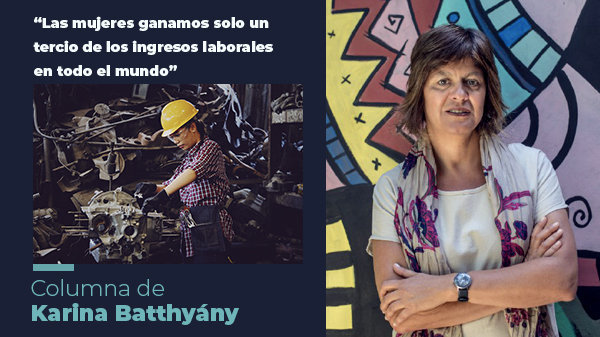
(Transcription of Karina Batthyány's Column)
(In InfoCLACSO – December 22, 2021)
Before writing today's column, I want to address Sunday's elections in Chile, which are part of a series of processes we've observed this year in Latin America and the Caribbean: clearly Peru, and Honduras, where the elections took place a few weeks ago but Xiomara Castro was officially proclaimed president-elect two days ago. This perhaps marks the path toward what we might call a new progressive wave in Latin America and the Caribbean, one we will be watching closely, and we will be waiting to see what happens in Colombia and Brazil next year.
These are some of the themes we will also address at our Ninth Conference in Mexico #CLACSO2022 regarding these crossroads that we have so often mentioned in Latin America and the Caribbean: economic, social, and political crossroads in this case, where these ambivalences are on full display. Because, of course, we welcome and celebrate the process in Chile following Sunday's election, as well as in Honduras and Peru further back in time, but we must not forget that this is also accompanied by far-right and, in many cases, fascist conservative expressions in our Latin American countries. Brazil is the case that has caused the most concern in the region, but it is not the only one. In Uruguay, we also have these expressions, for example, alongside the Military Party, which exists and consistently maintains this type of stance.
Therefore, we welcome and celebrate Chile's result, and frame the process we are witnessing alongside Honduras, Peru, and, of course, the countries already on this path: Mexico, Argentina… And we must pay close attention to next year, as what happens in Colombia and Brazil could be absolutely decisive for our continent. All of this will be a key topic at our Ninth Conference #CLACSO2022.
Gender inequalities
In the previous column, we analyzed the key findings of the 2022 Global Inequality Report, a research project primarily led by Thomas Piketty. We reviewed the main results, but due to time constraints, I had left gender inequalities for later. This report focuses on a dimension we have addressed regularly here at InfoCLACSO on Wednesdays: women's economic autonomy. Specifically, it addresses autonomy in terms of labor force participation and the ability to earn their own income, two of the indicators used to define this concept of economic autonomy.
This report offers an interesting summary of what is currently happening with women's labor income. To begin: if a country had perfect equality between women and men, women's share of labor income should be equal to or very close to 50%. What happens in practice? Women's share of income is consistently (regardless of the country) below 50%, with significant variations between countries, ranging from less than 10% to a maximum of 45%. Therefore, in no case does it reach the 50% share that would demonstrate perfect equality in this area.
Let's quickly examine how this plays out in different regions of the world. Let's begin with what is known as the former Eastern Bloc, where women's participation in labor income is higher. This is obviously linked to the social and political systems of these former Eastern Bloc countries, which strongly promoted women's entry into the labor market; these countries have a female participation rate in labor income of around 41%. Looking at the rest of Europe, what is called Western Europe, it also has a high participation rate in labor income compared to other parts of the world, but it is lower than the figure I just mentioned. There, this participation is estimated at around 39%, but with variability among countries, ranging from 35% in Austria (the lowest) to 44% in Portugal (the highest).
North America and Australia, for their part, have similar but lower shares than Europe. Specifically, the United States and Canada have shares of 38% and 39%, respectively. This means that men capture around 62% and 64% of total labor income, more than half of what women receive. This illustrates the magnitude of systemic gender inequality, at least with regard to this notion of economic autonomy.
What about our Latin American countries? They appear third in the report, and I want to emphasize that the behavior of Latin American countries seems relatively homogeneous. The average female labor income share is 35%, ranging from 26% in Guatemala to 42% in Barbados. And in the two most populous countries, Brazil and Mexico, the shares are 38% and 33%, respectively.
Next, we have the Asian countries, which have lower percentages than Europe and lower than North America, averaging 27%. There appears to be a strong distinction between East and West Asian countries. East Asian countries have higher percentages, and the two most densely populated countries, China and India, have shares of 33% and 18%, respectively.
Finally, countries in the Middle East and North Africa have low levels of female labor participation in total income, averaging 15%, with most below 20%. Five countries—Yemen, Iraq, Saudi Arabia, Qatar, and Oman—have the lowest figures globally, below 10%.
Then we also have to look at what happens in sub-Saharan Africa, which has an average value close to 30%.
One conclusion: Women earn only one-third of global labor income. Remember that women make up approximately 50% of the population. Women's share of global labor income is calculated by adding up all labor income, including women's income, and dividing by total global labor income.
Today, that share is one-third, but it must also be said that women's share of income increased slightly from 31% in 90 to 35% in 2019. In other words, it seems that we cannot and will never surpass that percentage of around 30%, and the growth that occurred is too slow to really say or imagine and project when we will reach conditions of equal participation in this dimension of income.
There are many factors that could explain the issue we're raising today, which, of course, we'll surely have time to explore in more depth next year. But I don't want to fail to mention that there's one factor we've addressed extensively here in these InfoCLACSO columns, which is everything related to unpaid care work. This report also identifies this dimension of unpaid care work as one of the main factors in explaining the gaps and inequalities I just mentioned. These are essentially income inequalities between men and women that are significant both within countries in the region and globally. This reaffirms, once again, the systemic nature of gender inequality.
-Besides, there's a clear pattern that keeps recurring, that intensifies brutally in some countries, that softens in others, but the pattern is crystal clear. Because what all the figures you're not disclosing show is a continuity in almost every part of the world, right?
To put it almost humorously, the pattern is patriarchy, which we observe in every country and which has these and other consequences that we've also addressed here in the InfoCLACSO columns, but I think this is very clear. That's why I wanted to share it with everyone so that we can see, first, the global reality, and second, what's happening in Latin America in this regard. And, to conclude presenting this data from the 2022 Global Inequality Report, let's remember that the Webs of Inequality are the theme that will bring us together at our upcoming #CLACSO2022 Conference in Mexico in June.
-You mentioned the word "plots," and I think you have something very important new. Would you like to tell us about it before we say goodbye, because it's something fundamental and very powerful for this time of year?
The exciting news is that the new journal of the Latin American Council of Social Sciences, "Tramas y Redes" (Networks and Structures), is now available online and on social media. Its first issue has been released, and the journal is beginning its indexing process. It has all the characteristics of a scientific journal, and we invite everyone to contribute to this issue and subsequent ones. Information is available online for anyone who wishes to contribute their academic articles to this journal.
We had truly set out to build, to imagine, to create a new scientific journal for our Latin American Council of Social Sciences, and we are very pleased to be presenting this first issue of “Tramas y Redes” today. Everyone is invited to read this first issue and to contribute to it in subsequent issues.
If you would like to receive more information about CLACSO's training programs:
[widget id=”custom_html-57″]
to our email lists.

