
Gender inequalities and violence in Latin America and the Caribbean

RESEARCH GRANTS FOCUSED ON CENTRAL AMERICA AND THE CARIBBEAN
Registration closes: November 23, 2020
The countries of Latin America and the Caribbean still face numerous challenges in overcoming gender inequalities. These inequalities continue to pose a serious obstacle to building more just and democratic societies with greater rights and recognition.
In Latin America and the Caribbean, the feminization of poverty, gender biases in fiscal policies, gender and racial/ethnic wage gaps, and the sexual and international division of labor demonstrate that implemented public policies remain limited and insufficient in most countries. Thus, inequalities cut across gender lines, perpetuated by patriarchal subordination and capitalist coercion, deepening processes such as the feminization of poverty, discrimination against women in various social spheres, and femicide, among others.
This structurally violent situation calls for acknowledging the multidimensional nature of inequalities. That is, not only relating gender to other dimensions such as ethnicity, territory, or generation, but also considering gender inequalities as multiple: associated with the care economy, working conditions, education, social participation, access to justice, health, violence, environmental conflicts, migration processes, interculturality, public policies, and social movements.
Today, violence, intertwined with inequalities, permeates the lives of millions of women. Therefore, denunciation and political engagement are important, but so too are research, understanding, and proposals to counteract the processes of production and reproduction of the inequalities that sustain gender-based violence.
Based on this analysis, this call for proposals focuses on gender inequalities that permeate other dimensions of social life, emphasizing the links between increased inequality and the rise in violence. The call also includes dimensions such as environmental conflicts, migration, interculturality, public policy, and social movements, all addressed through cross-cutting gender perspectives.
Likewise, this call seeks to draw attention to the stagnant elements and even some setbacks in terms of women's rights and recognition, showing the urgent need to propose alternatives that include equality as a founding premise of our societies.
Applicant profile.
-
The applicant must be a researcher with accredited ties to CLACSO Member Centers, which they will demonstrate with a sworn statement. If awarded the scholarship, they must submit a letter of support signed by the highest authority of the center.
-
Submissions from individual or collective authors (up to 3 members) will be accepted.
-
In the case of teams, their composition must respect gender parity, and one member must be selected as the person responsible for registering the project. These teams may consist of established researchers, meaning those with a master's degree, doctorate, or equivalent qualification and a proven academic track record, and/or researchers in training, meaning those currently pursuing a master's or doctoral degree or who are up to 35 years of age, in which case they must hold an undergraduate degree.
-
Two categories of researchers will be considered:
-
Trained researchers: Those who hold a master's degree, doctorate or equivalent and have a proven academic track record
-
Researchers in training: Those who are currently pursuing master's or doctoral studies or are up to 35 years of age, in this case with a degree.
-
-
The application will be evaluated according to the composition of the team and the category of the researcher/person responsible for the proposal.
-
Each researcher may only participate with one proposal in this call.
-
If the scholarship is awarded and travel is necessary, the winners will be responsible for covering the costs of medical insurance or similar expenses.
Support to be granted
Up to 12 scholarships will be awarded (5 for established researchers and 7 for researchers in training). At least 50% will be awarded to women and at least 30% to applicants from Central American and Caribbean island countries.
The amount of the scholarships awarded will consist of:
-
US$8.000 for the scholarship recipients/students trained
-
US$5.000 for scholarship recipients in training.
The proposed research will be carried out over a maximum period of 10 (ten) months. The scholarships will be paid in installments via bank transfers made to the recipients. It is expected that at least 60% of the scholarship funds will be used for activities related to gathering and processing the information necessary for the research, which must be reported to CLACSO with supporting documentation.
The winners will work with the support of tutors assigned by CLACSO who will follow the process of their research and results.
CLACSO will publish the final products in print and/or digital media, giving them wide publicity and dissemination through the means it deems appropriate.
The authors will transfer the original publication rights of their works, given that CLACSO adheres to and defends the principles of open science and open access to knowledge, so that the resulting work is easy to find, accessible, interoperable, and reusable. Subsequently, these works may be published in any other medium, always citing the grant received. Grant recipients must inform CLACSO of the subsequent publication of works resulting from the grant work.
Characteristics of the proposals
-
The member centers to which the applicants are linked must not have any outstanding debts in the payment of membership fees corresponding to the year 2019, due on June 30 of the same year.
-
Completed research projects will not be accepted. Proposals may be linked to ongoing research processes, but the final works must be original and unpublished products and developed within the period established by the call for proposals.
-
Members of the Steering Committee or officials of the CLACSO Executive Secretariat may not participate.
-
Proposals from researchers who are currently recipients of research grants, fellowships, or research projects organized by CLACSO will not be accepted. Applications from researchers who have previously received a CLACSO research grant will be accepted, provided that the recipient has fulfilled all obligations in a timely manner.
-
Texts written in the four languages commonly used in Latin America and the Caribbean (Spanish, English, Portuguese and French) will be accepted, depending on the country of origin of the proposal.
Selection criteria for proposals
-
In the first stage, the submitted proposals will be reviewed for their formal and administrative aspects to ensure their compliance with the competition rules. Proposals that do not meet the established requirements will be rejected.
-
Applications that pass to the next stage will be evaluated by an International Committee composed of experts who will assess the quality and relevance of the proposals, which will be submitted under a pseudonym.
-
The Call may be declared void or a smaller number of scholarship recipients may be selected, if the proposals submitted do not meet the required quality and consistency.
-
Situations not covered in this document will be resolved by the convening institution.
-
The ruling will be final.
Characteristics of research papers
-
The research projects will develop their work plan between January 2021 and October 2021. This plan will be implemented under the facilitation of tutors assigned by CLACSO.
-
The progress and final reports submitted by the scholarship recipients will be reviewed by the tutors.
-
In their final version, the research papers submitted as a result should be between 12.000 and 15.000 words in length (excluding appendices and bibliography), written in Times New Roman 12-point font, single-spaced. This is an approximate guideline, and CLACSO reserves the right to make adjustments or exceptions if deemed necessary.
-
The structure of the text will be free, respecting the conventions of presentation of an academic text and the editorial standards of CLACSO, in addition to APA + GENRE.
-
In addition, each team must submit a Guidelines for Action Document, containing inputs and recommendations for public policies and social intervention on the topics investigated.
-
Texts written in the four languages commonly used in Latin America and the Caribbean (Spanish, English, Portuguese and French) will be accepted, depending on the country of origin of the proposal.
It is mandatory that the submission be made through the online registration system provided by CLACSO. Printed submissions and submissions sent by email will not be accepted. It is recommended to access the online system to review the registration form.
-
Visit the CLACSO website www.clacso.org . The online registration system will be available starting October 16th.
-
Register in the CLACSO Single Registration System (SUIC). The generated username and password will be required each time you wish to access the system to consult, modify, add, or submit information for this or any other CLACSO activity. Applicants submitting collective proposals must designate one of the authors as responsible for registration. This same person will receive the corresponding monetary award if the proposal is selected by the Jury.
-
Identify the proposal by indicating its title and the pseudonym of the applicant(s). Applications with pseudonyms that correspond to the applicant's first and/or last name will not be accepted. Once the corresponding fields are completed, the system will enable the uploading of the following data.
-
Applicants must complete the sworn statement on the registration form indicating their affiliation with a Member Center belonging to the CLACSO network. The database of member centers can be found at: www.clacso.org.ar/clacso/centros_miembros_clacso/inicio.php.
-
Complete the personal and academic data form and attach the curriculum vitae in free format; the digital copy of the identity document, passport or ID card; the digital copy of the highest academic degree obtained (or proof of degree in process) and the photograph.
-
The proposal must be filled out on the form that appears once the personal and academic data has been completed.
-
Once registration is closed, the system will produce an electronic certificate of receipt that will serve as proof.
Registration closes: November 23, 2020, 24:00 PM (Argentina)
Winners will be announced on December 30, 2020.
Project completion: January 2021
Final report due: October 2021
The results will be published on the CLACSO website. The winners will be contacted by email.
Inquiries: [mail protected]
If you would like to receive more information about CLACSO's training programs:
[widget id=”custom_html-57″]
to our email lists.
Results
Opinion
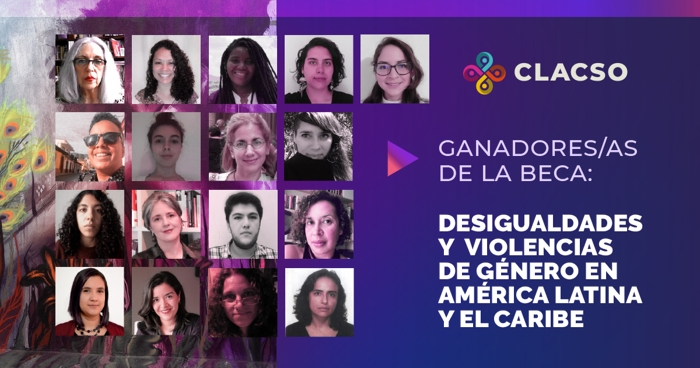
The Latin American Council of Social Sciences (CLACSO) announces the results of its research call, “Gender Inequalities and Violence in Latin America and the Caribbean ,” which seeks to draw attention to the stagnation, challenges, and setbacks in women's rights and recognition. It also aims to demonstrate the urgent need to develop alternatives that include equality as a fundamental principle of our societies and acknowledge that, currently, violence intertwined with inequalities permeates and shapes the lives of millions of women.
Seventy applications were received , of which, after the technical and formal review, 149 were in a condition to be qualitatively evaluated by the International Committee to consider the quality, relevance and coherence of the proposals according to the Call.
The evaluation process was carried out by an International Committee composed of 23 experts from 15 countries: Ana Silvia Monzón (Guatemala), Marcia Leite (Brazil), Gabriela Marzonetto (Argentina), Blanca Munster (Cuba), Ana Carcedo (Spain), Javier Gómez (Bolivia), Patricio Dobree (Paraguay), Patricia Ames (Peru), Natalia Quiroga (Argentina), Claudia Piedrahita (Colombia), Delmy Cruz (Mexico), Catalina Arteaga (Chile), Daniela Perrotta (Argentina), Alejandra Valdés (Chile), Karina Gregory (El Salvador), Montserrat Sagot (Costa Rica), Catalina Mendoza (Ecuador), Clara Araujo (Brazil), Rita Alves (Brazil), Nora Goren (Argentina), Natalia Genta (Uruguay), Norma Vasallo (Cuba), Martha Patricia Castañeda (Mexico).
Following the evaluation, 12 (twelve) proposals were selected : 5 (five) for established researchers or teams and 7 (seven) for researchers or teams considered to be in training. Based on the above, the list of winning proposals for the Call for Proposals is as follows:
|
TRAINED RESEARCHERS |
|||
|
Authors |
Member Center or Institution |
Country |
Title of the proposal |
|
Katherine Esponda Contreras |
Institute for Sustainability Studies – IEPS – Autonomous University of the West |
Colombia |
An intersectional approach to analyzing femicides in Colombia: cases that matter without being counted |
|
Diana Marcela Blanco Betancourt |
The College of the Southern Border – ECOSUR |
Mexico |
Challenging historical invisibility: Life stories of indigenous Tseltal women from their intersections. |
|
Alba Carosio |
Center for Women's Studies – CEM – Central University of Venezuela |
Venezuela |
Teenage pregnancy, inequality and violence |
|
Lirio del Carmen Gutiérrez Rivera |
Faculty of Humanities and Economics – FCHE – National University of Colombia |
Colombia |
Women in contexts of crime: Strategies of community leaders and activists to inhabit neighborhoods controlled by illicit groups in Medellín, Colombia |
|
Denise Ocampo Alvarez |
Cuban Institute of Cultural Research – ICIC – Ministry of Culture |
Cuba |
Discursive strategies on Facebook used in the religious escalation against gender equality in Cuba |
|
RESEARCHERS IN TRAINING |
|||
|
Vivian Grace Fernández Dávila Urquidi, Ana Carolina Moura Fernandes de Almeida, Graziela Tavares de Souza Reis |
Post-Graduation Program in the Integration of Latin America – PROLAM – Universidade de São Paulo |
Brazil |
The invisibility of indigenous women in Guatemala in human rights reports and documents |
|
Andrea Artavia Vargas |
Latin American Faculty of Social Sciences, Ecuador – FLACSO |
Ecuador |
Territory, gender and extractivism: The case of pineapple expansion in Costa Rica and its effects on the women of Los Chiles de Alajuela |
|
Marisa Gisele Ruiz Trejo, A. Tito Mitjans Alayón, Hened Josefina Musalem Aquino |
Faculty of Social Sciences Campus III – FCS C-III – Autonomous University of Chiapas |
Mexico |
Cartographies of Indigenous and Afro-diasporic sex-gender dissidence against colonial violence in Chiapas, Central America and the Caribbean |
|
Liliana Elizabeth Trejo Rodríguez |
Latin American Faculty of Social Sciences, Costa Rica – FLACSO |
Costa Rica |
Public security policies. The terrorist criminalization of young women living in precarious circumstances in El Salvador |
|
Viviana Leticia Parody |
Interdisciplinary School of Advanced Social Studies – IDAES School – National University of San Martin |
Argentina |
Gender dynamics and racialization/ethnicization: violence(s), culture and inequality(ies) in the post-heritage of San Basilio de Palenque. |
|
Gonzalo Ernesto Aguilar Riva, María José Erazo Fernández |
Departments of Social Sciences and Humanities – DCSH-Central American University |
El Salvador |
Dynamics of gender gaps in the paid labor market in El Salvador: How do they change according to the age of the children? |
|
Debie Inés Buelto Harry |
Directorate of Scientific Research – DICIHT – National University of Honduras |
Honduras |
Public Policies in Intercultural Bilingual Education: The Garifuna Experience in Honduras |
This ruling is irrevocable and cannot be appealed.
Buenos Aires, February 18, 2021

