
“The pandemic exacerbated the difficulties and inequalities in education.”
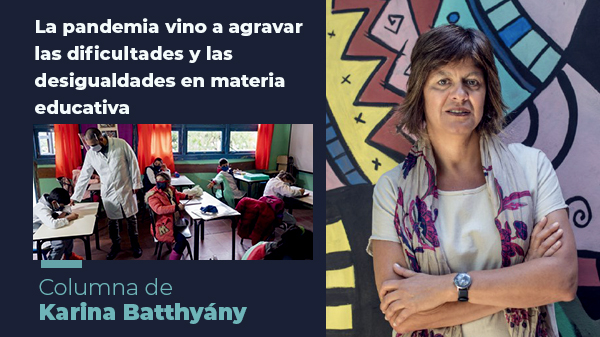
(Transcript of the Column by Karina Batthyány
in InfoCLACSO – August 19, 2020)
We were discussing the different dimensions of inequality, and education is certainly a significant one. We know that educational gaps are widening, and this leads us to place schools back at the center of public debate. Schools, of course, are important materially, but so too are they symbolic as institutions that guarantee a set of basic rights, not just the right to education. In many cases, this also includes providing food and access to other services that ensure the well-being of children, especially in schools, and this is a concern we have. Because, let's say, one of the most common measures in 190 countries has been closing schools in the context of this pandemic: some have reopened, others still have them closed, but it was one of the measures to mitigate the impact of the coronavirus.
In May, UNESCO estimated that some 160 million students in Latin America and the Caribbean had stopped attending classes. This worries us because of the widening educational gaps caused by the interruption of educational pathways, but also, as I mentioned, because of the cuts to other services, primarily food and nutrition, for this entire population. ECLAC (Economic Commission for Latin America and the Caribbean) estimates that roughly 90 million children receive some form of food in schools in Latin America and the Caribbean. We see that the measures taken, in addition to school closures, reveal a concern that I want to discuss: the central concern is how we evaluate, how we grade student performance in these complex times of school closures. And that is what worries me because we are actually forgetting the educational process itself, which is much more than three, four, five, or six months in the life of a student, a boy or a girl. And the central concern is there: how to maintain the evaluation, the programs, the tasks that are completed, and not so much thinking about the continuity of this educational process and how to try to help in these complex times so that this process can continue.
Furthermore, returning to the topic of inequalities, we must point out that the solutions proposed in many of our countries highlight other gaps, such as the technological divide. Distance education, being implemented in all our countries, may yield results (which must be discussed) for some sectors. However, there are clearly sectors where internet access or the possibility of accessing distance education is unavailable, where there are no devices to use it, or where the necessary physical conditions in homes and other places are lacking to engage in distance education. This is exacerbating the difficulties and widening the gaps and inequalities between those who can maintain some continuity in their education through distance learning and those who, in some cases, have clearly had no educational contact whatsoever for five or six months.
-How difficult it was for some analysts to read the situation at the beginning, when their first impression of the pandemic was that it had a democratizing effect, almost as if it impacted everyone in the same way. I thought: what a distorted view of reality some analysts had in March, and how different it looks today… Just looking at the educational landscape, it's clear that the pandemic has very little to do with democracy.
Absolutely. As I was saying, many children and adolescents have lost contact with the educational process, and that's worrying now, but it's also worrying for the future because it implies dropouts and disengagement from school or high school during their educational cycles. And I must mention that it's also concerning to see if there isn't a gender-based impact in some countries, where more girls or adolescents are disengaging from the education sector than boys. Furthermore, we also have to look at how this has affected homes (you have young children, you must know this very well) and the increased pressure on responsible adults to ensure and follow up on schoolwork. That's why I mentioned the emphasis placed so much on assessment and not on the idea of education as a process.
Clearly, some adults—many of whom have taken on this task—are able to do so, and here again we find the gaps in inequality among those adults who are unable to do so for various reasons. This is because they have to prioritize generating income, leaving their homes and therefore not being there to support these processes, or, again, due to various kinds of deprivation that prevents them from doing this. So, this dimension of education, which was already a concern in Latin America before the pandemic, is worsening, and we believe we must take it into account. And there's another dimension that I won't address today because it would take up too much time, but that is also considering this problem from the perspective of education workers, all that has changed in their working conditions, and also the guarantees of their rights in the exercise of their educational function. I promise not to address that topic today, but I didn't want to leave it unmentioned.
If you would like to receive more information about CLACSO's training programs:
[widget id=”custom_html-57″]
to our email lists.

