
The time of anguish
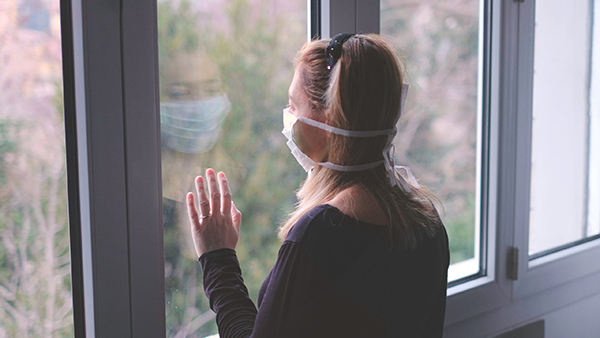
horizontal background woman in isolation at home for virus outbreak or hypochondria.
Esteban De Gori[1]
I
Covid-19 is one of the greatest crises the global world has ever faced. Neither the collapse of Lehman Brothers in 2008 nor the crises that affected various countries in the 90s compare to this pandemic that brought the world to a standstill. For decades, nothing had forced so many millions of people into their homes to protect themselves from a virus—to this day—that remains incurable. The movement of people, a significant number of industries and businesses, came to a halt, and, in a way, the overwhelming speed of capital was called into question—something no one could have imagined. Globalization is being seriously affected by something unimaginable.
It wasn't capital that withdrew from the scene, causing a crisis and greater inequalities, but rather the men and women who work, trade, negotiate, and perform tasks essential to globalization's functioning who withdrew or ceased to collaborate. Bodies were excluded from, or excluded from, various aspects of life by the State, which then assumed something even more uncertain: governing fragments of the future and trying to care for its citizens without a vaccine.
The State, in this act of sending everyone home, is being eroded not only by the lack of a cure, but also by its weak response regarding the future. How can we once again guarantee the lives and livelihoods of men and women who lost their jobs, whose professional, employment, or business futures were jeopardized in the name of their own health? Much will be lost in this pandemic (economic and emotional resources), which foreshadows global times of anguish and great concern that will impact civic and political life.
Postmodern optimism in hyper (individual) freedom and in medical science, as an amplifier of life, has been severely damaged.
II
The pandemic has triggered some dynamics that must be considered for the immediate future. We are witnessing states deploying, depending on the country, healthcare, enforcement, and financial resources without yet having a cure and receiving daily news of deaths. They are undertaking a significant exercise in legitimization at a time when each individual and collective death can contribute to political discouragement. It is not easy when coffins stand before the State. Undoubtedly, the State is in charge and seeks to protect without being able to cure; it is as if it were saying, "For now, this is what we have."
At the same time, we are witnessing strong presidential leaderships that rely on metaphors of crisis, exception, and war, and that call upon their citizens to obey their policies of care. The crisis presents an opportunity to resolve tensions and disrupt political and electoral processes.
And finally, we observe individuals in their homes, wavering, tense, caught between asserting their individual rights and delegating those rights. States (altered), strong presidencies, and individuality form a framework in which the horizons of all political regimes will be "metabolized." Neither the state, nor presidencies, nor individuality will emerge unscathed.
It is possible that various grievances will resurface, exacerbate previous ones, and fuel protests of all kinds. We have already seen some in Southern Italy, Medellín, Tel Aviv, and in Maryland, Ohio, Michigan, and other cities (United States), as well as tensions between different branches of government, as in Brazil and El Salvador.
We still have something even more unsettling to see: the exit from and “return” to social interaction (“to touching each other”). The return to the streets, to public spaces, to workplaces, businesses, and government institutions. It will also be interesting to observe how governments manage economic activity amidst the recessions, stagnation, and collapses that may occur in different economic sectors of each country. The drop in demand at the global, national, and local levels will fuel bankruptcies, unemployment, and conflicts. Added to this is the excessive accumulation of certain natural resources, minerals, and hydrocarbons, which could drive down prices and affect public budgets, worsening the situation in some countries, and potentially triggering a storage infrastructure crisis in various parts of the world. Where will we store all that we don't consume?
III
The pandemic and its aftermath are and will be handled in different ways. China has not only overcome the most brutal stage of the coronavirus but has also managed to reposition itself geopolitically with its healthcare aid packages. A geopolitics of health is underway. The United States faces its own internal political challenges, tensions between governors and the federal government, and a number of deaths due to government negligence. It is very busy resolving its pandemic. In Latin America, inequalities have intensified, and the burden of states dismantled for years has become very evident. But, despite its circumstances, it has implemented various social aid packages, the social impact of which remains uncertain.
Now it remains to be seen how all states will manage the crisis and how they will position themselves for the future. Will they bail out economic actors and allow the market to continue allocating resources, or will they attempt to change the currently highly asymmetrical relationship with business and financial groups in order to reposition themselves with certain regulatory capabilities? Presidential figures also face their own challenge. This crisis has solidified the phenomenon of "Zoom Presidencies" (or presidencies in Zoom format). This unprecedented virtualization and mediatization of communication and political dialogue, both with the citizenry and with the broader range of actors, bypasses intermediaries and places presidencies in front of citizens from within their homes. However, the actors and their interests have not disappeared, nor can they be ignored. The future of presidencies will not only involve demanding sacrifices, but also making a political order viable, recreating a "national" community of isolated individuals, and reinserting it, once this is all over, into a community that will have to confront complex economic situations. In other words, the sacrifice requested should not end up shifting votes towards opposition options against the incumbent presidents.
IV
Will we return? How will we do it? How will we reconnect socially and politically after this? All analyses revolve around this question. The focus on strictly economic and health-related issues has displaced questions inherent to the social sciences. How do we think about social and political relationships in the post-pandemic world? What reflections are warranted for an individual (bodily) shaped by virtuality and besieged by illness and the state? How will we address labor, neighborhood, youth, and territorial dynamics? What will we do about social closeness? That's it. We are left with something very important: connection. A space where the time of anguish can be mitigated.
[1] Latin American Strategic Center for Geopolitics – CELAG. Member of the CLACSO Working Group The Central American Isthmus: Rethinking the Centers.
If you would like to receive more information about CLACSO's training programs:
[widget id=”custom_html-57″]
to our email lists.

