
Participatory Processes and Methodologies
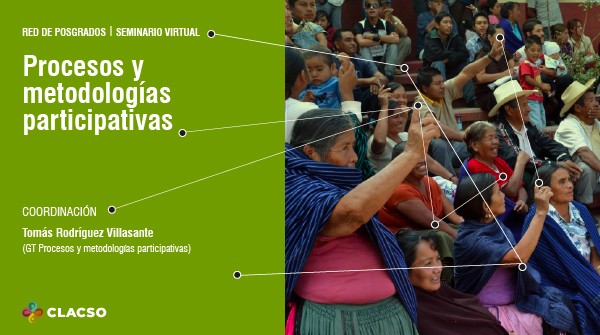
Seminar 2032
Coordination: Tomás Rodríguez Villasante (Complutense University of Madrid, Spain)
Teaching team: Alfonso Torres Carrillo (National Pedagogical University, Colombia), Mariano Suárez Elías (University of the Republic, Uruguay), Gisela Vanina Signorelli (National University of Rosario, Argentina) and Alejandro Noboa Silva (University of the Republic, Uruguay).
Home: 29/05/2020 | Registration: 20/04/2020 to 24/05/2020
Workload: 12 weeks – 90 hours.
This Virtual Seminar is organized by a teaching team belonging to the "Participatory Processes and Methodologies" Working Group of the CLACSO Network. It is aimed at university graduates, master's degree holders, and doctoral candidates, as well as professionals and technical staff from public administrations and social organizations whose interests, training expectations, and professional performance are focused on the design, management, and/or implementation of participatory processes in the field of social planning and territorial management (cities, neighborhoods, social policies, cooperatives, agroecology, local development, land-use planning, protected areas, among others).
The seminar aims to be an introduction to training in participatory methodologies and in that sense raises the general issues of the cycles of a participatory process, those that favor the development of a self-diagnosis and that from this lead to the planning of comprehensive and sustainable actions and consequently to the collective execution of said planning.
Training is offered in specific participatory techniques, such as "actor maps", "multi-syllable" analyses, "social creativity" feedback workshops ("flowcharts", "problem trees", etc.), and ways to develop participatory social planning that allows for self-organization, "monitoring", and appropriate evaluation techniques.
- Starting Point, First Contacts and Self-Reflection
- Mappings and Action Sets
- Listening and Fieldwork
- Discourse analysis
- Creative feedback workshops
- Lines of action. Initiating Strategic and Sustainable Planning
- Scenario building and the main idea
- Strategic Planning and Participatory Budgeting
- Organizing into democratic-participatory networks
- Execution, Monitoring of the Strategic Plan, Continuity and Creative Overflows
- AAVV (2009) “Participatory Methodologies. Manual”. Madrid: CIMAS Network.
- Allegreti et al. (2016). “Traveling through participatory budgets” Par Local. Diputación de Málaga.
- Astudillo et al. (2016). “Social Participation with alternative methodologies from the south.” Quito: Abya Yala.
- Canales, Manuel et al. (2006). “Social research methodologies. Introduction to the trades”. Santiago de Chile: LOM.
- Cifuentes and Paño (2006). “Participatory practices in contemporary Latin America”. CIMAS and Diputación de Málaga.
- Collins, Patricia Hill (2017). The Difference That Power Makes: Intersectionality and Participatory Democracy. In Feminist Research Magazine. No.8 (1). Pp. 89-39.
- Dabas, Elina (1993). “Network of networks”. Buenos Aires: Paidos.
- Fals Borda, Orlando., Brandao, Carlos. and Cetrulo, Ricardo. (1986). "Participatory research." Montevideo: Institute of Man.
- Galtung, Johan (2004) “Transcend and Transform” Quimera Ediciones. Mexico.
- Ganuza, E., Olivari, L. and Paño Yáñez, P. (2011). "Democracy in action: citizen participation in public management." Participatory Methodologies and Participatory Budgets. In Andrés Falck and Pablo Paño Yáñez, Participatory Democracy and Participatory Budgets: an approach and deepening of the current debate. Málaga: Parlocal.
- Ganuza, Ernesto (2002). “Course on the analysis of the reality and perspectives of the associative fabric in Getafe”. (Available in the Methodology section of www.redcimas.org)
- Granoveatter, Mark et al. (2000) “The Strength of Weak Ties” and “Social Network Analysis” (available in Politics and Society. 2000, No. 33 – Dialnet
- Harnecker, M. and Bartolomé, J. (2015). “Planning from below”. Barcelona: El Viejo Topo.
- Hernández, Dolores (2010). "Before starting". In Notebooks, CIMAS.
- Jara, Oscar (n.d.). Guide for the Systematization of Experiences - Resource Center.
- Karlsson, Lars and Velázquez, Isabel (2000). "EASW Workshop: Participating to Improve": Lanzarote
- Kong, Felipe (2015). "The construction of future scenarios as a didactic and methodological contribution..." Doctoral thesis
- Martín, Pedro (2010) “Participatory planning from a social network perspective”. Doctoral Thesis UCM
- Martínez Palacios, Jone (2018). Deepening democracy in light of intersectional heuristics. In Viento Sur. No. 157.
- Martínez Palacios, Jone (2019). Intersectionality and participatory methodologies. Manuscript for the course
- Martínez Palacios, Jone. (2019). Public policies and the sustainability of life. Readings from intersectional praxis. Unpublished manuscript made available to the course.
- Matos, José (1986). “Popular uprising and crisis of the State”. Lima: Institute of Peruvian Studies.
- Matus, Carlos (2007). "The theory of social games"
- Matus, Carlos (2007). “MAPP Method”
- Montañés, Manuel (2009). “Participatory Methodology and Technique (Theory and Practice of a Participatory Research Strategy)”. Barcelona: Editorial UOC.
- Montero, Maritza and others (1996) Participation, areas, challenges and perspectives. Caracas: CESAP.
- Noboa, Alejandro; Bisio, Natalia; Suárez, Mariano; and Robaina, Natalie (2013). "Citizen Participation: The public management of Participatory Budgets seen from its protagonists", Salto: CSIC-UdelaR. (Chapters 3 and 6).
- Núñez, Carlos (1989). Educating to transform, transforming to educate. S.José de Costa Rica: Alforja.
- Red Cimas (2015). "Participatory Methodologies". Madrid: Ed. Dextra.
- Rocha Torres, C. (2016). "Participatory Action Research. A commitment to communication and social transformation." Colombia: Uniminutos. (Chapter 4.)
- Santos, Boaventura de Sousa (2005). "The Orphaned Millennium". Madrid: Trotta.
- Torres, Alfonso (1999). “Strategies and techniques of qualitative research”. Bogotá: UNAD.
- Villasante et al. (2007). "Participatory Methodology and Complexity in the Social Sciences." In Politics and Society, no. 44. Complutense University of Madrid. (Chapters available online: Vol. 44, no. 1).
- Villasante et al. (2015). “Building democracies and participatory methodologies from the south”. Santiago, Chile: LOM.
- Villasante, TR (2014) “Overflowing life networks. Foundations for change from everyday life”. Madrid: La Catarata.
- Villasante, TR (2017). “Transformative Democracies. Emerging and alternative experiences from the commons”. El Viejo Topo: Barcelona.
If you have a link with a CLACSO Associated Center:
- Paying in one payment: USD 95 (includes issuance and shipping costs of the digital certificate).
- Paying in one payment: USD 140 (includes issuance and shipping costs of the digital certificate).
- Paying in one payment BEFORE 17/05/2020: USD 150 (includes issuance and shipping costs of the digital certificate).
- Paying in one payment: USD 190 (includes issuance and shipping costs of the digital certificate).
FAQ
The basic requirements for taking a seminar are:
- Availability of at least 4 hours per week to dedicate to the seminar course.
- Internet access.
- Reasonable handling of communication and computer tools.
- Language proficiency in the language in which the course will be taught. The official languages are Spanish and Portuguese.
|
|
Discount for one payment until 16/03 |
In one payment after 16/03 |
|
CM Plenos |
$75 |
$150 |
|
CM Associates |
$95 |
$190 |
|
No link |
$95 |
$190 |

