
The Global Alliance for Palestine
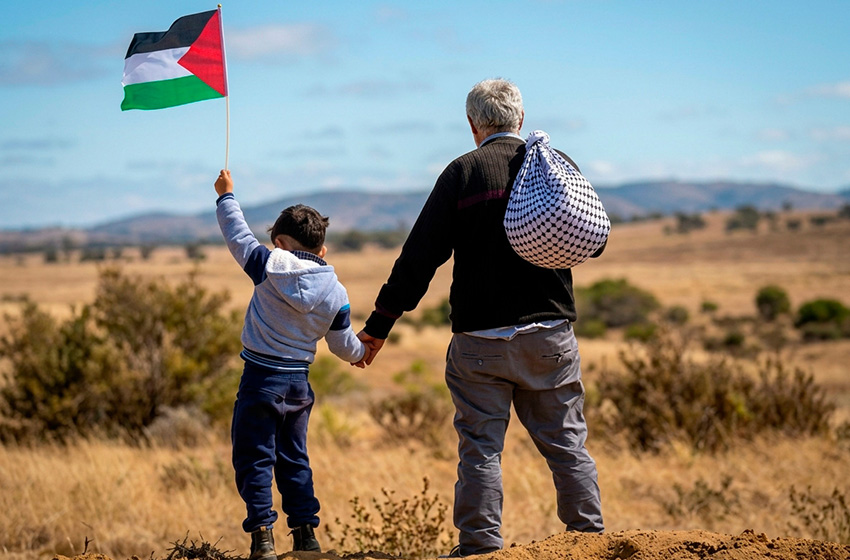
The Global Alliance for Palestine is preparing a major international mobilization from October 9 to 11 , the main event of which will be a Global Day of Action on Saturday, October 10, with protests and activities coordinated around the world, with the participation of the Latin American Council of Social Sciences Network.
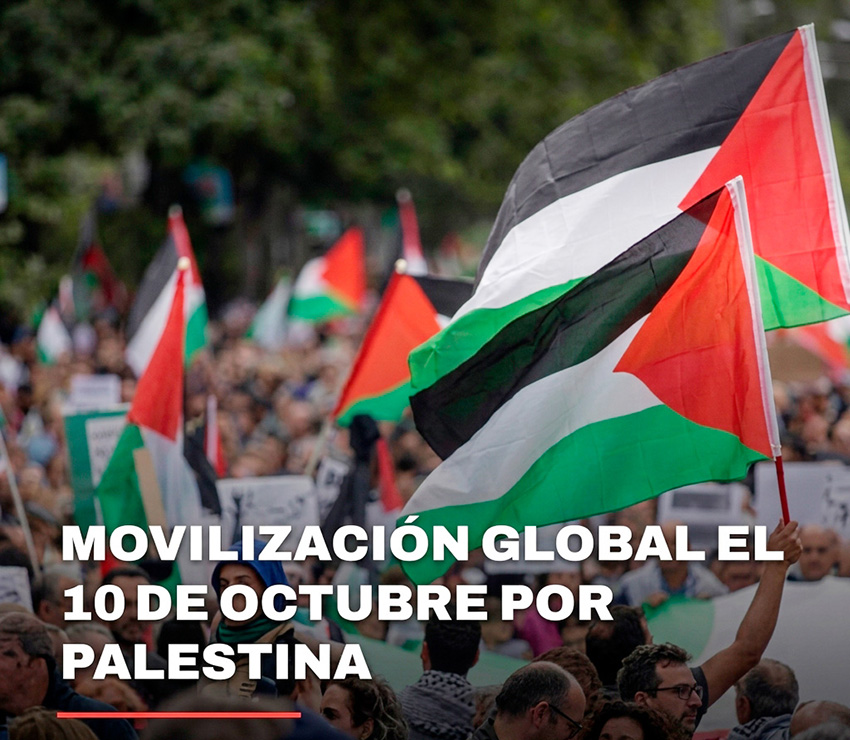
The main objective is to demand an end to the genocide in Gaza, denounce the violence and displacement in the West Bank, and claim the full rights of the Palestinian people.
The conference will bring together social and civil organizations from multiple continents to break the political silence in the face of destruction in the region.
The call is open to global civil society and will bring together profiles from multiple sectors on continents such as Asia, America, Europe, Africa and the Middle East:
-Community movements and grassroots activists: Human rights defenders at the local level.
-Unions and workers: Labor organizations that will coordinate strikes or actions in workplaces.
-Students and academics: University groups in charge of protests on campuses and in discussion forums.
-Community leaders and parliamentarians: Political and social figures who seek to formally pressure their governments towards an arms embargo and sanctions.
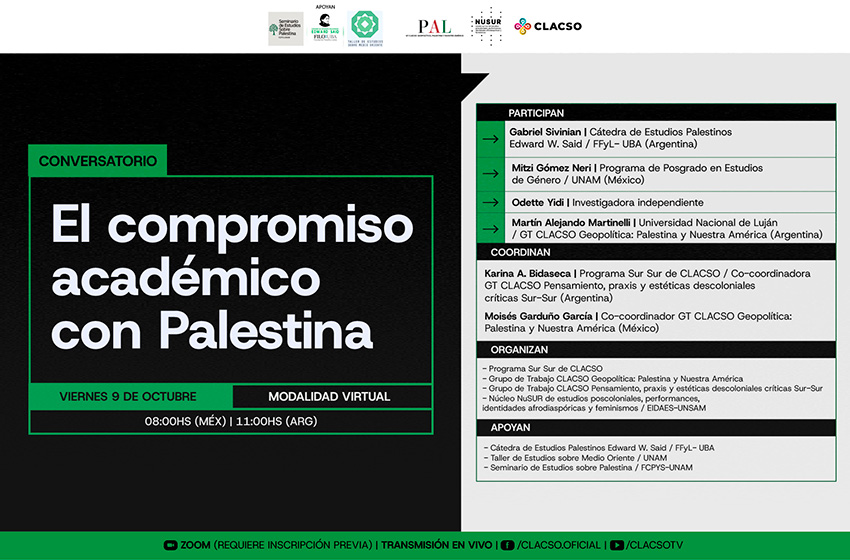
The virtual discussion “ Academic Engagement with Palestine ” took place on Friday, October 9, as part of the activities and international mobilization organized by the Global Alliance for Palestine 2026. The voices of intellectuals against the genocide in Gaza bring us together in the face of political silence regarding the ongoing genocide of the Palestinian people.
Participated:
Gabriel Sivinian – Edward W Said Chair of Palestinian Studies / FFyL- UBA (Argentina)
Mitzi Gómez Neri – Postgraduate Program in Gender Studies / UNAM (Mexico)
Odette Yidi – Embassy of Colombia in Qatar (Colombia)
Martín Alejandro Martinelli – National University of Luján / CLACSO Working Group on Geopolitics: Palestine and Our America (Argentina)
They coordinated:
Karina A. Bidaseca – Program South-South Working Group of CLACSO / Co-coordinator of the CLACSO Working Group on Critical Decolonial South-South Thought, Praxis and Aesthetics (Argentina)
Moisés Garduño García – Co-coordinator of the CLACSO Working Group on Geopolitics: Palestine and Our America (Mexico)
They organized:
CLACSO South-South Programme
CLACSO Working Group “Geopolitics: Palestine and Our America”
CLACSO Working Group “Critical South-South Decolonial Thought, Praxis and Aesthetics”
NuSUR Center for Postcolonial Studies, Performances, Afro-Diasporic Identities and Feminisms / EIDAES-UNSAM
They supported:
Edward W. Said Chair of Palestinian Studies / FFyL- UBA
Workshop on Middle Eastern Studies / UNAM
Seminar on Palestine Studies / FCPYS-UNAM
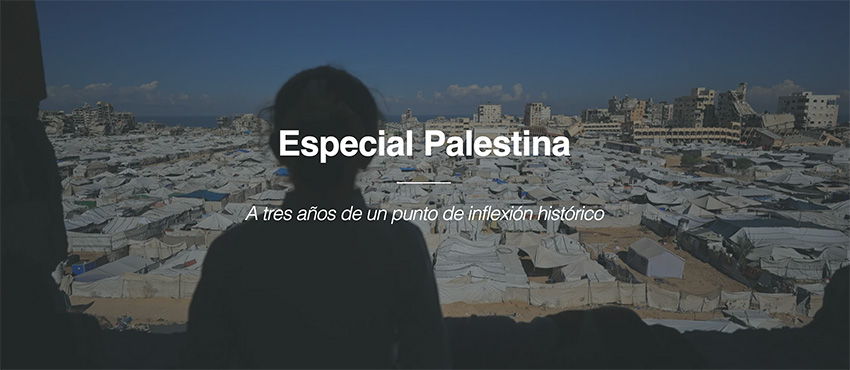
Palestine Special: Three Years After a Historic Turning Point
The Monitor . Publication of the CLACSO Working Group " Imperialism, Neocolonialism and Policies of Intervention ". A collective intellectual body made up of more than 90 researchers, communicators and activists from 23 countries who work on the historical and contemporary dynamics of imperial and neocolonial intervention.
GT's participation in a TRT special on Zionism in Latin America.
CLACSO 's participation gives the mobilization a structural and critical thinking dimension through the following key functions:
1. Geopolitics of knowledge and academic legitimation
CLACSO functions as a bridge connecting social activism with scientific research. Through its working group "Geopolitics: Palestine and Our America," it produces data, books, essays, and educational materials that conceptualize the situation in Gaza and the West Bank from the perspective of "Epistemologies of the South." This helps to counter the narratives of mainstream Western media.
2. Institutional political positioning and influence
CLACSO issues official statements and pronouncements condemning the military actions of the Israeli government. As an association with international organizations such as UNESCO, the Council uses its institutional weight to demand a ceasefire and denounce human rights violations.
3. Platform for debates and solidarity networks
CLACSO organizes international seminars, thematic forums, and audiovisual productions (such as its CLACSO TV channel) under themes like "Palestine, the Cause of the Global South" or "Voices Against Genocide in Gaza." These virtual and in-person spaces serve to connect academics, students, and leaders from the nearly one thousand research centers associated with its Network.
4. Direct link with activism missions
Members of CLACSO have actively participated in international civil society initiatives, such as the humanitarian flotillas aimed at breaking the blockade of the Gaza Strip. Their involvement extends beyond academia, actively supporting methods of civil resistance and boycotts.
As a contribution to the historical memory and the present of the Palestinian people, CLACSO rescues several poems by Palestinians, one of them a victim of the bombings by the Israeli armed forces on Gaza.
“Palestine” – Fatma Nazzal (Palestine, 1968). Poet, prose writer, and cultural promoter. Recitation and presentation by Karina Bidaseca , coordinator of the CLACSO South-South Program and co-coordinator of the CLACSO Working Group “Critical South-South Decolonial Thought, Praxis, and Aesthetics.”
Goodnight, Gaza – Hiba Abu Nada (1991-2023). The poem was written a few hours before the October 2023 bombing in which the poet lost her life. Recitation and presentation by Magdalena González Almada , member of the CLACSO Working Group “Critical South-South Decolonial Thought, Praxis and Aesthetics.”
The Hanged Man – Salim Jabran (1940-2011). He was one of the leading figures in the new poetic movement in occupied Palestine. He lived in Galilee and was persecuted. Recitation and presentation by José Guadalupe Gandarilla Salgado of the CLACSO Working Group “Critical South-South Decolonial Thought, Praxis, and Aesthetics.”

It is enough for me to remain in his lap – Fadwa Touqan (Nablus, Palestine, 1917–2003). A prominent poet of Arabic poetry. Darwish refers to her as the mother of Palestinian poetry. A committed woman who wrote poetry of resistance and against the occupation. Recitation and presentation by Haydée García Bravo of the CLACSO Working Group “Critical South-South Decolonial Thought, Praxis, and Aesthetics.”
SEE ALSO:
"Breaking the Blockade: Humanitarian Action Against Israeli Genocidal Policy" Lautaro Rivara
"We were kidnapped and tortured by the Israeli army in international waters," Lautaro Rivara

