IV Convention of Studies in Emancipatory Education and Critical Pedagogy CONEEPEC 2026
October 10 All day
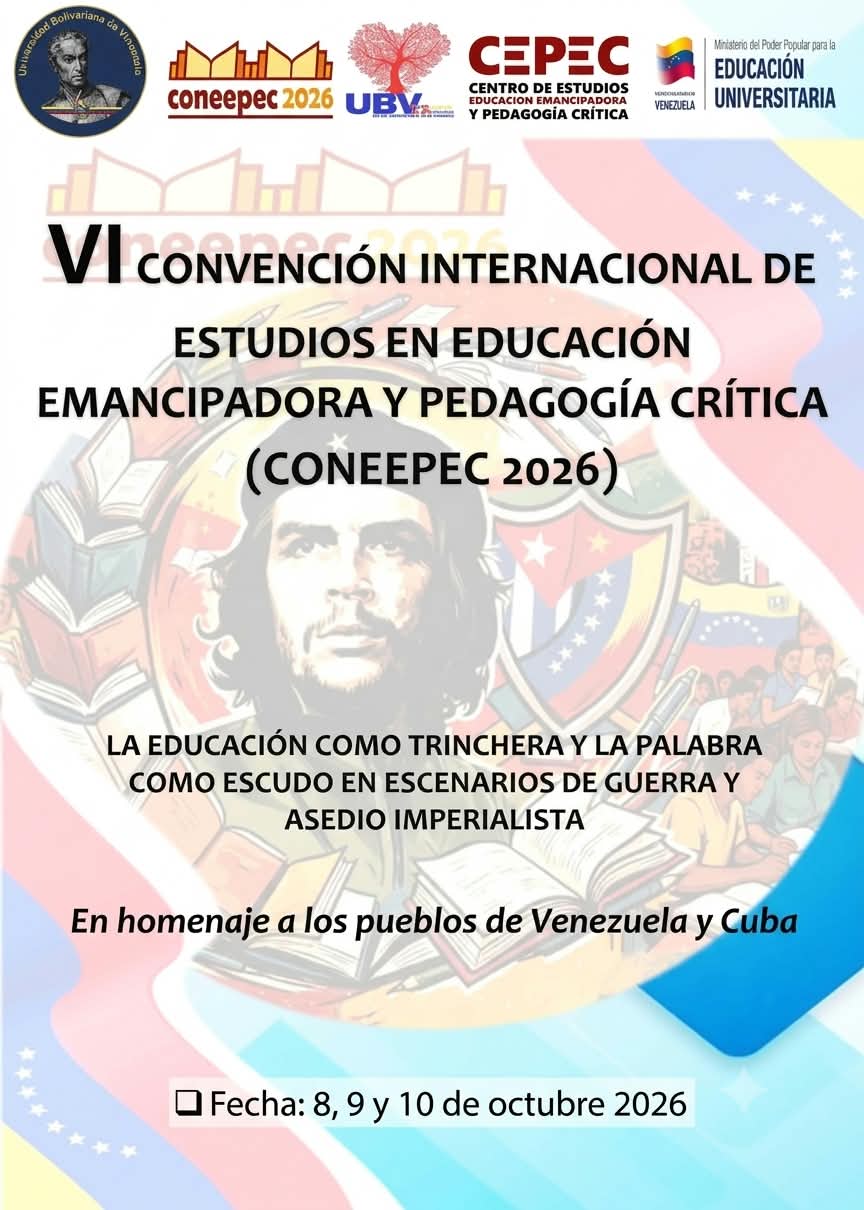
INTERNATIONAL CONVENTION ON STUDIES IN EMANCIPATORY EDUCATION AND CRITICAL PEDAGOGY
(CONEEPEC 2026), in homage to the peoples of Venezuela and Cuba, will be held from October 08 to 10, 2026. Event Venue: Bolivarian University of Venezuela. Organized by: Center for Studies in Emancipatory Education and Critical Pedagogy (CEPEC UBV)
Purpose: To generate free participation spaces for students, teachers, researchers and the general public of Venezuela and Our America, interested in disseminating scientific productions related to the thematic axes and/or participating in conferences, panels and debates on insurgent educational practices in the current sociopolitical and socioeducational context.
Those invited: teachers, professors, children and young people, university students, researchers from Venezuela and Our America.
436 papers have been registered, which will be presented in person at various locations throughout the country. Virtual presentations will be streamed on the cepecubv YouTube channel.
THEMATIC AXIS: CHARACTERIZATION
1. Emancipatory education as a bulwark for peace and sovereignty in the Venezuelan and Latin American context. This section will present works and activities related to:
Strategies for protecting the right to education
Didactics of the emergency: Use of recycling and resources from the environment when traditional laboratories are lacking and production is needed for food sovereignty.
Testimonials from teachers and students who maintain open educational spaces despite the difficulties.
Chronicles of itinerant educators in border and rural areas.
Popular science: How robotics and programming with free software are being appropriated by children in communes.
Science teaching with awareness: How to teach physics, chemistry or mathematics to solve concrete problems of the electricity or water crisis.
Teacher training for emotional support in crisis contexts.
Education as a psychosocial refuge from uncertainty
Psychological first aid: How to manage trauma and anxiety in students affected by economic crisis or conflict.
2. Emancipatory education in the face of escalating sieges, armed conflicts, and "data warfare" in the global context. This section may include papers and activities related to:
Critical culture of peace: Educating about the structural causes of extractivism and imperialism that generate current wars.
Media literacy against war for the decolonization of thought: Critical reading of war propaganda and algorithms that promote hatred towards "the other" (xenophobia, racism).
Internationalist solidarity: Connection between the pedagogical struggles of Venezuela, Cuba and the world.
Geopolitics and maps of dispossession: Infographics on disputed resources (lithium, oil, water) and why education is needed to defend them.
Comparative analysis on the right to education in contexts of external aggression.
3. Trends in studies on emancipatory education and critical pedagogy
Critical pedagogy and emancipatory education focus on understanding education as a political act.
This axis allows for the presentation of works on current trends that integrate contemporary debates on decolonization, ecology, intersectionality, and emerging technologies.
The most prominent trends and approaches in this field include:
• Decolonial and Southern Pedagogies: Eco-pedagogy and environmental justice.
• Intersectional and gender approach, popular and community education:
• Digital Critical Pedagogy
• Other insurgent pedagogies