
Perspectives from China on governance, rights and development
Artificial intelligence has now become a central topic on the international agenda. Jacob Coxon, a former researcher at Anthropic, highlighted the dangers of AI development in the West, while Donald Trump spoke of a “sick conspiracy” against AI. Meanwhile, the People’s Republic of China and the BRICS nations have been emphasizing the need for global AI governance, proposing the creation of a World Organization for Cooperation in Artificial Intelligence.
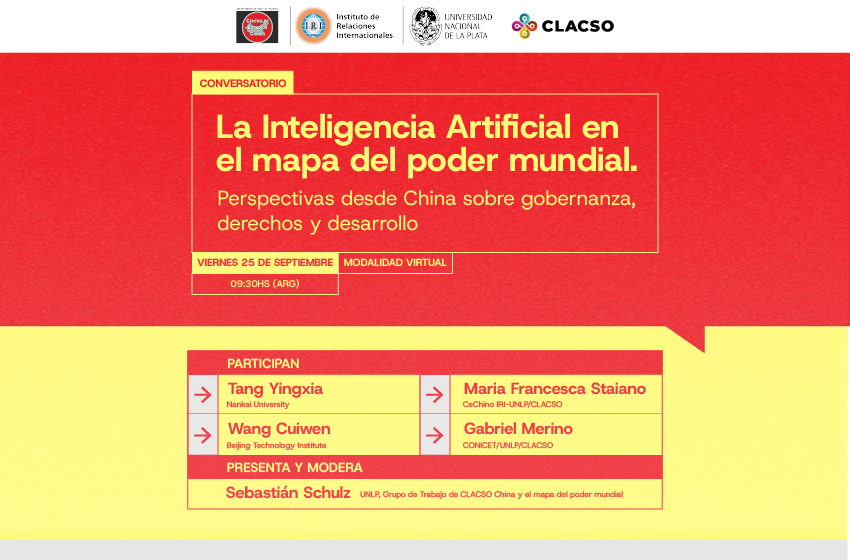
The discussion panel “ Artificial Intelligence on the World Power Map: Perspectives from China on Governance, Rights, and Development ,” organized on Friday, September 25 , is an initiative of the CLACSO Working Group “China and the World Power Map” in conjunction with the Center for Chinese Studies at the Institute of International Relations of the National University of La Plata , Argentina. Researchers from Nankai University and the Beijing Institute of Technology are invited to explore various strategic dimensions present in the debate on artificial intelligence.
Participants:
Tang Yingxia (Nankai University)
Wang Cuiwen (Beijing Technology Institute)
Maria Francesca Staiano (CeChino IRI-UNLP/CLACSO)
Gabriel Merino (CONICET/UNLP/CLACSO)
Moderator: Sebastián Schulz (UNLP/CLACSO Working Group on China and the map of world power)
Virtual format – At 9:30 AM in Argentina, Chile and Brazil.
Activity with prior registration
The discussion will delve into the geopolitical disputes surrounding Artificial Intelligence within the context of a world order in crisis and undergoing historical and spatial transition. It will also present perspectives from China on the link between AI and human rights, the establishment of legal frameworks to protect individuals, and the connection between Artificial Intelligence and shared prosperity—that is, the vision of a people-centered AI. As a backdrop, the discussion will focus on China's proposal to build a community with a shared future for humanity, in which AI is linked to solving social problems rather than to private profit.

