
Understanding collapse. Alternatives in times of polycrisis
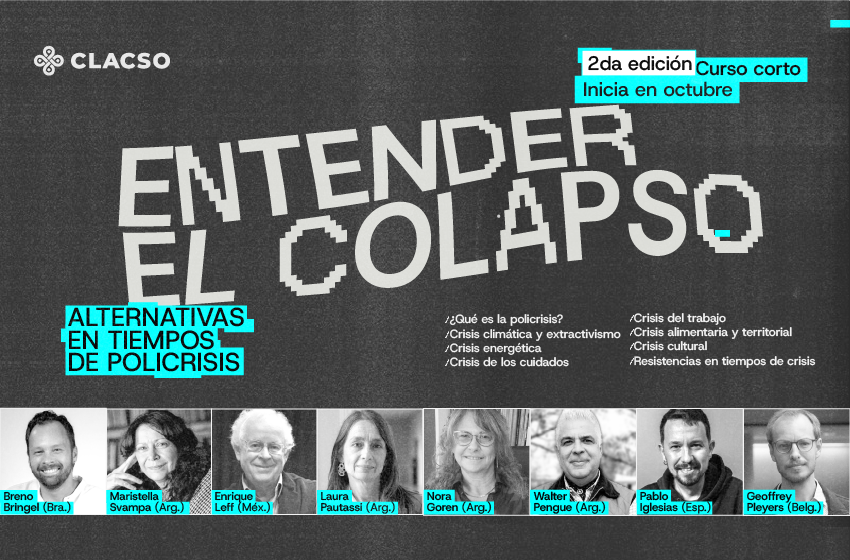
2nd cohort – 2026
TEACHING TEAM: Breno Bringel (Brazil) , Maristella Svampa (Argentina) , Enrique Leff (Mexico) , Laura Pautassi (Argentina) , Nora Goren (Argentina), Walter Pengue (Argentina) , Pablo Iglesias (Spain) , Geoffrey Pleyers (Belgium), Victor Manuel Ocampo Velasco (Colombia)
Home: 12 / 10 / 2026 | Registration: 04/08/2025 al 09/10/2026
Format: Virtual
Total workload: 50 hours
Duration: 5 weeks
This course engages with critical debates on contemporary polycrisis and the multiple dimensions of civilizational collapse, offering a space for reflection, dialogue, and the collective construction of alternatives. From a Latin American perspective and in dialogue with voices from the Global South, it seeks to challenge dominant narratives, understand the interrelationships between the ecological, social, economic, and political crises, and provide tools for imagining and promoting transformative horizons in defense of life and the planet.
We are living through a time of historical rupture. The world, as we knew it, is rapidly disintegrating. We find ourselves immersed in what contemporary critical theory calls a civilizational polycrisis: an unprecedented convergence of ecological, economic, political, and social crises that reinforce each other, overwhelming our capacity for understanding and action.
This is not simply an era of change, but a paradigm shift that challenges the very foundations of Western modernity. The climate crisis is intertwined with social fracture; the technological revolution amplifies inequalities, and contempt for democracy is normalized as authoritarian projects advance globally. Faced with this complexity, progressive narratives prove inadequate, while the far right strategically exploits discontent and fear. This course stems from a fundamental conviction: to navigate this civilizational turbulence, we need new critical cartographies that allow us to map the interconnections between the various crisis fronts. We propose to do so from a perspective situated in the Global South, recognizing that Latin America and the Caribbean constitute privileged laboratories for understanding both the mechanisms of collapse and the seeds of alternative futures.
Beyond the catastrophic diagnosis, our approach seeks to identify and strengthen counter-hegemonic projects that are already weaving alternatives amidst the collapse. From struggles for the commons to feminist care economies, from territorial defenses to cultural resistance, responses are emerging that prefigure post-capitalist horizons.
In this sense, the course constitutes a critical contribution from Latin America to understanding the multiple dimensions of the contemporary polycrisis, to make visible the voices and experiences of the Global South and to contribute to the construction of transformative alternatives in defense of life, social justice and the planet.
- What is polycrisis? A conceptual introduction to the term and its uses in contemporary critical thought. Breno Bringel (Brazil)
- Climate Crisis and Extractivism: A Global South Perspective, with an Emphasis on the Latin American and Caribbean Experience. Maristella Svampa (Argentina)
- Energy Crisis: Energy Transition, Fossil Fuels, Renewables, and Disputes over the Meaning of “Transition.” Enrique Leff (Mexico)
- The Care Crisis: Feminisms and Care Economies as Alternatives to Social Fragmentation. Laura Pautassi (Argentina)
- The Crisis of Work: Digitalization, Precariousness, and Labor Resistance. Nora Goren (Argentina)
- Food and Territorial Crisis: Food Sovereignty, Agribusiness, and Peasant Struggles. Walter Pengue (Argentina)
- Cultural crisis: Post-truth, neoliberal subjectivities, disputes over meaning, media and networks. Pablo Iglesias (Spain)
- Resistance in Times of Crisis: Social Movements, Alternatives to Development, and Post-Capitalist Horizons. Geoffrey Pleyers (Belgium)
- Breno Bringel (Brazil)
- Maristella Svampa (Argentina)
- Enrique Leff (Mexico)
- Laura Pautassi (Argentina)
- Nora Goren (Argentina)
- Walter Pengue (Argentina)
- Pablo Iglesias (Spain)
- Geoffrey Pleyers (Belgium)
- Victor Manuel Ocampo Velasco (Colombia)
The course will be delivered in a blended format, combining recorded video lectures and live sessions to make the experience more dynamic and engaging. Two video lectures will be available each week, accompanied by a required reading to delve deeper into the material. In addition, there will be a weekly synchronous session on Wednesdays at 4:00 PM (Colombia, Ecuador, Peru) / 6:00 PM (Argentina, Uruguay, Brazil). This session is optional and designed to provide a space for collective discussion, the exchange of perspectives, and active learning.
As a closing activity, the course will include a discussion with Enrique Leff, Maristella Svampa, Laura Pautassi, and Breno Bringel, which will take place on Wednesday, November 11th at 16:00 PM (Argentina time). The meeting will be dedicated to an exchange with the participants based on the questions and main points of discussion developed during the course.
At the end of the course, students will be required to complete a final evaluation questionnaire. Those who pass this stage will receive a digital certificate of completion, certified by CLACSO, which accredits 50 hours of training.
| Early registration (until 15/09) | General registration (16/09) as of 05/10) | Registration without discount (06/10 to 09/10) | |
| Full or Associate Member Center | $100 | USD 150 | $200 |
| No link | $150 | USD 225 | $300 |
Inquiries: [mail protected]

