CLACSO: a collective history
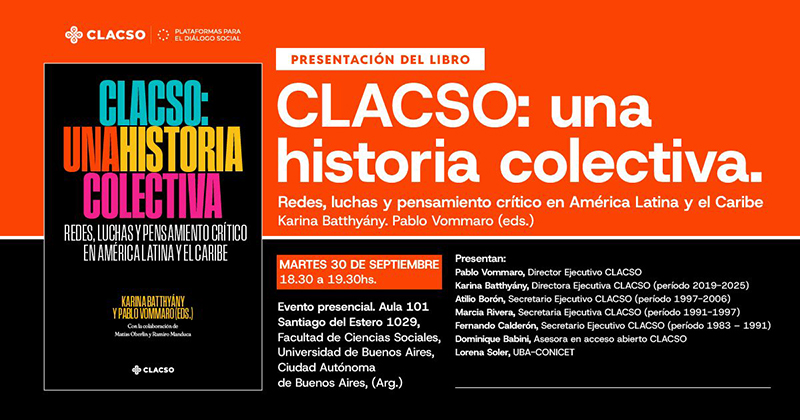
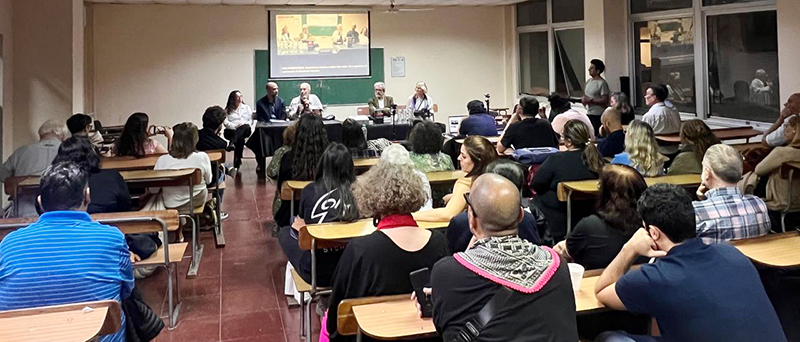
Release: Tuesday, September 30
At the Faculty of Social Sciences, University of Buenos Aires. Santiago del Estero 1029. Autonomous City of Buenos Aires, Argentina.
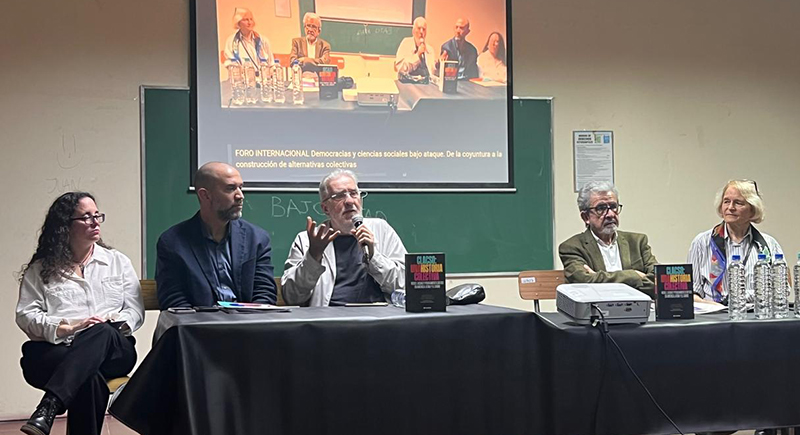
They presented:
Pablo VommaroExecutive Director of CLACSO
Karina Batthyány, Executive Director CLACSO (2019-2025 term)
Atilio BoronExecutive Secretary of CLACSO (1997-2006)
Marcia Rivera, Executive Secretary CLACSO (period 1991-1997)
Fernando Calderón, Executive Secretary CLACSO (period 1983-1991
Dominique BabiniOpen Access Advisor at CLACSO
Moderated: María Fernanda Pampín, Director of Publications at CLACSO
Support CLACSO in continuing to research, publish, and train in critical and transformative thinking.
As a token of your support, you will receive at your home one of the thousand copies of the special printed edition of the book “CLACSO: a collective history”, with your name included on its pages, so that you can be a tangible part of this collective narrative that we have built among generations of intellectuals, researchers, teachers, students, activists and people committed to the knowledge that transforms our societies.
Thanks to your support, we can sustain and expand our open access digital library, strengthen publications, and ensure that critical research impacts more people and communities.
Faced with the threat from the right wing and the attacks on critical thinking that we are experiencing, your active support is key for CLACSO to continue working for democracy, for fairer societies, for memory and for the strengthening of critical and transformative thinking, pillars that have guided our history and that we project into the future.
Be a part of this initiative and spread the word so that the CLACSO community continues to grow stronger.
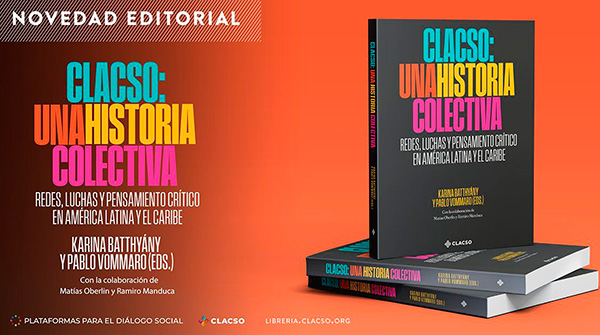
CLACSO: A collective history. Networks, struggles, and critical thinking in Latin America and the Caribbean Karina Batthyány and Pablo Vommaro editors.
Building a collective and diverse history is a great challenge. Even more so when the aim is to narrate the journey of a continental organization like the Latin American Council of Social Sciences (CLACSO). With this colossal task in mind, this book sets out to account for the nearly sixty years of contributions from the largest network of social sciences, humanities, and arts in Latin America and the Caribbean. To this end, more than twenty interviews with key figures, previously unpublished institutional sources, and articles with recent research—most of them also previously unpublished—on CLACSO have been compiled.
The book is composed of four main parts dedicated, respectively, to the institution's origins, its role during the military dictatorships, its efforts to combat epistemological dependency, and its current research agendas. Each part includes an introduction, analytical articles, a selection of historical documents, and excerpts from interviews conducted specifically for this work. Following this trajectory, these pages aim to offer a possible reading itinerary and a map of critical and emancipatory thought in the region. Through a network of voices, the book seeks to shape a narrative that reflects the polyphony of the very fabric of action and thought that is CLACSO.