
"The choice in Uruguay is between two models of country"
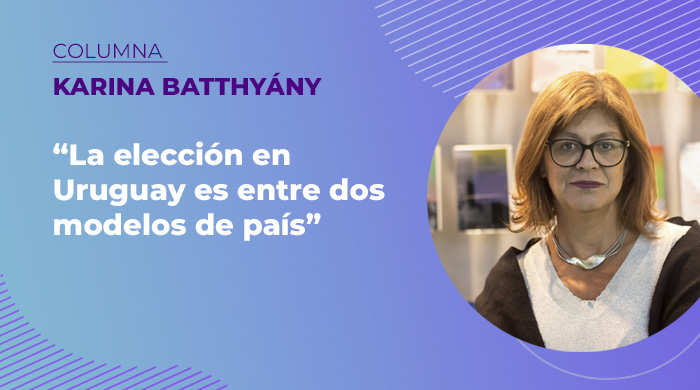
Transcript of Karina Batthyány's column
in InfoCLACSO – November 20, 2024
We are in Washington, D.C., participating in the III Conference of the Coalition for Academic Freedom in the Americas (CAFA-CLAA). This is a new initiative that CLACSO has been developing in conjunction with these institutions. We recently launched an open call for research to advance the main dimensions to consider when discussing the protection of academic freedom, its principal challenges, and some policies that can be implemented in our region.
Second round of elections in Uruguay
This Sunday I will be back in Uruguay to exercise my right to vote in the runoff election, part of the process of democratic consolidation. On November 24, we will have the second round of the 2024 presidential election, contested between candidates Yamandú Orsi, of the Broad Front, and Álvaro Delgado, of the National Party and the self-styled Republican Coalition. Both presidential tickets have women as their vice-presidential candidates: Carolina Cosse and Valeria Ripoll, respectively.
But this isn't just a choice between these two figures; it's two visions or models for the country that will determine the social, economic, and cultural policies of Uruguay for the next five years. We need to ask ourselves what's at stake and what we saw in the last debate between the two presidential candidates last Sunday.
On the one hand, Álvaro Delgado's vision for the country is essentially one of governmental continuity. This candidate presents himself as the political heir of Luis Lacalle Pou and focuses his ideas on maintaining the main tenets of liberal reforms, particularly those related to fiscal control, private investment, and the ongoing debate about the social security system, all of which have been promoted by the current administration. He proposes strengthening international trade alliances, especially with the European Union and China. Security is also a key issue, where he proposes a hardline policy emphasizing the repression and control of crime and drug trafficking.
On the other hand, we have the Broad Front's proposal for change (in many senses), led by Yamandú Orsi. Its main slogan is a safe change that will reverse what he considers the current stagnation in our country in key areas such as reducing inequality, strengthening the role of the State as guarantor of social rights in health, education, and housing, and an international policy geared toward regional integration to promote Mercosur and other multilateral forums.
In the presidential debate, which took place on November 17, the two models of the country became clear in terms of the styles and approaches of each candidate.
Yamandú Orsi highlighted some achievements of the Broad Front administrations in reducing poverty and inequality and expanding social rights. He also criticized the lack of concrete results from the current Lacalle Pou administration, especially regarding employment and security, arguing that the country needs more inclusive policies.
The ruling party candidate and representative of the National Party focused on defending Lacalle Pou's administration and highlighted some advances in international integration, infrastructure improvements, and public safety. He also spent considerable time discussing previous Broad Front governments, accusing them of being incapable of managing a modern economy. He stated that a victory for the proposal led by Orsi would represent a clear setback for the country.
It became very clear that the main themes of the campaign are indeed inequalities and how to reduce them, but from two distinct perspectives. Topics such as education, scientific and technological development, regional integration and multilateralism, security, and human rights were the central themes around which the final presidential debate was organized.
In terms of proposals, I must mention that in neither case was the issue of gender or the rights of women and LGBTQ+ people present. These topics were practically absent from the electoral debate. Neither candidate expressed concern about gender-based violence or femicides.
This is not because the gender situation has improved in recent years in Uruguay; quite the opposite. To illustrate, in 2019 the total number of women murdered was 47, and in 2023 it rose to 59.
Furthermore, regarding the National Care System, in 2019, the last year of the Broad Front government, there were 950 people awaiting evaluation to become beneficiaries, while today there are 6700. This represents an increase of 5750 people waiting to benefit from this system, in which Uruguay has been a leader. Additionally, there has been an increase in the percentage of poor households headed by women (7,5% in 2019 compared to 8,8% in 2023).
In short, on Sunday, November 24, the choice is between two competing models: one that deepens the current government's policies, characterized by a liberal logic and neoliberal economic policies, and another that proposes a return to policies that expand rights for everyone and reduce inequalities in Uruguay.
– I'm left with some concern regarding the gender issues that weren't present in the last presidential debate, given how central the issue of femicides and the care system are, right?
– Absolutely. They weren't very prominent issues in general throughout the election campaign, and they were conspicuously absent from the last presidential debate.
All election polls, without exception, predict a narrow victory for Broad Front candidate Yamandú Orsi. We'll see what happens this Sunday, November 24th, in Uruguay.
Finally, I want to emphasize that in the first round of these presidential elections, unlike on other occasions, the number of Uruguayans who returned to the country to vote from our neighboring countries was not large. There is no reason to believe that this will change now in the second round. Uruguay is the only country in the region that still does not recognize the right to vote for its citizens who are outside its territory, an issue that remains unresolved.
Uruguay: On the cusp of a new era?
If you would like to receive more information about CLACSO's training programs:
[widget id=”custom_html-57″]
to our email lists.

