
Today in the south, tomorrow in the north
Julian Dasten
Sociologist, Catholic University of Temuco
The South is complex and a network of power structures distinct from those of the metropolises, yet linked and articulated to the center. I was invited to write this column, intending to offer a perspective from the periphery of the periphery on the processes, mobilizations, and open crisis in Chilean society today. Without knowing for sure if these words will aim for anything more than this description, and acknowledging that I cannot account for all the potential and particularities of thinking about the South, I believe it is necessary to answer some questions before reflecting on the present, especially considering the region known as La Araucanía.
First and foremost, the "south" asks the "north": does a Chilean society exist? Geographical differences establish borders, barriers, and limits when considering identity and the processes of constructing a social habitat. Cultural forms and positions in relation to the center suggest a heterogeneous assemblage of realities and subjects that is not necessarily coherent or symmetrically cohesive. These diverse scenarios, currently permeated by central, national, and mono-cultural governance practices, are also the foundations of the state, which are themselves under tension.
Therefore, it is important to first recognize that in "the South" there are characteristics that ultimately suggest that these centralized borders have, in many ways, consolidated first-class and second-class zones and geographies. Metropolitan and capitalist development is accompanied by a large-scale displacement of people from rural and southern territories, as a center of decision-making, programs, policies, and opportunities, based in Santiago, becomes increasingly concentrated. This is the foundation of a socio-spatial inequality of power, which does not imply that Santiago is homogeneous or a haven of privilege for well-being.
The second question would be: What does the center understand by "south"? The south is not a romanticized, rural, and traditional construct. It is not the moral and scenic refuge of the center. Rather, it is an assembly of new apparatuses of spatial and symbolic expansion that is rapidly redefining the character and reproduction of territories. The cities that are being configured and growing in this process are shaping local communities, "nature," social interaction, and ways of thinking about development at various scales. However, these same areas are also becoming home to large concentrations of marginalization, exclusion, and discontent.
Internal migration, coupled with a rural-to-urban diaspora, has become the focus of attention in areas that are being depopulated for various reasons, such as displacement, dispossession, and exploitation, as well as the allure and comforts of city life. The demographic growth of cities goes hand in hand with a way of thinking about growth that involves dispossessing small towns, their people, their youth, their property, water, land, and so on. The promises of neoliberalism resonate here with a unique resonance that empties and fills lives with precarity, reinstituting a transfer of rural expressions into the city.
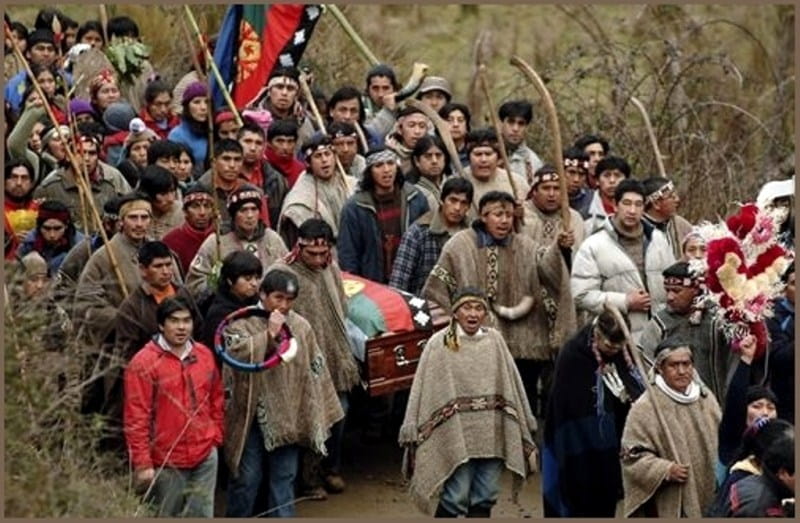
Furthermore, it's important to remind the central government that this "south" isn't solely Chilean. The south has been constructed by the Chilean state as wild, inhospitable, uninhabited, and unproductive. Whose south? A large part of the Mapuche people have historical, political, and organizational knowledge of the processes underway. They possess a collective memory that allows them to have a broad understanding of the progress and crises of national projects in Chile. They have witnessed the comings and goings of presidents, ministers, senators, representatives, mayors, and so on, for decades. Just as they possess a strong conviction and experience of injustices, precariousness, and murders, they can also clearly see the Chilean state as an organized machine designed to continue subjecting these territories to the needs of capital and the winka (non-Mapuche).
In this southern region, the land of the Mapuche people, Wallmapu, there are experiences that offer the Chilean people a wealth of lessons on forms of resistance, international action, everyday solidarity, and sophisticated organizational practices for confronting the state. These experiences have evolved and spread both within and across territories, generating enclaves and hubs of exchange and collaborative solidarity that find their own expression in daily life as well as in political struggle. These forces have coalesced over decades in various territories, remaining invisible to the north, yet sustaining and projecting their influence over time in the south.
It is this sustainability of these processes that makes it interesting to ask: what should the North learn from this South? For decades, the South has demonstrated its own power of organization, resistance, and struggle against the extractive and expansive dynamics of neoliberalism. The forms that protest and social mobilization have taken are found throughout Punta Arenas, Aysén, Chiloé, Osorno, Valdivia, Mehuín, Temuco, Lautaro, Collipulli, Ercilla, and Angol. Diverse local cases, experiences, and specific processes configure a network of actions and a long march of accumulating meanings, lessons learned, and strength.
These experiences are also part of more local, grassroots processes, where places like San Juan de la Costa, Curarrehue, Melipeuco, and Pangupulli, among others, have generated their own currents and channels for popular, plurinational, economic, and ecological processes of redefining life in community. Today, it seems that the north has much to learn from these community-based, societal, and mobile experiences, as they contain the foundations for a more complex struggle against the precariousness of life and for a new definition of life in society.
The question then arises: What will be the relationship between the North and the South in this process of transformation? The faster we dismantle the image of a South that is opaque, nostalgic, and backward, the faster the processes of respect, recognition, and socio-popular learning will take shape and expression in this context of symmetrical rearticulation. The transfer of resistance technologies will be a central part of the social intelligence required to establish constituent, assembly-based, and autonomous processes of debate, deliberation, and democratic decision-making.
The questions that remain for us in the South concern the clientelistic and conservative apparatuses that have perpetuated an oligarchic and landowning vision of social relations, especially in the management and manipulation of precarity. However, it is important to emphasize that this is a trans-spatial problem within peripheral and neo-colonial capitalism, and it invites us to examine the explosion of this mobilization in the Santiago metro and its multiple repercussions in the southern territories.
These questions mobilize challenges, which are forged and accompanied as a humble, slow and dense horizon of possibilities, a horizon for which we are called to work in unison, not only for a new constitution, but rather for a new way of understanding ourselves as a society in the world, where we disrupt geography, and the south can be the north and the north can be the south.
If you would like to receive more information about CLACSO's training programs:
[widget id=”custom_html-57″]
to our email lists.

