
From the bean revolution to Piñera's war
Dr. Silvia Lamadrid (university senator) & Dr. Miguel Urrutia, Academics of the Department of Sociology of the University of Chile, Members of the Social Convergence Party, Broad Front.
How can we understand, from the perspective of recent history, the social mobilizations that have been taking place since October 18th? (Although we could trace their origin to the mass fare evasions called for and led by high school students in the preceding days). The first point of reference that comes to mind is the national protest movement that occurred during the dictatorship between 1983 and 1986. However, besides the obvious difference of currently living in a democracy—a flawed one, but a democracy nonetheless—there is another element that marks a significant difference: those protests were called for by political parties and labor unions. Despite the brutal repression they faced for a decade, these organizations—in a time before social media—were the ones that articulated the framework of public discontent against the dictatorship.
Much emphasis has been placed on the double meaning of the protests. Initially, they were intended as a peaceful solution (…) However, as time went on, due to their own dynamics, the protests became something different, more spontaneous, anarchic, and, horror of horrors, populist, popular. The rotation system was back, comrades (…) These days unfolded in a predominantly nocturnal setting (…) configured by curfews, military patrols, hooded figures, cars without license plates, sometimes firing indiscriminately, bomb explosions, attacks on trains and railway lines, sabotage, blackouts, ambulance sirens, barricades, bonfires, tollbooths, pot-banging protests, smoking tires, flares, raids, “bursts of machine gun fire, pellets, tear gas, and armored vehicles, on one side; and stones, Molotov cocktails, and shouts on the other” (…) Santiago, without anyone being able to foresee it, suddenly found itself besieged by “a veritable ring of fire” (…) The specter of entire marginalized populations threatening to besiege the city and make it explode, an old fear in this country, became a permanent nightmare. [1]
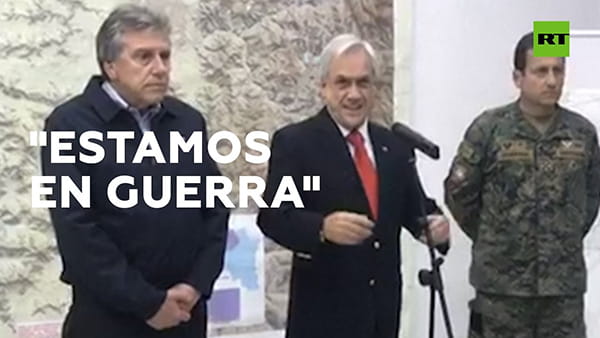
What we are experiencing now, apart from the call by the Coordinating Assembly of Secondary School Students for mass fare evasion [2] , was not the result of calls from labor or political organizations for the initial expressions of social unrest, much less for the pot-banging protests or the subsequent attacks on the subway infrastructure. In fact, Piñera's allusion on the third day of mobilizations to being at war with "a powerful enemy of organized groups" [3] revealed precisely his inability to name that powerful enemy. And it's not for lack of trying: the government would certainly like to be able to blame someone for the social tsunami that has engulfed it, but this tsunami continues to present itself as nothing more than an ominous and elusive evil that has invaded the national territory.
With no clear organizers, and without diminishing the progress of “SOCIAL UNITY. WE ARE TIRED, WE UNITE,” we are witnessing a primarily spontaneous collective action, in which individual grievances have found collective avenues to express themselves and to connect, in a two-way exchange, the worlds that have been separate until now, the social and the political. Undoubtedly, recent history—the protests of the 80s, the student mobilizations of 2006 and 2011, the “rebirth of the strike” in the subcontracting sector in 2007 and 2008, the uprisings in Magallanes, Freirina, Aysén, and Chiloé, the feminist mobilizations for legal abortion, against femicide, and the feminist university May—provided more than mere hints of what we see today.
In Chile, spontaneous explosions of popular discontent had indeed occurred, especially in the city of Santiago, also triggered by the increase in the price of public transport.
During the González Videla administration, the "revolution of the small change" took place on August 16 and 17, 1949. At that time, the González Videla government was facing serious difficulties because the post-war economic crisis had caused the price of copper to plummet, impacting the Chilean state budget. The resulting inflationary process was particularly damaging to the living conditions of the poorest segments of society. Furthermore, in 1948, the Law for the Permanent Defense of Democracy had been enacted, outlawing the Communist Party and granting the government broad powers to repress the labor movement. In this context, and given the decreasing availability of foreign currency, fuel prices were increased, which in turn led to a rise in public transportation fares.
In broad terms, it was a sudden and spontaneous social explosion, led by students, workers, employees, and the general public against the rising cost of living during Gabriel González Videla's presidency. The main target of the protests was public transportation, which had raised its fares on August 12, provoking the anger of Santiago residents. Marches, traffic disruptions, overturned buses, burning of bus shelters, clashes with the Carabineros (police), shootings, injuries, deaths; in short, for approximately a week the Chilean capital experienced very tense moments, culminating in the approval of Extraordinary Powers in Congress and a violent repression of the demonstrators. [4]
Between August 12 and 17 of that year, there were several demonstrations protesting the fare increase. The government press blamed the Communist Party for organizing the violence, but this version was not accepted by other media outlets. On the contrary, the actions unfolded spontaneously, and after the first demonstrations called by students in downtown Santiago, the violence escalated, with protesters using stones and bricks from the street to attack buses. The bus companies decided to take their vehicles out of service.
The riots continued into the night, with the destruction of streetlights, the throwing of stones at the Union Club and the Bus Drivers' Cooperative, two gas pumps, and some guard booths. Numerous people were arrested, but none were students. The following day, demonstrations intensified in various locations, this time targeting businesses in the city center. Overwhelmed by the police, the government deployed Army and Air Force personnel, who suppressed the student marches with cavalry and gunfire. Shootings continued throughout the afternoon, with reports of up to thirty dead and hundreds wounded. Finally, the government repealed the fare increase and obtained immediate congressional approval for extraordinary powers. On the 18th, La Moneda Palace awoke surrounded by a cordon of machine guns and supported by infantry and cavalry platoons. A state of emergency was declared, prohibiting gatherings and controlling the media.
The political assessment was that, despite the government's rapid repressive response, the experience strengthened the unity of grassroots organizations of workers, students, and employees against the high cost of living, serving as an important precedent for the later formation of the CUT (1953) and marking the most significant social conflicts of the 50s. [5] However, in 1952, former dictator Carlos Ibáñez, who became known as "the General of Hope," was elected President with an absolute majority. He promised to sweep away corruption and political maneuvering and lift the country out of poverty. By 1957, that hope had vanished; the economy was once again in crisis, and the neoliberal measures proposed by the Klein-Sacks Mission to contain the inflationary spiral were making the situation for workers even more critical. [6]
In Valparaíso, a Command Against Price Hikes had been formed, comprised of the CUT (Central Unitaria de Trabajadores, the main Chilean trade union confederation), university and high school student federations, dockworkers, and the political parties of the Popular Action Front, the Radical Party, and the National Falange. This command devised a plan of action that began with rallies on March 27 and culminated in marches and an unauthorized rally in O'Higgins Square. The police fired on the demonstrators, killing one and wounding numerous others. In response, the Command called for strikes that, on April 2, brought production in Valparaíso to a complete standstill.
In Santiago, however, the organization was more precarious. There was no central command, and political parties played a minor role. The struggle was initiated by university and high school students. On April 1st, they defied the police by singing, forming circles, and shouting slogans against the high cost of living. That night, police repression intensified, with officers firing shots and wounding protesters. Among them was nursing student Alicia Ramírez, who was killed.
The news of this murder sparked widespread outrage, intensifying the protests, and the police were unable to contain the demonstrators. There was destruction of streetlights, attacks on Congress and media outlets, and looting of businesses, especially in the city center. The Carabineros (police) were withdrawn and replaced by Army troops, who took three hours to achieve a precarious control, using the curfew. That night, large numbers of people marched from various neighborhoods and through areas such as Estación Mapocho, San Diego, San Miguel, Plaza Chacabuco, and Barrio Matadero, among others.
Student organizations condemned the vandalism and looting, feeling overwhelmed. On Thursday, April 4, a strong earthquake struck in the morning; the violent demonstrations subsided, and on Friday the 5th, the government created a commission to review public transportation fares. Following this, a bill granting extraordinary powers was submitted to Congress, which was approved by a majority vote, with only the FRAP and the Radical Party opposing it. This allowed the government to arrest, imprison, and exile dozens of opposition members. The repression resulted in 21 deaths, nearly 500 arrests—many of whom were later exiled—and an undetermined number of disappearances.
Incomprehensible at the time, the movement left almost all political actors without a response. Only the government's extremely violent reaction was able to quell the force of the uprising. Despite the intensity, violence, and large number of dead and wounded, the events of 1957 did not have major institutional repercussions. [7]
There are numerous common elements between these two events and the current situation. A precarious economic situation, social unrest, and the rise in public transportation fares as a trigger. Students spearheaded the first expressions of discontent, which then materialized in attacks on public transportation services: buses and the subway. The ensuing social explosion also surpassed the initial call to action, drawing in diverse social sectors, without the direct leadership of political parties, with some presence of social organizations, and with significant violence directed at symbols of power. The lack of control frightened the political authorities, who unleashed disproportionate repression, presenting it as the only means of control.
Like the current one, the uprisings of 49 and 57 laid bare social discontent and the inability of most of the civil political establishment to respond to that discontent. All three uprisings also share the common thread of violence stemming from social injustice—an injustice that, for the dominant sectors, only becomes visible when symbols of abuses are attacked. The violent response of the State in the name of order is also a shared characteristic of all three uprisings. Finally, they all share the common element of a lack of political leadership, which limits the capacity to negotiate and impose the movement's demands.
There are also important differences. In the 20th century, the repressive response allowed the government to regain control of the situation, at the cost of lives and arrests for the protesters. Now, despite the repression, the 2019 demonstrations continue, extending for more than a week; far from diminishing once the government declares a state of emergency, they spread throughout the city and to cities across the country. It is the first time that collective expressions of discontent are not limited to large cities, nor only to certain neighborhoods within them. Indeed, the repression has had very particular characteristics: with the military present in the streets, they seem careful not to use weapons of war openly, leaving the firing of pellets, most of the beatings, and the arrest of protesters to the Carabineros (police). We say “it seems” because the accounts of violence and torture indicate that it is not a matter of less repression, but of not making the punishment visible, despite which the balance speaks irrefutably of Serious Human Rights Violations with direct political responsibility of the rulers.
The government's response, in the hands of a right wing stubbornly deaf to the social signals of "the other," has been so inept that for extended periods, institutional order has been nonexistent. Trapped by history, it lacks the ability to openly repress (as it would undoubtedly like) and is forced to resort to the same forms of state violence practiced by the dictatorship: the murder of protesters, the kidnapping of opponents, and the very likely establishment of secret detention and torture centers.
On the other hand, the remarkable capacity of the Chilean people to coordinate through social media can only be explained by the experience gained since 2006. The current uprising must be understood within the context of the ongoing social mobilizations that have developed since then, involving a diverse range of new and established actors and forms of struggle. From barricades to bike rides, from pamphlets to WhatsApp messages, all of this is a good indicator of the cultural depth that social struggles have acquired, also expressed in the recovery and innovation of artistic expressions of protest.
The absence of traditional “political leadership” is being replaced by the capacity of civil society itself to generate common proposals. It is hoped that the countless grassroots organizations, whether local or focused on specific demands, will form the framework within which a social and political proposal begins to take shape—one that, for the first time in our history, truly reflects what the people who work and build society want for their lives.
[1] Jocelyn-Holt, Alfredo (1999). The Perplexed Chile. From Advancing Without Compromising to Compromising Without Stopping , Planeta/Ariel, Santiago. Pp. 194-195.
[2] https://radio.uchile.cl/2019/10/17/aces-por-evasiones-en-el-metro-demostramos-la-indignacion-colectiva-que-existe/
[3] http://piensachile.com/2019/10/pdte-pinera-estamos-en-guerra-contra-un-enemigo-poderoso/
[4] Palma, Daniel (2005). The “Chaucha Revolution”. Santiago, Chile, August 16 and 17, 1949. Alternativa, Quarterly Journal of the Alejandro Lipschutz Institute of Sciences. [email protected] • www.ical.cl . Santiago, Chile
[5] Palma, op. cit.
[6] Milos, P. (2007). History and memory: April 2, 1957. Lom Ediciones.
[7] Back cover of Milos, P. (2007). History and memory: April 2, 1957. Lom Ediciones.
If you would like to receive more information about CLACSO's training programs:
[widget id=”custom_html-57″]
to our email lists.

