
Until victory, always, Norita
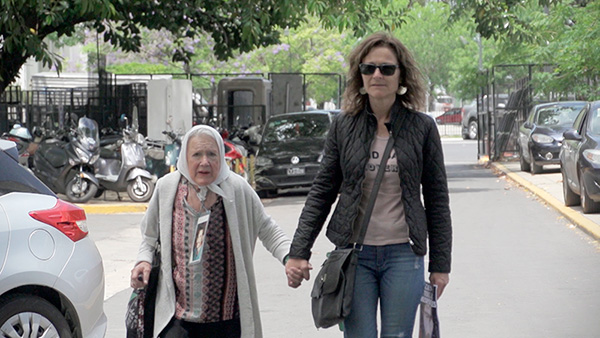

Which story should we tell about Norita? The question echoes as images and snapshots of this extraordinary woman, who walked the collective history of Argentina to transform it and be transformed herself, crowd in. “Exactly half her life: my father disappeared when Norita was 47. And for another 47 years she searched for him.” This round number is offered by Damián, Norita's grandson and son of Gustavo Cortiñas, who was kidnapped on April 15, 1977. We talk in the indoor arena at the Mansión Seré grounds in Morón, where the line to say goodbye to Norita is endless, a testament to her boundless capacity to expand and embrace diverse social struggles. From feminist plazas to the demands of the mothers against police brutality. From Japan to Kurdistan. From Zapatista Mexico to Lula's Brazil. From the demand for justice for Rafael Nahuel to the first marches denouncing the disappearance of Luciano Arruga . But as always, at the intersection of the grand narrative of history, are our own stories. The small things, the ones that ultimately take hold in our memory. The ones that circulated during the vigil that bid farewell to Norita and materialized in t-shirts, letters, pennants, posters, and objects that people offered her, forming a bright and colorful circle around her. Like the colors of the scarves that began to accompany the emblematic white scarf. Before each event, Norita would initiate the scarf ritual: the green of feminist activism, the orange of the separation of Church and State, or the seven-colored one of the Wiphala. “In those scarves are your definitions, your place in the world. What are your struggles?” I once asked her . “I fight against the exploitation of one human being by another. I am anti-capitalist, a little bit socialist, and a little bit anarchist. And I also fight against patriarchal culture . ” Along with that definition, Norita rehearsed the long history of the handkerchiefs and recalled that the white one was born in a pilgrimage to Luján, during the dictatorship, when the mothers of the disappeared used diapers to meet and attract the attention of the press and the pilgrims.
No one wants to leave the Morón arena. Norita was given a send-off with the love and passion that popular leaders inspire . Among the colors of the makeshift funeral chapel are those of soccer: there are several jerseys and a ball. Norita was a Boca fan, but she cared about the fights the girls were fighting. "Now that girls are making progress in soccer, we have to support them," she said when the Norita soccer club was founded.
What story to tell? When she was arrested and ate Chicha Mariani's plane ticket in the police car? When, in the midst of the dictatorship, she went to Mansión Seré with the story of buying the house for a nursing home? When she participated in the first Women's Meetings? "I was raised with a patriarchal mindset," Norita affirmed, who at 19 was married, a housewife, and a seamstress. She recalled with a smile the anger of Carlos, her husband. "What does a Mother of Plaza de Mayo have to do in a workshop on sexuality?" That's how she became a feminist and established herself as a kind of rock star of the green wave.
What story should we tell about Norita? The story of waiting? “I waited for my son many times during the holidays. For Christmas in ’77, I bought him loafers and jeans. I stayed up all night looking out the window. Even when we moved later, we made sure the house we bought had a front door similar to the old one, in case Gustavo came back with amnesia.” Gustavo Cortiñas was kidnapped at the Castelar train station. Norita never stopped looking for him. That’s how she politicized her motherhood and taught us to defy fear. That’s how she broadened her horizons and ours. That was her way of searching for Gustavo and understanding his legacy. She searched for him in every just struggle and became the Mother of us all. “The only thing I couldn’t do was become a Peronist like Gustavo. That’s why I ask my grandson Damián to take care of himself and be a better Peronist.”
She walked alongside Osvaldo Bayer, Adolfo Pérez Esquivel, Alberto Santillán, Carlos Cajade, Vanesa Orieta, Sergio Maldonado, and Diana Sacayán. She stood with the Mothers of Kurdistan and the Mothers of Soacha in Colombia. She accompanied the Mothers of Ituzaingó in Córdoba and the "No to the Mine" Assembly in Esquel. From the endless wound of disappearance, she taught us the unwavering fight for justice without ever relinquishing joy and hope. Norita's radiant laughter burst forth constantly. There will be no way to remember her without the knowing mischief that accompanied each of her witty remarks.
We never wanted to say goodbye to Norita. Her presence was like confirmation of being exactly where we needed to be. An ethical and loving compass. But that day came, and we felt a profound sense of loss . Norita gave everything and more. She passed away at 94, leaving us a legacy that must be honored in these difficult times. Luckily, we were able to hug her and applaud her wildly in every town square. And she left knowing she was loved. Until victory, always, Norita.
* Text published in La Pulseada magazine
If you would like to receive more information about CLACSO's training programs:
[widget id=”custom_html-57″]
to our email lists.

