
"Central America is one of the regions with the highest levels of conflict surrounding migration."
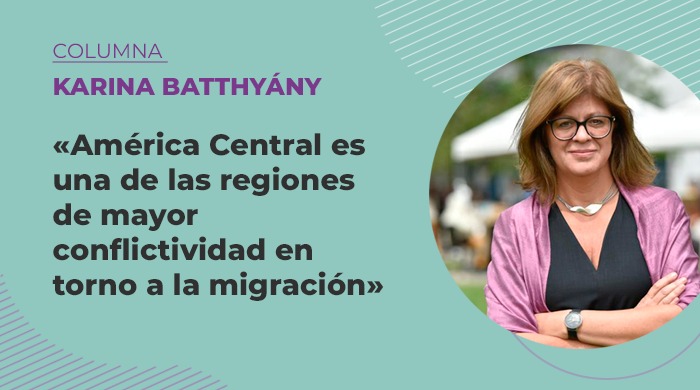
Transcript of Karina Batthyány's column
in InfoCLACSO – October 18, 2023
Migration and the environment are central themes for the CLACSO Steering Committee as it analyzes the current situation in this complex moment for our region. These topics were chosen by the CLACSO Member Centers throughout Central America for the international forum on the theme of “Migration and Environmental Conflicts in Central America.”
The CLACSO Platforms for Social Dialogue (PDS) cover issues that affect the entire Latin American and Caribbean region. However, migration and environmental issues, in particular, have some of their most complex expressions in this region: Central America and the Caribbean.
If we focus specifically on the issue of migration, we must point out that CLACSO promotes the idea of migration and human mobility as a right for all people. We work to break down the stigmas and negative labels associated with migrants and to take into account the particular conditions surrounding this migratory flow.
Many migrants do so in vulnerable conditions. We should recall the reports from the International Organization for Migration (IOM), which focus on analyzing these vulnerable conditions of migrants, estimating that around 90 million people have been displaced from their place of origin, whether due to political, environmental, or social conflicts.
The environmental dimension has become an increasingly significant cause of migration in recent years. Specifically, the IOM, in its latest report, states that the number of people displaced by environmental disasters is around 30 million worldwide.

What future for Central America?
InfoCLACSO 25-10-23
We must also address the vulnerability of migrants and the consequences of their migrations, which are often unsafe and carried out under extremely precarious conditions. Many of these journeys end with people dying in the attempt, when, once again, mobility and migration should be a right and a guarantee for everyone.
Let us remember the deaths that have occurred in our region and throughout the world. Although not in our region, one of the places that serves as a vast graveyard for migrants is the Mediterranean Sea. More than half of all migrant deaths occur there, amidst the desperation to reach European territory. These people supposedly have opportunities there to build a dignified life. That fact is appalling and deeply moving.
But behind migration lies the phenomenon of human trafficking, which has grown significantly in recent years. The United Nations Office on Drugs and Crime (UNODC) reports that the human trafficking industry generates approximately $7 billion annually worldwide.
What is happening in our region? How do we see this situation in Latin America and the Caribbean? We have approximately 30 million Latin Americans and Caribbeans who have migrated to other regions (data from the latest IOM report). Approximately 25 million have migrated to North America, either the United States or Canada, and another 5 million to Europe.
Central America is precisely one of the regions with the greatest conflict surrounding this issue. It is where the largest number of displacements occur. Migration from and through Central America has various dimensions or factors that explain this migration: economic insecurity, violence, crime, and also the environmental effects of climate change.
Honduras, Guatemala, and El Salvador had nearly one million forcibly displaced people by the end of 2020 and the beginning of 2021. More than half a million of them had crossed borders in migrant caravans, which are large groups of people traveling by land across borders—the only way for them to escape due to economic reasons—and which have been steadily increasing in this region since 2018.
Of course, this has led to increased restrictions at North American border crossings, particularly those of the United States, but also those of Mexico. This is the opposite of what we would expect if we view it as a right.
There is another dimension that is crucial to consider: the economic dimension associated with migration. We know about remittances and their importance. Remittances are money that migrants send to their countries of origin. In Central America, they currently represent up to 20% of GDP in some cases, which is an enormous figure. Consider, for example, the ongoing struggle in all our countries to ensure that education spending reaches 6% of GDP.
Therefore, when considering migration, we must keep in mind the labor dimension. On the one hand, there is the representation of migrant workers as a workforce in the countries receiving this migration, primarily those in the Global North. On the other hand, there are the conditions under which these individuals are employed in host countries, which are not always dignified, lacking social security and rights.
– In many cases, discrimination would be added to the mix…
– Of course. Discrimination is always present. Even when migrants manage to find employment with access to social security, they often end up in jobs that are both economically disadvantaged and socially unrecognized. In other words, they find jobs that the local population doesn't want to do. A large number of migrants work illegally because they lack legal status and are employed informally without access to any social benefits.
We must work to break down these labels, to showcase these migratory flows, and to highlight the right to human mobility as a contribution to the development of the countries that receive migrants. In some cases, these are transit countries or countries that are major sources of emigration. But we must present it as a contribution to development and social well-being.
We are far from that moment, because reality shows us that migrants face daily barriers and obstacles that jeopardize their most basic rights, if not their very lives. From a migration perspective, within the framework of our Sustainable Development Plans (PDS), we are considering how to integrate our knowledge on this topic with public policies and with social movements and organizations. In this case, particularly with social movements and organizations linked to migrant communities and also to environmental groups.
– Today, environmental issues are key in Panama, with protests against open-pit mining, protests around the University of Panama, and a very dynamic student movement. This even prompted the government to introduce a bill that would allow mining companies to continue open-pit mining… How relevant is this to the many struggles taking place in other parts of Latin America?
– Indeed, we see these issues throughout the region, but it's Central America's turn to address them, given the many environmental challenges, such as open-pit mining, which is extractivism in its harshest, most dramatic, and brutal form. The consequences of climate change are also evident throughout Central America and the Caribbean.
There are direct consequences for the daily lives of those who live in these territories, as well as environmental and migration-related consequences. Ultimately, it is necessary to analyze the various layers of inequality in the region, where migration and the environment are two increasingly important and prevalent issues.
If you would like to receive more information about CLACSO's training programs:
[widget id=”custom_html-57″]
to our email lists.

