
Public policies, education and inequality
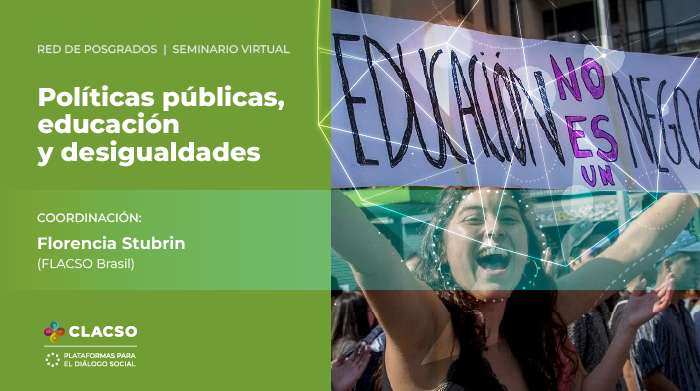
Seminar 2324
ChairCLACSO
Coordination: Florence Stubrin (FLACSO Brazil)
Home: 08/08/2023 | Registration: 27/06/2023 to 07/08/2023
Workload: 12 weeks – 90 hours.
The view of education as a public and social good, a universal human right, and a responsibility of states is now a consensus and is reflected in much of the regulatory framework governing educational systems in Latin America. However, the effective realization of this right is far from being a reality in our region. Educational inequalities continue to plague our societies and our educational systems, finding new and increasingly sophisticated forms of expression. The growing consolidation and expansion of differentiated educational circuits result in the segmentation of educational systems. This, in turn, reproduces conditions of lower quality in education associated with social origin, ethnicity, gender, geographic location, and family structure. We begin with the recognition that education is a social, political, and cultural phenomenon and is therefore subject to ongoing disputes that determine its main configurations and directions within the specific context of historical moments. Thus, the analysis of educational inequalities and public education policies requires the consideration of multiple dimensions. The increasing privatization of educational offerings and the weakening of public education systems, the decline in funding, infrastructure deficiencies, the limited integration of digital tools and resources into pedagogical processes, and the consequent disconnect between school learning and the development of new cultural forms and expressions are some of the main educational shortcomings in the region. For their part, the impacts of the pandemic dramatically highlighted and intensified these shortcomings, revealing a series of unavoidable challenges. In this seminar, we propose to reflect on the main debates that are currently urgent from the perspective of the conception of education as a right and the promotion of educational justice. These include the analysis of education in emergency situations, the need to develop actions to strengthen and expand public investment in education in response to post-pandemic needs, and the challenges of teacher training. New literacies and digital citizenship; the gender perspective; reflections on ethics and human rights in artificial intelligence, are some of the topics we propose to address.
|
|
Discount for one payment until 04/08 |
In one payment after 04/08 |
|
CM Plenos |
$75 |
$150 |
|
CM Associates |
$95 |
$190 |
|
No link |
$95 |
$190 |
FAQ
The basic requirements for taking a seminar are:
- Availability of at least 4 hours per week to dedicate to the seminar course.
- Internet access.
- Reasonable handling of communication and computer tools.
- Language proficiency in the language in which the course will be taught. The official languages are Spanish and Portuguese.
|
|
Discount for one payment until 04/08 |
In one payment after 04/08 |
|
CM Plenos |
$75 |
$150 |
|
CM Associates |
$95 |
$190 |
|
No link |
$95 |
$190 |
More information: [email protected]

