
40th anniversary. The denial of justice and the question of memory in the April 1984 massacre in the Dominican Republic
Amaurys Pérez Vargas*
Devis Cabrera Heredia**
Despite the testimonies, evidence, and reports documented by journalists and human rights organizations in the country, no member of the military or government official has been brought to justice or convicted for their participation in the massacre in which more than 100 people died on April 23, 24, and 25, 1984, during the popular uprising led by the Dominican people in rejection of the economic measures dictated by the International Monetary Fund. The socio-political phenomenon dubbed "La Poblada" by Professor Juan Bosch during our "democratic transition" left, among other things, the police violence that plagues neighborhoods to this day. Another tangible legacy is the wound inflicted by the denial of justice for the victims and their families. From the outset, this event has been marked by impunity, perpetuating the pain and outrage of all those who lost a loved one during those tragic days of repression.
The lack of investigation, the cover-up, and the institutional complicity are clearly evident in the press release published by the newspaper La Noticia on page 9, on April 24, 1985, whose headline reads, “Attorney General Justifies April 84 Deaths; Says Government Had to Confront Rebellion.” The article reveals the attitude of the Attorney General, Dr. Américo Espinal Hued, who stated that “the reason dozens of people died in violent events a year ago was that the government had to confront a rebellion against the regular and legally constituted power.” The news report adds that “under this justification, the Attorney General refused to receive a letter that leaders of the Popular Unity Council and relatives of those killed in the violent events of April of last year were to deliver to him.”
Certainly, the Public Prosecutor's actions generated a feeling of powerlessness and despair among the families and activists demanding truth and justice for the victims. This view is consistent with that expressed a year earlier by President Salvador Jorge Blanco, who, during the protests, reported "16 wounded soldiers and police officers." This statement bore a certain resemblance to that made by Joaquín Balaguer during the tragic events that took place on Espaillat Street in Ciudad Nueva on October 20, 1961, when, following a student massacre, the president declared: "Let my first words be to warmly congratulate the National Police for the exemplary conduct they displayed during the outbreaks of violence that have occurred in recent days in different parts of the country."
The position of the Attorney General and the President of the Republic, the latter stated in the press release published in La Noticia on April 24, 1984, entitled “Jorge Blanco promotes soldiers wounded in recent incidents,” contrasts with that expressed by the PRD leader José Ovalles, who was considered “the main strategist of President Salvador Jorge Blanco’s electoral victory,” who asked that “those who gave the order to ‘shoot to kill’ be identified and punished severely.”
This last point is particularly important when we thoroughly analyze the figures and data from the various sources we consulted. For example, of the 39 death certificates we found, 14 indicate that the shots were to the head. If we subtract the 12 that do not specify the location of the gunshot wounds, we find that more than 50% died in this way, while another 6, equivalent to 22% of the total of 27, had gunshot wounds to the chest, which suggests that the military's objective corresponds to what Ovalles indicated.
But Ovalles didn't stop there, categorically holding his superiors responsible for "the true culprits behind the deaths of these unfortunate citizens." In that vein, he conveyed his solidarity and thoughts to "the mothers, wives, and children who bury and mourn their dead, and the entire Dominican people who resist seeing their misfortune compounded by the rising cost of living. They need to hear a voice... to demand, with vigor and courage, justice for their cause and punishment for the guilty," as seen in the article published in La Noticia on April 25, 1984, titled "Ovalle Maintains Government Action Contradicts the PRD's Trajectory." In that same vein, Dr. José Francisco Peña Gómez, who was then mayor of the city of Santo Domingo and historical leader of the Dominican Revolutionary Party, stated, “recognizing the excesses in the elimination of disorders,” that the causes of the military violence lay in the fact that “the military institutions developed within a government that did not respect public freedoms, such as the regime of the dictator Rafael Leónidas Trujillo Molina and later the 12-year government of Dr. Joaquín Balaguer.”
Although, as historian Roberto Cassá rightly points out in the expanded and corrected edition of Volume II of his Social and Economic History of the Dominican Republic, when he emphasizes that “an event of this magnitude was unprecedented and the violence with which it was repressed left such an impact that it morally ruined Jorge Blanco,” the truth is that the military officials responsible for the tragedy—namely, General Ramiro Matos González, Secretary of State of the Armed Forces, General Manuel Antonio Cuervo Gómez, Chief of the National Army, and José Félix Hermida, Chief of the National Police—were not prosecuted for the “excesses and crimes committed.” They knew perfectly well what they were doing when they sent the “Green Berets” into the streets with heavy weapons against an unarmed populace, trained under the national security doctrine imposed on Dominican society since the time of the first US military intervention, 1916–1924.
The denial of justice is still evident today in the lack of official recognition by the Dominican State, which has neither assumed responsibility nor apologized for the massacre perpetrated, an act for which it would easily be condemned in court, following the precedent established by the Inter-American Court of Human Rights regarding the Caracazo in Venezuela. Nor has an official ceremony been organized to pay tribute to all those who died defending their dignity and survival, much less designated a public space, apart from the plaque at the Autonomous University of Santo Domingo (UASD) dedicated to the student Adolfo Brito, to honor and remember those who perished in those days of struggle for social and economic justice in the Dominican Republic.

Plaque dedicated to the student Adolfo Sebastián Brito, Autonomous University of Santo Domingo, UASD, Chemistry laboratory.

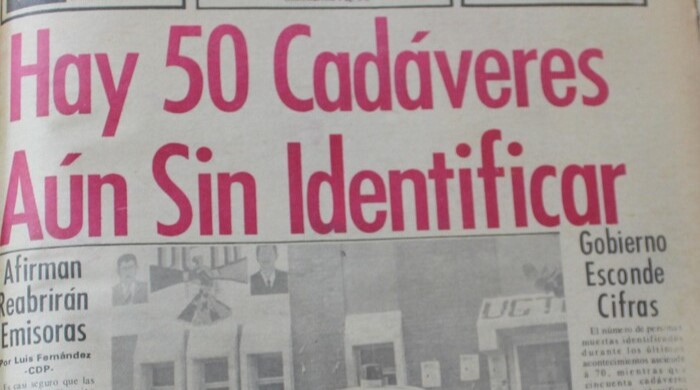
Front page of the newspaper La Noticia, April 30, 1984

Photo of Dr. Salvador Jorge Blanco, President of the Dominican Republic; General Manuel Ant. Cuervo Gómez, Chief of the National Army; and General Ramiro Matos González, Secretary of the Armed Forces.
* Prof. Amaury Pérez, Ph.D. Schools of Sociology and History – Autonomous University of Santo Domingo – UASD. Member of the CLACSO Working Group on Collective Memories and Practices of Resistance. Co-coordinator of the CLACSO Working Group on Exodus of Cultural Matrices
** Member of the CLACSO Working Group on Collective Memories and Practices of Resistance.

