
Third World Forum of Cities and Territories of Peace
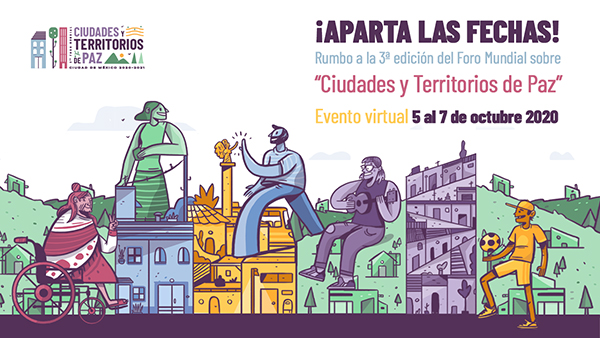
The 3rd World Forum of Cities and Territories of Peace took place from October 5 to 7, 2020 with the participation of Karina Batthyány , Executive Secretary of CLACSO, and Pablo Vommaro , Director of Research.
With the aim of advancing the lines of work and proposals that emerged in the first two editions, the goal was to generate an open process that continues and expands reflection and debate, in order to place the culture of peace on local and global agendas.
Subject areas:
1. Welcoming migrations to cities
2. Addressing the gaps: Economic and socio-spatial inequalities
3. Eradicating violence against women and sexually diverse people
4. Promoting actions against racism, xenophobia, antiphobia, homophobia and other forms of intolerance
5. Cities and territories free of corruption
6. Countering violent extremism
7. Building spaces free from direct interpersonal violence
Tuesday, October 6, from 11:00 a.m. to 13:00 p.m. Mexico time: Forum “ Youth in the construction of justice and peace ”, with the participation of Pablo Vommaro , Director of Research at CLACSO.
Wednesday, October 7, from 11:00 a.m. to 13:00 p.m. Mexico time: Forum “Women, culture of peace and non-violence” , with the participation of Karina Batthyány , Executive Secretary of CLACSO, and various Working Groups.
More information:
https://www.ciudadesdepaz.com
[email protected]
The forum is a global, collective, and horizontal space for reflection, aiming to offer solutions at the political level and in the implementation of peacebuilding policies in diverse territories. The impact of the pandemic presents us with an even greater challenge, as the health, economic, social, political, cultural, and environmental consequences of the coronavirus are enormous and require greater creativity, advocacy, exchange of experiences, and collaboration.
The forum began in Madrid in 2017 and has brought together nearly 10.000 participants from over 100 countries across the globe, representing international institutions; national, regional, and local governments; civil society organizations; social activists; universities; businesses; and young students. The in-person edition of the third forum, scheduled to take place in Mexico City, has been postponed to 2021 due to the health crisis. The International Association of Educating Cities is part of the forum's Scientific Committee, along with UCLG, Mayors for Peace, Metropolis, and various United Nations agencies.
The Government of Mexico City, accompanied by an International Organizing Committee (IOC) in which different entities (international, regional, national and local organizations) participate, assumed the realization of a third call for the Forum.
The COVID-19 pandemic demonstrates that vulnerability can affect all of humanity, whether due to natural or social causes. The quadruple crisis (health, social, economic, and political) brought about by this pandemic also highlights the need to place greater value on a culture of the commons, coexistence, care policies, the circular economy, sustainability, and harmony with nature.
Therefore, the discursive narrative of this meeting revolves around the "positive work of peacebuilding", without neglecting the importance of naming the violence and the educational processes, from which community resilience strategies are generated that contribute to the creation of other possible scenarios: cities and territories of peace.
In this third edition, we consider the positive conception of peace, understood not only as the absence of armed conflict, but also as the presence of social justice, sustainable development, the democratic exercise of citizenship, the fulfillment of human rights within and between states, and, consequently, the opposition to any type of violence. In this sense, ESCR (Economic, Social, Cultural, and Environmental Rights) will be considered as conceptual pillars of the Forum, approached from the perspective of the Right to the City.
If you would like to receive more information about CLACSO's training programs:
[widget id=”custom_html-57″]
to our email lists.

