
29 days in China
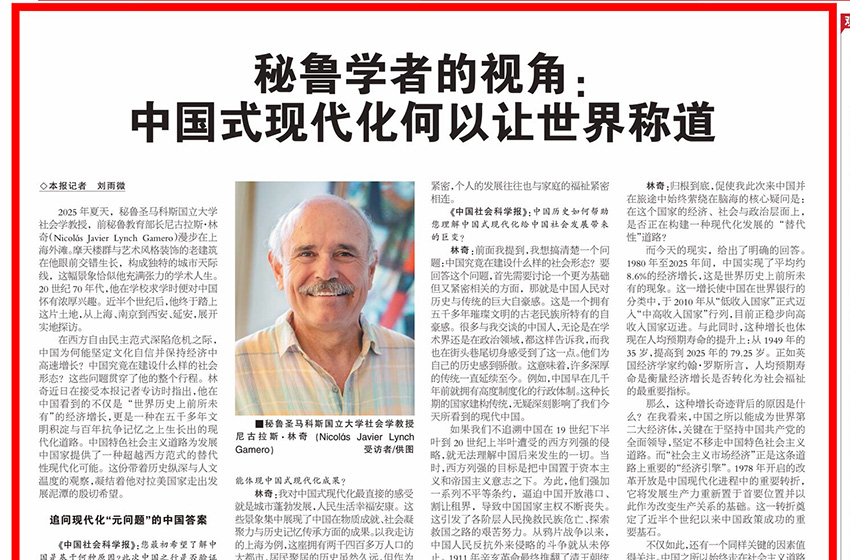
This article, published in the April 2026 issue of the China Social Science Journal , is an interview based on the article written by Nicolás Lynch* last year, “29 Days in China” ( https://otramirada.pe/29-d%C3%ADas-en-china ), following a visit to that country where he gave the lecture “The Dilemmas of Democratization in Latin America.”
The article was submitted to the journal by Professor Yiyang Cheng , an academic at Fudan University. The piece reflects Lynch's impressions of his trip, addressing the blend of tradition and modernity that characterizes China today and which, given the extremely serious challenges facing Latin America and the world today, can offer valuable insights into these realities.
29 days in China
This text is a chronicle of a journey that does not pretend to be exhaustive or conclusive. Finding the right narrative tone has not been easy for someone like myself, accustomed to analytical and conclusive language, but I believe it is worthwhile to begin recounting such an important experience that literally took us to the other side of the world. What I write is the product of my personal observations, as well as the many conversations we had during the trip, and it does not claim objectivity but, like everything I have written in my life, is nourished by my feelings and ideas.
It is impossible not to connect my desire to learn about China, at least during the brief academic and sightseeing trip I took between July 5th and August 6th, 2025, with the beginning of my political life at the National University of San Marcos in the 1970s. It is unnecessary to elaborate further, as I have already covered these details in my early book, "The Red Youth of San Marcos," in its two editions of 1990 and 2019. In these short months, I have sought the underlying reason for this desire and have found it in the impression made on me by the connection between egalitarianism, nationalism, and audacity professed by the Chinese version of Marxism and its application in socialist construction, as expressed by Mao Zedong. This was a version expressed with great independence of judgment by the Chinese leaders. We should recall their unorthodox emphasis on the role of the peasantry as the majority class in the revolutionary change, their concept of war as both popular and protracted—in a country with a long history of reflection on the subject—and the letters exchanged between the Chinese and Soviet leadership that motivated the "Nine Commentaries," which would form the basis of the break they underwent in the early 1960s, leading up to the "Cultural Revolution" and its emphasis on "revolution within revolution," before experiencing the setbacks of that process. However, my reasoning on this topic had never fully matured until I visited China and felt the contrast, both as change and continuity, between those early reasons and the transformations that had taken place over the last fifty years.
But I was also plagued by more immediate concerns. On the one hand, there were the assessments of the Western, and more specifically Latin American, left regarding the shift that occurred in China under Deng Xiaoping from 1978 onward, and on the other, China's growing role in the world, which, due to its importance, is the subject of daily news coverage these days. Regarding the first point, the question has been: what is being built in China? Socialism or capitalism? Perhaps as an echo of the rhetoric of the Cultural Revolution and the so-called Gang of Four, which pointed to the dangers of a "capitalist restoration" as they assumed had occurred in the Soviet Union and other socialist countries. Regarding the second point, the question is whether China, in its global projection over the last few decades—a very important aspect of its economic and political development—has an imperial ambition, as the United States has and practices today, and as other Western countries have practiced in the past. Capitalism and imperialism, one precedes the other and are mutually reinforcing, as the classics of Marxism point out. This dilemma then becomes crucial. Finally, the democratic question. Whether we like it or not, this “far west,” which in some ways is Latin America, is part of the Western political tradition and, as such, is not immune to the influence of liberal democracy. It is very difficult to view China differently. However, given its economic and social successes and the crisis—in some cases, the bankruptcy—of liberal democracy, it is worth trying to understand the Chinese institutional regime in political terms as well.
El viaje
I had been warned that it was going to be a long trip, but even so, I had no idea of what we were about to embark on. The first decision was to avoid the United States, so as not to fall victim to any of Trump's bluster. This made the trip longer, about ten hours or perhaps more. We went through Europe and crossed the Middle East, finally traversing Asia and arriving in Shanghai. 34 hours in total if we include flight time and layovers in airports. The journey itself, however, was already a showcase of the mosaic of groups and cultures we encountered along the way. Latin Americans, Europeans, Arabs, Iranians, and finally Chinese, passing through airports that reflected different ways of treating people.
Shanghai
Pudong Airport foreshadowed what other airport terminals and train stations would become. It looked brand new, although we were later told it wasn't really, but its design, cleanliness, and order put any other airport we had imagined to shame. We had to postpone our trip on the bullet train that connects the airport to downtown Shanghai in eight minutes, thanks to the kindness of our host from Fudan University, who was waiting for us with a taxi to take us to the hotel. The postponement wasn't in vain, though, because we were able to enter Shanghai via an eight-lane highway with multiple viaducts. Despite the slow rush-hour traffic, the drive revealed the metropolis's architecture, from its suburbs to the very center, finally arriving at the "French Concession" where we were staying.
READ THE FULL REPORT HERE
* Nicolás Lynch is an academic at the National University of San Marcos and a member of the CLACSO Steering Committee representing the member centers of Peru.

