
2nd Graduate School of the Network of Contemporary Latin American and Caribbean Social Studies
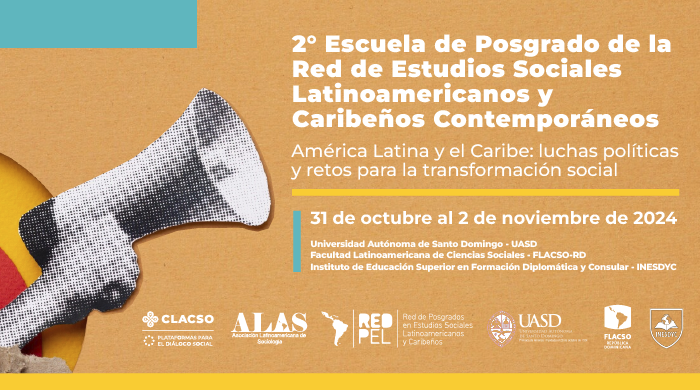
Latin America and the Caribbean: political struggles and challenges for social transformation.
Santo Domingo City, October 31 to November 2, 2024
SEDES
- Autonomous University of Santo Domingo, Dominican Republic
- Institute of Higher Education in Diplomatic and Consular Training “Dr. Eduardo Latorre Rodríguez”, Ministry of Foreign Affairs of the Dominican Republic
- FLACSO Dominican Republic
The Latin American Council of Social Sciences (CLACSO), the Latin American Sociological Association (ALAS), the Network of Postgraduate Programs in Latin American Social Studies (REDPEL), the “Dr. Eduardo Latorre Rodríguez” Institute of Higher Education in Diplomatic and Consular Training of the Ministry of Foreign Affairs of the Dominican Republic, FLACSO Dominican Republic, and the Autonomous University of Santo Domingo (UASD) invite master's and doctoral students—preferably in the first half of their programs and in the initial formulation of their thesis projects—as well as established public policy officials and activists from civil society organizations in Latin America and the Caribbean interested in the topic, to submit their applications to participate in the II International Postgraduate School of the Network of Contemporary Latin American and Caribbean Social Studies (REDPEL), to be held from October 31 to November 2 in Santo Domingo, Dominican Republic.
The Network of Contemporary Latin American and Caribbean Social Studies (REDPEL) emerged in 2019, within the framework of an agreement between CLACSO, ALAS and the Postgraduate Program in Latin American Studies of UNAM, on the occasion of a preparatory event for the ALAS Congress.
The REDPEL First Graduate School was created in response to the challenge of generating a space for theoretical and methodological training in Latin American and Caribbean studies, one of the fields of knowledge that has produced some of the most important and significant theses for interpreting the place of Latin America and the Caribbean in history and in the world.
Up to 40 scholarships will be awarded to students from Latin America and the Caribbean.
ORGANIZING INSTITUTIONS:
- Latin American Sociological Association (ALAS)
- Latin American Council of Social Sciences (CLACSO)
- Network of Postgraduate Programs in Latin American Social Studies (RedPEL)
- Institute of Higher Education in Diplomatic and Consular Training “Dr. Eduardo Latorre Rodríguez” (INESDYC), Ministry of Foreign Affairs of the Dominican Republic
- Latin American Faculty of Social Sciences Dominican Republic (FLACSO)
- Autonomous University of Santo Domingo (UASD)
They support:
- Friedrich-Ebert-Stiftung (FES), Caribbean
- UN Women
- Postgraduate Program in Latin American Studies of the National Autonomous University of Mexico (PPEL/UNAM)
- Bimodal Master's Degree in Contemporary Studies in Latin America, University of the Republic (UdelaR), Uruguay
ORGANIZING COMMITTEE:
- Dr. Alberto Riella (University of the Republic, Uruguay)
- Dr. Ana Rivoir (University of the Republic, Uruguay)
- Dr. Angélica Cuellar (National Autonomous University of Mexico)
- Dr. Efraín León (National Autonomous University of Mexico)
- Dr. Karina Batthyany (Latin American Council of Social Sciences and University of the Republic, Uruguay)
- Dr. Nayar López (National Autonomous University of Mexico)
- Dr. Alejandra V Liriano (Institute of Higher Education in Diplomatic and Consular Training)
- Dr. Cheila Valera Acosta (Latin American Faculty of Social Sciences)
- Ma. Antonio Ciriaco (Faculty of Economics and Social Sciences of the Autonomous University of Santo Domingo)
RESULTS
We thank all master's and doctoral thesis students, public policy officials, and representatives of social organizations for the positive response to this call.
We have received 143 applications which were evaluated by an international jury made up of members of the academic committee and the organizing committee, this whole team was in charge of considering the quality, relevance and coherence of the applications according to the bases of the call.
In accordance with the above, the selected participants in the School are:
| Name and surname | Country of residence | Application type |
| Akemi Nitahara Souza | Brazil | PhD |
| Alejandra Paulina Rojas Correa | Mexico | PhD |
| Ana María Sterling Bastidas | Colombia | PhD |
| Boris Alberto Céspedes Muñoz | Bolivia | PhD |
| Camila Estévez Corporán | Dominican Republic | Social Movement Leader |
| Danny Bilbao | Ecuador | Master's degree |
| Eliana Alba | Bolivia | PhD |
| Erika Garcia | Dominican Republic | Master's degree |
| Fabian Chavarria | Costa Rica | Master's degree |
| Federico Bruno | Uruguay | Master's degree |
| Hector Alejandro Zuluaga Cometa | Colombia | PhD |
| Javier Alejandro Avila Larrea | Ecuador | Public Policy Officer |
| Karla Mylena Faillace Delgado | Mexico | Master's degree |
| Luis Fernando Astudillo Becerra | Chile | Social Movement Leader |
| Luis Idme Ccajma | Peru | PhD |
| Marcia Bernardes | Brazil | Master's degree |
| Margaret Carolina Ferreira Diaz | Dominican Republic | Master's degree |
| María Alejandra Garay Báez | Paraguay | PhD |
| Mery Anyelina Santana Heredia | Dominican Republic | Public Policy Officer |
| Micaela Anahí María Aguirre | Colombia | PhD |
| Milton the Wise | Argentina | Public Policy Officer |
| Misael Soto | Mexico | Master's degree |
| Nadia Fabiana Barreto Blanco | Uruguay | Public Policy Officer |
| Omar Alonso Marañon Tovar | Chile | PhD |
| Oscar Aristides Alonso Castilla | Nicaragua | Master's degree |
| Robinson Guerrero | Dominican Republic | Master's degree |
| Rocío Valentina Millar Barría | Chile | PhD |
| Tatiana Marlene Francishini | Argentina | PhD |
| Vandemberg Do Nascimento Fonseca | Uruguay | Master's degree |
| Victoria Noelia Cabral | Argentina | PhD |
List of substitutes:
| Name and surname | Country of residence | Application type |
| Arturo Marcel Maldonado Corvalán | Chile | PhD |
| Beatriz Eugenia Ornelas Cerda | Mexico | PhD |
| Fabian Riveros | Colombia | PhD |
| Lizbeth Nelva Diaz Redolfo | Peru | Master's degree |
| Lyda Marcela Herrera Camargo | Colombia | PhD |
| María Catalina Musso | Argentina | Master's degree |
| María Mónica González | Argentina | PhD |
| Ricardo Martín Sinchigalo Martínez | Ecuador | Master's degree |
| Yeimer Gerardo Ramos Torres | Costa Rica | Master's degree |
This ruling is final and irrevocable.
The Network of Contemporary Latin American and Caribbean Social Studies emerged in 2019, within the framework of an agreement between CLACSO, ALAS and the Postgraduate Program in Latin American Studies of UNAM, on the occasion of a preparatory event for the ALAS Congress.
The REDPEL First Graduate School was created in response to the challenge of generating a space for theoretical and methodological training in Latin American and Caribbean studies, one of the fields of knowledge that has produced some of the most important and significant theses for interpreting the place of Latin America and the Caribbean in history and in the world.
The schools dThe CLACSO postgraduate programs are an intensive training space, coordinated by distinguished professors from some of the most prestigious postgraduate programs in the region. The school aims to create a space for postgraduate students and representatives of civil society organizations already responsible for public policy, based on interdisciplinary work and the knowledge that characterizes Latin American and Caribbean social studies. The second edition of the School is titled “Latin America and the Caribbean: Political Struggles and Challenges for Social Transformation” and will focus on methodological aspects, the presentation of topics, and relevant theoretical frameworks for analyzing research and territorial intervention plans within a Latin American and Caribbean context.
The School's main objective is to develop a training space for postgraduate students in Latin American and Caribbean social studies, members of social movements, and public policy leaders, contributing to the advancement and quality of thesis work and socio-territorial intervention planning. It will provide training in methodology and theory, as well as address key issues for the continent.
- Methodological axis consisting of a workshop and course with the purpose of guiding and strengthening the capacities for the preparation of the final work, which will preferably be part of your thesis or thesis project.
- The theoretical and thematic axis consists of conferences and colloquia focusing on theoretical discussions and in-depth exploration of central themes for the study of the Latin American continent. These will be grouped around:
- Crisis and socio-political transformations in Latin America. Current situation and long term.
- Between tradition and recent theoretical emergences for understanding processes in Latin America – dependency, decoloniality, gender, among others.
- Gender, inequalities and rights in tension. Reflections on current challenges and alternatives deployed from feminisms and territories.
- Certificate of participation: They will be given to all students who participate in carrying out the set of proposed activities.
- Certificate of completion of postgraduate seminar 40 hours of in-person work and 95 hours of remote work (135 total hours). Only for those who complete the written work after the School.
At the end of the School, the evaluation guidelines for the intensive seminar will be established, which include the completion of a written paper in article format. These papers will be evaluated by the School's academic committee.
The target audience includes master's and doctoral students, preferably in the first half of their programs and in the initial formulation of their thesis project, public policy officials, and leaders and activists from civil society organizations in Latin America and the Caribbean interested in the topic.
Participation in the School is free for all selected applicants.
The participants Latin Americans and Caribbeans (not residents of the Dominican Republic) will have their accommodation in shared rooms covered from the night of October 30th to the night of November 2nd.
In addition, lunch will be provided for all participants on the days the school takes place (31/10 to 2/11) at the location arranged by the organizers.
The institutions organizing the school They do not assume or cover air or land transport costs, nor another lodging or food beyond what is mentioned in this call for applications.
An international jury, made up of members of the academic committee and other designated evaluators, will select the participants.
The evaluation will take into account academic, geographic, and institutional criteria to ensure the participation of students from diverse countries and institutions. The decision will be final and cannot be appealed.
A total of up to 40 participants will be selected.
The results will be published on the CLACSO websites.
Those interested should register on the CLACSO website. To do so, they must complete the following requirements:
- Online form with personal data
- Summary of your research project (graduate students) / territorial intervention plan project (representatives of civil society organizations and public policy officials). The document should be a maximum of 5 pages.
- Curriculum vitae or summary resume
- Letter of intent
- Letter of endorsement (mandatory requirement for representatives of civil society organizations and public policy officials)
Queries: [email protected]

