
October 12: “Cultivating memory and respect for indigenous peoples”
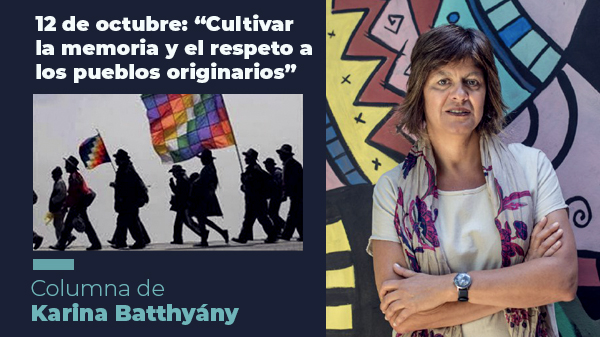
(Transcription of Karina Batthyány's Column)
(In InfoCLACSO – October 13, 2021)
October 12th is an iconic day in Latin America and the Caribbean, which undoubtedly has different perspectives both in the past and in the present.
Until not so long ago, when we were in school, official history in parts of our continent referred to October 12, 1492, as a cause for celebration. We all remember those history books calling it "Columbus Day" or the "encounter of cultures," undoubtedly obscuring the pain, subjugation, death, and suffering that the conquest—as we must call it—entailed more than five centuries ago.
Reviewing history, learning to listen to those voices that were silenced for so long, introduced us as societies to a different perspective than that of the manuals, the history books that taught us, and led us to travel the path of recognizing the rights of the ancestral civilizations that populated this continent, and to understand why the native peoples call October 11th "the last day of freedom".
Beginning on October 12, 1492, the Americas were subjected to a brutal conquest that claimed the lives of more than 80 million people. It was a true genocide, let's call it what it is; there's no other way to define it. This extermination also set in motion a process of dependency, a process of plunder that continues to this day under different methods, without a doubt.
Far from acknowledging this shameful past, the dominant power continues to stigmatize the Indigenous inhabitants, accusing them of being usurpers—usurpers of their lands, those lands inhabited by their ancestors and which they, of course, claim as their own. These lands ended up in the hands of large landowners, of vast estates, who occupy tens, hundreds, or thousands of hectares, for example, here in Patagonia, to name just one place.
This date is also a good opportunity to cultivate memory and respect for those who came before us in these lands, to cultivate respect for their cultures, their wisdom, their love for Mother Earth, for Pachamama. Because upholding the rights of Indigenous peoples today, in the 21st century, is also defending nature against the processes of appropriation and destruction of natural resources by transnational, extractive, and agricultural-livestock companies. Furthermore, all the alarms are sounding, as we have seen here at InfoCLACSO: the Amazon is in danger, the waterways are in danger, the air is in danger, everything, ultimately, is in danger; humanity is in danger.
In these times of pandemic, Indigenous peoples are among the populations most affected by the coronavirus, by COVID-19, and are also the most neglected by some states, such as Bolsonaro's Brazil. In this context, we cannot fail to highlight the capacity demonstrated by Indigenous communities that have implemented measures to strengthen the use of their traditional knowledge, for example, in healthcare, or to disseminate information in their own languages, sharing experiences and strategies to prevent the spread of the virus.
Today in Latin America and the Caribbean, we are still far from the full recognition of Indigenous Peoples, their political, cultural, economic, and territorial rights, and the plurinational character of our states. These are all central themes present in "Knowledge, Struggles, and Transformations," the theme of our #CLACSO2022 Conference, and they remain relevant today. We need to continue working on these issues. To achieve this, we must establish a genuine intercultural dialogue, with respect for and recognition of the original inhabitants of our lands.
And CLACSO has been working on these issues since 1967, advocating for these rights, and I want to highlight one of the important initiatives that we have presented together with one of the Working Groups, which is the map of Indigenous Languages (https://lenguasindigenas.clacso.org/).
-You're talking about the map of Indigenous Languages; specifically, when you look at that map, you can find a variety of words, because part of the process of cultural appropriation was to destroy the lives of those communities, but also to destroy their cultures…
Absolutely. With this map, we aim to highlight these languages, their uses, their richness, and their distinct diversity. Furthermore, it's one of the 34 themes that will be explored at the #CLACSO2022 Conference in June in Mexico. That's why I decided to dedicate this column to reflecting on October 12th, encouraging you to visit our website, where you'll find numerous discussions and seminars focused on this topic. And of course, we invite you to contribute to this theme at our upcoming Conference by submitting your work, presentations, and contributions.
If you would like to receive more information about CLACSO's training programs:
[widget id=”custom_html-57″]
to our email lists.

