
Join the largest global academic network on Latin America and the Caribbean
- What is Clacso?
- The 10 objectives of CLACSO
- The 10 axes of CLACSO
- Why join?
- CLACSO Facts
- Areas and programs
Who can join?
- Research and / or postgraduate institutions in any field of the social sciences and humanities, based in any country in Latin America or the Caribbean. In this case, the institutions become part of the CLACSO network as FULL MEMBER CENTERS.
- Research and / or postgraduate institutions with an interest in Latin America and the Caribbean and whose headquarters are outside Latin America and the Caribbean. In this case, the institutions become part of the CLACSO network as ASSOCIATED INSTITUTIONS.
- Academic associations, forums or networks that do not conduct research but develop actions in any field of the social sciences and humanities, based within or outside Latin America and the Caribbean. In this case, the institutions become part of the CLACSO network as ASSOCIATED NETWORKS.

The Latin American Council of Social Sciences (CLACSO) is an international non-governmental institution with associative status in UNESCO, created in 1967. Currently, it brings together 668 research and postgraduate centers in the field of social sciences and humanities in 51 countries in Latin America and other continents.
Download our institutional presentation:

- Promote social research to combat poverty and inequality, strengthen human rights and democratic participation.
- Contribute, from the contributions of academic research and critical thinking, to promoting sustainable development policies in economic, social and environmental terms.
- Build bridges between social research and public policies, promoting innovative, creative and viable actions in the face of the great social, educational, cultural and environmental challenges of Latin America and the Caribbean..
- Support the formation of networks of researchers and institutions that work in the field of social sciences and humanities.
- Strengthen the academic internationalization processes in Latin America and the Caribbean.
- Expand South-South and North-South cooperation and academic dialogue.
- To stimulate the development and consolidation of the social sciences and critical thinking in the poorest countries of Latin America and the Caribbean.
- Intervene in the national and regional public debate, contributing the perspectives and contributions of results-based social research.
- Collaborate with the training of government agents, social activists and professionals of the press on social, educational, cultural and environmental issues, bringing them closer to problems addressed from the social sciences and the evidence that social research provides.
- Generate open access conditions to Latin American and Caribbean academic production, contributing to the democratization of access to knowledge and allowing its more active use by public policy managers, social and citizen organizations, the press and the university system itself.

- Reduction of inequalities and social injustice.
- Combat racism, ethnic and gender discrimination.
- Guarantees and legal protection in migration and human mobility processes.
- Guarantees and legal protection in migration and human mobility processes.
- Contribution to the development of peace processes.
- Promotion of open access and the democratization of knowledge.
- Promotion of citizen security policies and the fight against violence.
- Promotion of the rights of children and youth.
- Promotion of participation, citizen mobilization and the strengthening of democracy.
- Promotion of sustainable economic, social and environmental development policies.

CLACSO is the largest academic network in Latin America and the Caribbean. It brings together 668 research and postgraduate institutions from 51 countries on the continent and also from Europe, the United States, Australia and Russia. It carries out hundreds of academic activities every year, bringing together more than 15,000 researchers from around the world.
It was created in 1967 by an initiative of UNESCO, a body with which it now maintains consultative status. Its objective is to promote international academic exchange and cooperation in the field of social sciences and humanities.
Who can participate in CLACSO?
- Research and / or postgraduate institutions in any field of the social sciences and humanities, based in any country in Latin America or the Caribbean. In this case, the institutions become part of the CLACSO network as FULL MEMBER CENTERS.
- Research and / or postgraduate institutions with an interest in Latin America and the Caribbean and whose headquarters are outside Latin America and the Caribbean. In this case, the institutions become part of the CLACSO network as ASSOCIATED INSTITUTIONS.
- Academic associations, forums or networks that do not conduct research but develop actions in any field of the social sciences and humanities, based within or outside Latin America and the Caribbean. In this case, the institutions become part of the CLACSO network as ASSOCIATED NETWORKS.
- The institutions interested in joining CLACSO must associate themselves in the corresponding category according to their characteristics.
What advantages and opportunities does being a CLACSO «associated institution» offer?
Join and participate in one of the largest and most representative academic networks in the world. In addition, being able to participate in a good part of the cooperation, exchange and production activities that CLACSO develops. For instance,
- that its researchers and students can participate in any of the 110 Work Groups that the Council has (those that develop more than 400 academic activities per year inside and outside of Latin America).
- be part of the CLACSO Postgraduate Network, made up of more than 700 postgraduate programs (masters and doctorates) in 26 countries.
- have information and support for the organization of visits or academic stays for graduate students or research teams in any Latin American or Caribbean country.
- include all its institutional academic production (and that of its researchers) in the CLACSO Virtual Library, one of the largest digital repositories in the world in the field of social sciences and humanities, with more than 1 million monthly downloads.
- include all its audiovisual production on CLACSO TV, an audiovisual platform with more than 1,000 hours of programming, with its own productions and a huge archive of access to the productions and records of the institutions that participate in the Council.
- upload all their bibliographic production to the Latin American and Caribbean Library of Social Sciences, thus being able to disseminate it and having there a link to their own sales and marketing system.
- make co-editions with CLACSO Libros and access the wide international publishing distribution network that the Council has.
- participate in the activities of the South-South Program, a wide space for exchange and cooperation with academic institutions in Africa and Asia, developed in agreement with institutions of large regional scope such as the Council for the Development of Social Science Research in Africa (CODESRIA) and Arab Council for the Social Sciences (ACSS).
- participate in the Virtual Courses and International Schools offered and organized by the Postgraduate Network.
- participate in the various activities promoted by the Poverty and Inequality Studies Program (meetings, schools, workshops).
- participate and intervene in the Latin American and Caribbean Social Sciences Conferences, which are held every three years and constitute one of the most relevant academic events in the world.
- participate in the CLACSO General Assemblies, also held every three years within the framework of the Conferences.
How can an institution join CLACSO?
The procedure is very simple and can be done online in a few minutes. Click here to enter the association system.
What is the cost to participate in CLACSO?
FULL MEMBER CENTERS pay an annual membership fee of USD 1,000 (one thousand United States dollars). The payment of this membership allows to receive direct financial support from CLACSO through scholarships or research subsidies, participation in Working Groups, publications, as well as scholarships or half scholarships for the completion of any of the activities of the Virtual Training Space. In addition, the MEMBER CENTERS participate with voice and vote in the General Assemblies and have representation in the governing bodies of the Council, in addition to electing, among its members, the Executive Secretary of the institution.
INSTITUTIONS AND ASSOCIATED NETWORKS do not pay a membership fee. For this reason, they cannot receive any direct financial contribution from CLACSO, nor do they participate with a vote in its General Assemblies or in its governing bodies.
CLACSO Facts
661
partner institutions in
51
countries
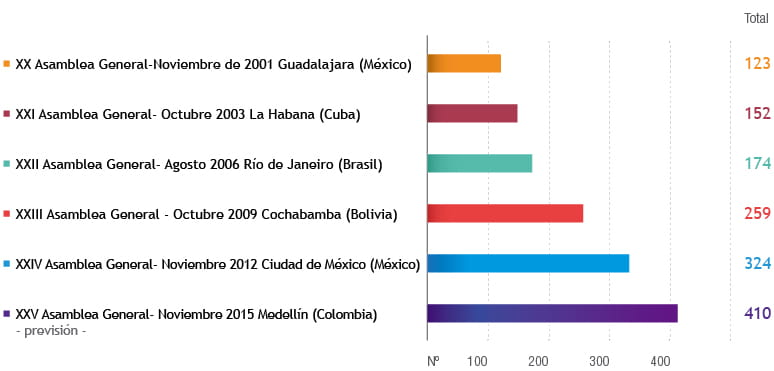
Evolution of partner institutions







- WORK GROUPS
- PROMOTION OF RESEARCH
- POSTGRADUATE NETWORK
- SOUTH-SOUTH PROGRAM
- STUDY PROGRAM ON POVERTY AND INEQUALITIES
- LATIN AMERICAN AND CARIBBEAN UNIVERSITY ASSESSMENT SYSTEM – SILEU


